Settore Industriale: Medical

Superelastic Metamaterials: How the Combination of Reticulated Structures and NiTi Works for Advanced Mechanical Properties

Superelastic Metamaterials: How the Combination of Reticulated Structures and NiTi Works for Advanced Mechanical Properties

Researchers have developed superelastic metamaterials in Nitinol with interwoven 3D-printed structures, combining superelasticity and lattice architectures to achieve advanced mechanical properties without altering the chemical composition. These materials, which behave more like fabrics than metals, open new possibilities for biomedical implants, protective devices, and stru

Safety and Standards in Post-Processing of Resins for Stereolithography

Safety and Standards in Post-Processing of Resins for Stereolithography

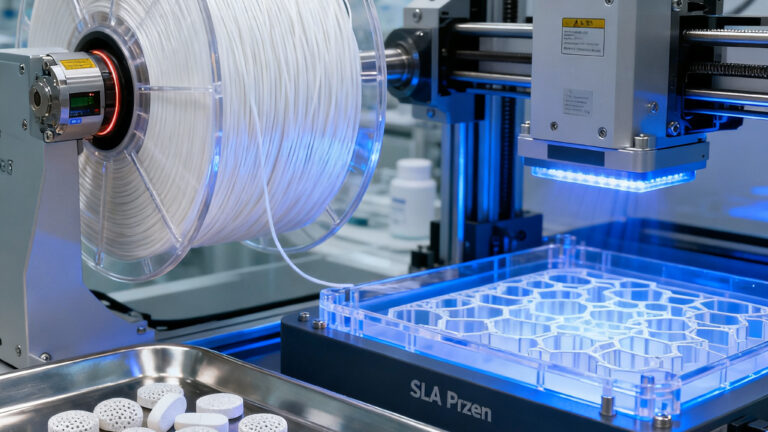
Post-processing is crucial in stereolithography to ensure safety and regulatory compliance. Stages such as washing and post-curing eliminate chemical residues and complete polymerization, ensuring mechanical properties and biocompatibility. The use of validated systems and low-risk solvents improves operational efficiency and safety.

Industrial Binder Jetting with Ceramic Slurries: Mechanisms, Criticalities, and Advantages Compared to Powder Systems

Industrial Binder Jetting with Ceramic Slurries: Mechanisms, Criticalities, and Advantages Compared to Powder Systems

Binder jetting with ceramic slurries offers industrial advantages such as higher green density and controlled shrinkage, but requires precise management of rheology and material stability. Compared to dry powder systems, this technology allows for greater uniformity and production scalability, provided that advanced control systems and stable formulations are integrated to ensure quality and repeatability

Additive Manufacturing: How Market Consolidation Redesigns Financial Strategy in the Sector

Additive Manufacturing: How Market Consolidation Redesigns Financial Strategy in the Sector

The additive manufacturing sector is experiencing a shift: from growth based on volumes to a strategy focused on margins, vertical specialization, and operational optimization. Companies like Materialise demonstrate how consolidation and attention to profitability, rather than expansion, can guarantee positive cash flows and solid financial positions, even

How a Custom 3D Surgical Guide Works for Tumor Localization

How a Custom 3D Surgical Guide Works for Tumor Localization

The Breast Cancer Locator by Cairn Surgical is a customized 3D guide obtained from magnetic resonance imaging to precisely locate breast tumors during lumpectomies. Created using 3D printing with biocompatible materials, it improves surgical margins, reduces reoperations, and offers millimetric positioning of the guide wire and dye. The device, created based on the anatomy

Accessible LPBF: How Startups Can Produce Metal Without Costs from Industry

Accessible LPBF: How Startups Can Produce Metal Without Costs from Industry

New entry-level LPBF systems, such as Metal-Base, make metal 3D printing accessible to startups and labs with costs under €10,000, thanks to innovative technologies, compact design, and open-source software.

How the PowTReX System Works for Advanced Management of Metal Powders

How the PowTReX System Works for Advanced Management of Metal Powders

The PowTReX by Volkmann is an advanced system for the automated management of metal powders in additive production. It integrates pneumatic transport, ultrasonic sieving, and automatic recovery in a closed, explosion-proof environment, ensuring safety, material quality, and production continuity. Ideal for scalable industrial contexts and multi-supplier environments, it supports various metal allo

HP MJF Technology in Industrial Services: How to Implement It for Resilient and Responsive Production

HP MJF Technology in Industrial Services: How to Implement It for Resilient and Responsive Production

HP MJF Technology revolutionizes industrial production, enabling flexibility, lead time reduction, and digital warehousing. Ideal for sectors such as aerospace, defense, medical, and data centers, it allows for on-demand production of custom components, improving supply chain resilience and reducing costs. Integration with traditional processes and the use of advanced materials make

Medical Bioprinting with Chitosan: Design and Implementation of Personalized Therapies for Chronic Ulcers

Medical Bioprinting with Chitosan: Design and Implementation of Personalized Therapies for Chronic Ulcers

Chitosan bioprinting allows the creation of customized patches for chronic ulcers, combining mechanical barrier, antibacterial release, and support for tissue regeneration. Studies from the University of Mississippi show promising results in accelerating healing and reducing infections, thanks to the biocompatible and multifunctional properties of chitosan. The technol

Medical Implants and Metal Sensitivity: Balancing Biocompatibility, Durability, and Costs

Medical Implants and Metal Sensitivity: Balancing Biocompatibility, Durability, and Costs

The choice of materials for medical implants requires a balance between biocompatibility, durability, and costs. Titanium, PEEK, and bioresorbable materials like magnesium offer different solutions with specific advantages. Innovations such as TPMS structures and AI improve bone integration and reduce surgical times. Customization allows for better results, even with higher initial costs.

Light Robotics and Multi-Material 3D Printing: How to Build a Soft Humanoid

Light Robotics and Multi-Material 3D Printing: How to Build a Soft Humanoid

Soft robotics and multi-material 3D printing are revolutionizing automation, enabling the creation of lightweight, flexible, and safe robots. Thanks to an innovative process developed at Harvard University, it is now possible to build soft humanoids without molds, integrating rigid and gel-like materials in a single printing process. This technology opens new avenues for applications

The 3D Printing Market Enters the Maturity Phase: Real Growth and New Regional Dynamics

The 3D Printing Market Enters the Maturity Phase: Real Growth and New Regional Dynamics

The 3D printing market reaches $24.2 billion in 2025, with a growth of 10.91%. The sector enters a maturity phase, shifting from machinery to production services. The Asia-Pacific region grows at 19.81%, while Europe and EMEA slow down. Services cover 48% of the market, highlighting an industrial conversion based on real usage and economic return.

/