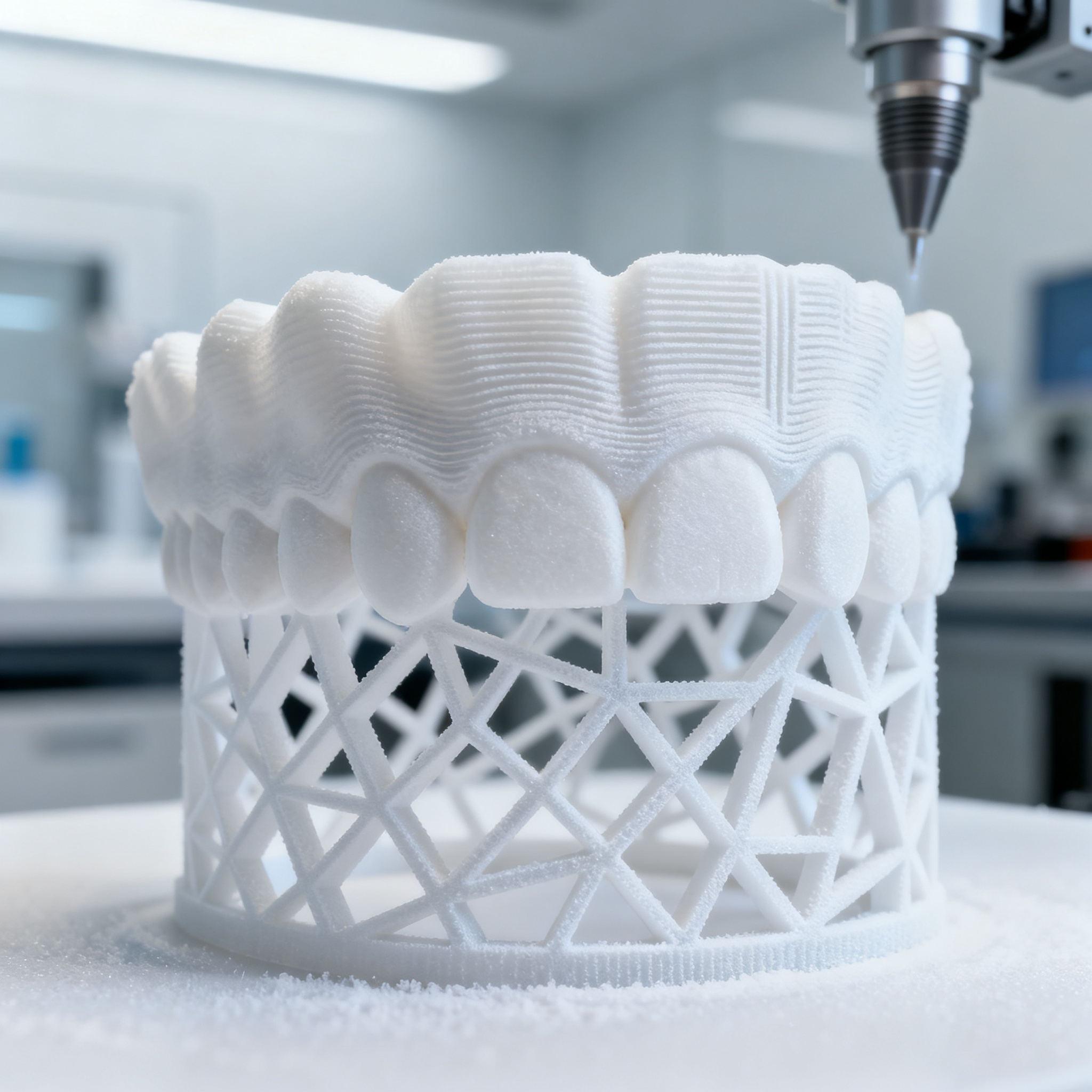
Can you really automate custom prosthetics?
Designing a medical device today means integrating not only functionality but also automated production and removal processes. Large-scale customization requires complete digital workflows, from scanning to final delivery.
Automation in custom medical devices is no longer an option for those who want to compete. It is an operational necessity that touches every phase, from initial design to post-processing.
Integrated design: the weight of post-processing
Support removal is often underestimated, but it conditions the efficiency of the entire production process.
The problem is not detaching supports faster, but designing the removal method, the shape of the supports, and the coupling system between the component and the detachment unit together.
If the supports are not designed for that type of automated removal, the automation risks being ineffective or damaging the part. This is especially true for dental components, where final precision is critical.
- Development of ultrasonic process parameters
- Design of optimized supports for automated removal
- Integration of a system to transfer energy to the component
More controlled removal reduces waste, rework, and dependence on the skill of a single operator. This is useful when producing batches composed of many similar but customized parts, a typical situation in dental 3D printing.
Automation in dental laboratories: real cases
The adoption of automated solutions reduces human errors and increases the scalability of customized production.
For dental laboratories, automation has value not only in terms of productivity. More controlled removal of supports can reduce waste and dependence on the operator.
Quality becomes more repeatable and the time required by laboratory staff is reduced. This is essential when managing high volumes of customized production.
Revision hip prostheses represent an even more complex case. In revision surgeries, the patient's anatomy can present conditions that vary greatly from case to case. The geometry of the bone, material loss, and the position of the previous implant make it difficult to use standard solutions.
The RAPID project aims to automate the entire chain, from the design of individual tools to documentation. In the medical sector, it is not enough to produce a correct part: it is necessary to demonstrate how it was designed, with what data, and according to which rules.
Data flows for rapid prosthetics
An end-to-end digital workflow is essential for responding to clinical requests in real time.
Customization takes time. Each case may involve design activities, verification, tool adaptation, and documentation preparation.
If the process remains manual, the production of patient-specific devices becomes expensive, slow, and difficult to scale. Design automation therefore becomes strategic.
Integrated digital workflow
- Data acquisition: Patient scanning and imaging to obtain precise geometries.
- Automated design: Generation of custom tools and implants with predefined parameters.
- Documentation: Automatic traceability of data, process, and controls for regulatory compliance.
Even apparently simple devices can benefit from custom production, especially when anatomical variability is high. The presence of centers like Duke Health and Mayo Clinic in projects of this type confirms that the topic requires clinical expertise and rigorous validation.
The logic of “few steps away” allows departments to bring a practical problem and evolve it rapidly with prototype-test-correction cycles. When a hospital produces internally, traceability, material management, and process control become central.
Conclusion
Integration between design and automation is no longer an option but a necessity to compete in the medical market. Large-scale customization requires processes designed to be repeatable, traceable, and scalable.
The difference between a prototype and series production is not only quantity but the ability to maintain uniformity between batches, shifts, and process windows. Evaluate your current process: where do you lose time in removal or reprocessing?
article written with the help of artificial intelligence systems
Q&A
Why is support removal considered a critical element in the automation of custom medical devices?
Support removal affects the efficiency of the entire production process. If supports are not designed together with the automated removal method, automation risks being ineffective or damaging the part, especially in dental components where precision is fundamental. Controlled removal reduces scrap, rework, and dependence on operator skill.
What are the three key elements of an integrated process for automated support removal?
The three fundamental elements are the development of ultrasonic process parameters, the design of supports optimized for automated removal, and the integration of a system to transfer energy to the component. These factors work in synergy to ensure controlled removal that preserves the integrity of the medical device.
How does automation specifically benefit dental laboratories that produce custom prostheses?
Automation reduces human errors and increases the scalability of custom production. Controlled support removal decreases scrap and operator dependence, making quality more repeatable and reducing the time required by staff, which is essential for managing high volumes.
What makes the production of revision hip prostheses particularly complex compared to standard ones?
In revision surgeries, the patient's anatomy presents very different conditions from case to case, such as altered bone geometries, material loss, and the presence of previous implants. This variability makes the use of standard solutions difficult and requires individualized instruments designed automatically.
What are the three main phases of the integrated digital workflow described in the article for rapid prosthesis?
The three phases are data acquisition through patient scanning and imaging, automated design of instruments and implants with predefined parameters, and documentation with automatic traceability of data, process, and controls for regulatory compliance. This end-to-end flow makes patient-specific production scalable and traceable.