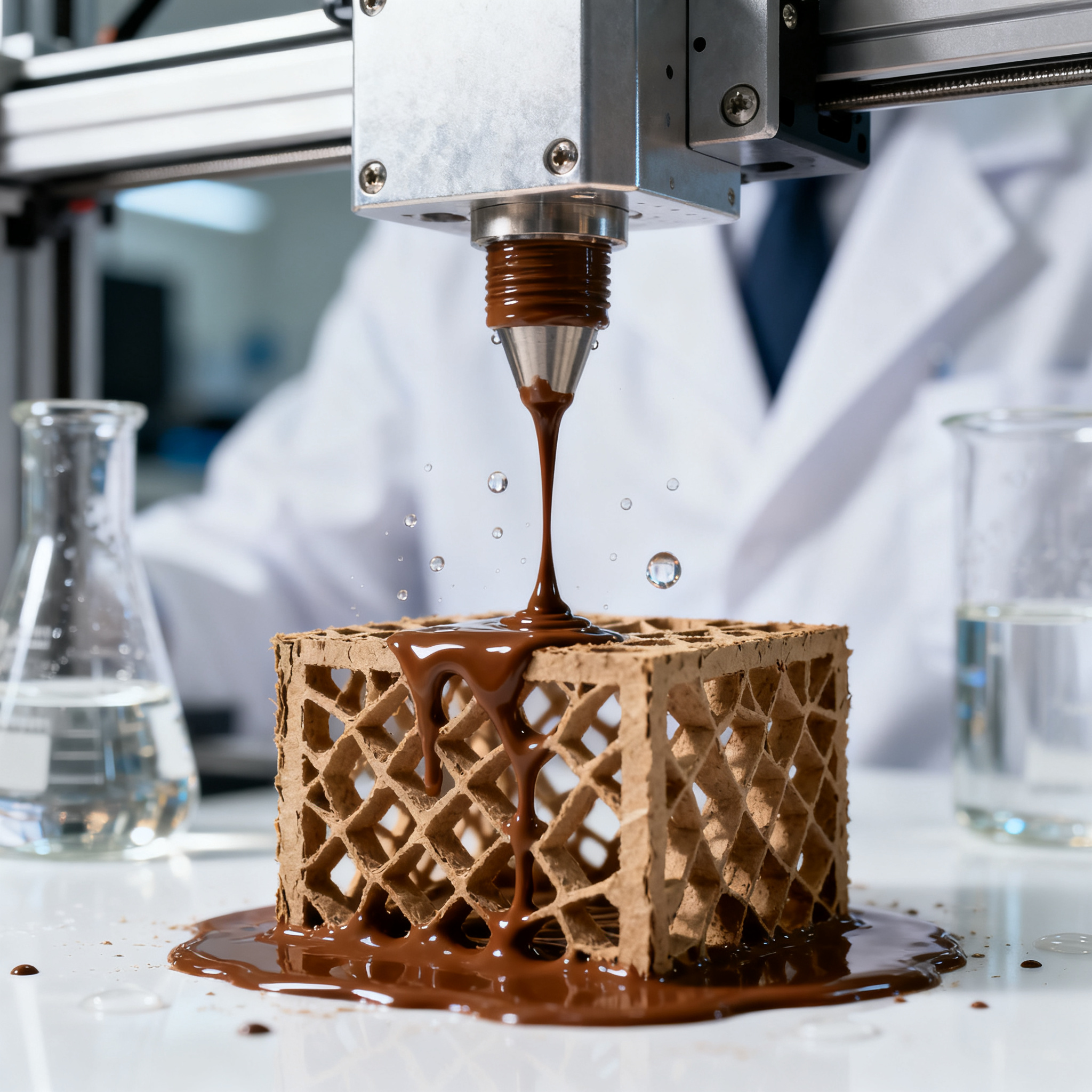
Recycled lignosulfonate: how does it really work?
A new lignosulfonate-based 3D ink, a byproduct of the paper industry, leverages reversible physical interactions to achieve stable performance without solvents or chemical polymerization. The material contains 70% by weight of lignosulfonate and can be recycled up to nine times while maintaining original properties.
Researchers at the Helmholtz-Zentrum Hereon have developed a formulation for Direct Ink Writing (DIW) processable at room temperature. The system eliminates organic solvents, chemical crosslinkers, and thermal post-curing, three elements that in most commercial inks prevent effective recycling.
Formulation and physical interactions
Lignosulfonate is made printable through reversible interactions with methylcellulose and glycerol, without permanent chemical alterations.
The formulation contains 70% by weight of lignosulfonate on the dry fraction. This byproduct of the paper industry represents approximately 88% of lignin waste streams and is water-soluble due to sulfonate groups.
Methylcellulose acts as a reversible physical binder. Glycerol acts as a plasticizer to modulate the mechanical response. All components are water-soluble and are mixed with a 1:1 ratio of dry mass to water.
- Lignosulfonate: 70% by weight (main structural component)
- Methylcellulose: reversible physical binder
- Glycerol: plasticizer for mechanical control
- Water: solvent, ratio 1:1 with dry mass
FTIR analysis confirms the presence of hydrogen bonds in the 3700–3000 cm⁻¹ region. The peaks shift from 3336 cm⁻¹ to 3319 cm⁻¹ as the glycerol content increases. Atomistic modeling estimates an increase in hydrogen bond density from about 50 to 65 bonds per 10 nm³ when going from 10% to 18% glycerol.
Rheology and extrusion behavior
The ink's rheological response is designed to ensure tank stability and fluidity during extrusion.
Rheological measurements show a time-dependent increase in viscosity. Viscosity increases from 2000 Pa·s at 3 minutes after preparation to 6500 Pa·s at 60 minutes, measured at a shear rate of 0.1 s⁻¹. This behavior is attributed to hydrophobic interactions in methylcellulose and hydrogen bonds between components.
Under shear stress, the material exhibits shear-thinning behavior essential for extrusion. Viscosity decreases from about 6000 Pa·s to 50 Pa·s when the shear rate increases from 0.1 to 16 s⁻¹.
| Parameter | Low shear value | High shear value |
|---|---|---|
| Viscosity (Pa·s) | ~6000 (0.1 s⁻¹) | ~50 (16 s⁻¹) |
| Yield stress | ~14 Pa | — |
| Behavior | Solid-like (G′ > G″) | Liquid-like (G″ > G′) |
Oscillatory tests identify a yield stress at about 14 Pa. This marks the transition from solid-like behavior (elastic modulus G′ greater than viscous modulus G″) to liquid-like (G″ > G′). The transition allows the material to flow during extrusion and recover consistency after deposition.
Mechanical properties vary with the methylcellulose-glycerol ratio. Young's modulus ranges from 2.4 ± 0.6 MPa with 18% glycerol to 106.9 ± 17.3 MPa with 10% glycerol. One-way ANOVA analysis confirms statistically significant differences (p < 0,001).
Recycling process and stability over time
The material can be regenerated multiple times without significant degradation of its mechanical or thermal properties.
Printed objects can be recycled via grinding and rehydration. The process returns the material to dispersion by adding water, without the need for chemical or thermal treatments. This approach differs radically from formulations based on covalent cross-linking or post-curing.
Researchers have documented at least nine reuse cycles while maintaining constant stiffness and thermal degradation behavior. Stability across cycles confirms that reversible physical interactions do not undergo significant cumulative degradation.
The absence of permanent covalent bonds allows the process to be reversed: water re-disperses the components, physical interactions reform during ink preparation, and subsequent printing replicates the original properties.
The formulation eliminates the main recycling obstacles present in conventional DIW inks. It does not require organic solvents that complicate recovery. It does not use chemical cross-linkers that create permanent networks. It does not need post-thermal treatments that irreversibly alter the structure.
The system maintains stiffness and thermal stability across cycles because the physical network reconstitutes each time. Hydrophobic interactions and hydrogen bonds reform during the ink preparation phase, reproducing the rheological structure necessary for printing.
This formulation demonstrates how targeted rheological design can enable sustainable materials without technological compromises. The use of an industrial byproduct as the main structural component, combined with the physical reversibility of the system, opens concrete prospects for low-impact additive processes.
Explore the industrial implications of this technology for low-impact processes and circular materials. The shift from permanent cross-linking to reversible physical interactions could redefine the approach to sustainability in paste- and ink-based additive manufacturing.
article written with the help of artificial intelligence systems
Q&A
What is the composition of the lignosulfonate-based 3D ink and what is the role of the individual components?
The formulation contains 70% by weight of lignosulfonate as the main structural component, methylcellulose as a reversible physical binder, glycerol as a plasticizer for mechanical control, and water as a solvent in a 1:1 ratio with the dry mass. Lignosulfonate is a water-soluble byproduct of the paper industry, while methylcellulose and glycerol respectively modulate the cohesion and mechanical properties of the material.
How does the recycling process of this ink work and how many times can it be reused?
The printed objects are ground and rehydrated with water to return the material to dispersion, without the need for chemical or thermal treatments. The process exploits the reversibility of physical interactions and allows stiffness and thermal stability to be maintained for at least nine reuse cycles.
Why is this ink considered more sustainable compared to traditional commercial formulations?
Unlike conventional inks, it eliminates organic solvents, chemical crosslinkers, and thermal post-curing, elements that prevent effective recycling by creating permanent networks. The use of an industrial byproduct as the main component and the possibility of regenerating the material through reversible physical interactions significantly reduce the environmental impact.
What rheological properties make the ink suitable for DIW (Direct Ink Writing)?
The material exhibits shear-thinning behavior that reduces viscosity from approximately 6000 Pa·s to 50 Pa·s as the shear rate increases, facilitating extrusion. Furthermore, it shows a yield stress of approximately 14 Pa that allows the transition from solid-like to liquid-like behavior, ensuring stability in the reservoir and consistency recovery after deposition.
How do the mechanical properties of the material vary depending on the formulation?
The mechanical properties depend on the ratio between methylcellulose and glycerol: the Young's modulus varies from 2.4 ± 0.6 MPa with 18% glycerol to 106.9 ± 17.3 MPa with 10% glycerol. FTIR analysis and atomistic modeling confirm that these variations are correlated with hydrogen bond density, which increases from 50 to 65 bonds per 10 nm³.