Settore Industriale: Energy

Polyamide for 3D printing: why traditional PA is no longer enough (and what to use today)

Polyamide for 3D printing: why traditional PA is no longer enough (and what to use today)

Technical polyamides offer excellent performance, but their printing complexity often makes them impractical. SP4 CF15 from 3DBooster was created to solve this paradox: 8.5 GPa rigidity, thermal resistance up to 180°C, and open-air printability without advanced setups.

Can AM revolutionize the transport of nuclear fuel?

Can AM revolutionize the transport of nuclear fuel?

Additive manufacturing could revolutionize the transport of spent nuclear fuel, reducing costs and production times for critical components such as impact limiters. Technologies like FFF and PBF allow for complex geometries and savings of up to $1.7 million per cask. Studies by Orano and UNC Charlotte confirm technical feasibility, but specific regulatory standards are still lacking.

High-temperature ceramics: which AM process to choose?

High-temperature ceramics: which AM process to choose?

Additive manufacturing of high-temperature resistant ceramics requires careful selection of the process: melt-infiltration, CVI, or PIP, each with advantages and limitations in terms of cost, speed, and complexity. Cellular structures reduce weight and material but can compromise structural integrity. Advanced materials such as SiC and multi-oxide composites offer high performance but at

Real-time correction: how patents promise to revolutionize 3D printing

Real-time correction: how patents promise to revolutionize 3D printing

New real-time quality control systems promise to revolutionize 3D printing by correcting errors during the production process. Optical and thermal sensors monitor printed calibration elements alongside the component, enabling immediate corrections to parameters. This reduces waste and improves precision, especially for complex geometries such as aerospace ones. The patent

Functional and Adaptive Filaments: Mechanisms of Failure and Thermomechanical Stability

Functional and Adaptive Filaments: Mechanisms of Failure and Thermomechanical Stability

Composite filaments for FDM 3D printing, enriched with carbon or glass fibers, exhibit brittleness and risk of breakage during printing due to poor integration between additives and the polymer matrix. Chamber heating does not improve the situation and may worsen the problem. Structural discontinuities generate localized stresses, especially in the filament path curves

Resilience and Hidden Costs: How Geopolitics Is Redesigning Global Supply Chains

Resilience and Hidden Costs: How Geopolitics Is Redesigning Global Supply Chains

The resilience of global chains is becoming crucial for economic sustainability. Geopolitics reveals hidden costs related to distances, logistics, and systemic fragility. Companies are reconsidering production localization and additive manufacturing to reduce risks and improve self-sufficiency.

Two wires instead of one: how multi-wire deposition is accelerating metal 3D printing

Two wires instead of one: how multi-wire deposition is accelerating metal 3D printing

Double-wire metal 3D printing accelerates production times by doubling the deposition speed without compromising quality. Thanks to a mathematical model that controls wire feeding in real time, the process reduces defects and allows the use of different alloys in the same component. Ideal for sectors such as aerospace and energy, this technology improves efficiency and

Advanced Training for Industrial 3D Printing: How Companies Build Scalable Competencies

Advanced Training for Industrial 3D Printing: How Companies Build Scalable Competencies

Advanced training in industrial 3D printing is now strategic for bridging the skills gap and ensuring the growth of the sector. Structured programs, academic partnerships, and hybrid learning models are preparing professionals capable of integrating technology and productive practice.

Sustainable 3D Printing: Quality vs. Environmental Impact in Recycled Materials

Sustainable 3D Printing: Quality vs. Environmental Impact in Recycled Materials

Industrial 3D printing with recycled materials offers environmental benefits but requires balancing between quality, cost, and performance. The use of recycled powders, if well managed, can reduce the carbon footprint without compromising mechanical properties, provided that parameters such as sphericity, oxygen content, and particle size distribution are controlled. Studies show up to 98.71% reduction

How to Redesign Industrial Metal AM Production: An Operational Playbook for Scalability and Efficiency

How to Redesign Industrial Metal AM Production: An Operational Playbook for Scalability and Efficiency

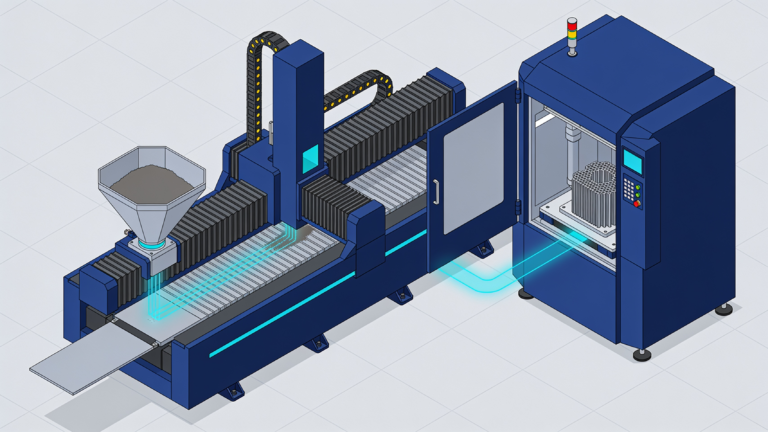
The future of industrial metal AM requires an integrated approach that connects all production processes into a single intelligent architecture, eliminating physical movements and operational delays. Winning factories do not improve individual steps, but redesign the entire workflow as a system coordinated by a common layer of intelligence, automation, and shared data.

New Investment Criteria for Additive Manufacturing: Operational Excellence Over Speculation

New Investment Criteria for Additive Manufacturing: Operational Excellence Over Speculation

Investors in additive manufacturing are increasingly focusing on operational efficiency and solid business models, leaving technological speculation behind. Businesses with stable contracts, sustainable margins, and the ability to generate real value in the production chain are being rewarded.

Bio-Based SLS Printing: When Sustainability Meets Technological Limits

Bio-Based SLS Printing: When Sustainability Meets Technological Limits

Bio-based materials for SLS 3D printing, such as PHB and PA11, offer more sustainable solutions but still present technological limitations compared to traditional polymers like PA12. Although they improve stiffness and thermal stability, they suffer from lower ductility, high porosity, and a narrow process window. Research continues to optimize composition and parameters, aiming for a balance between sust

/