ORNL and A.J. Tuck develop hybrid additive manufacturing process for nuclear
Oak Ridge National Laboratory has developed a technology that combines polymer 3D printing and electroforming to produce leak-free HIP containers. The process simplifies the production of components for advanced nuclear reactors.
3D printing and electrodeposition for critical components
ORNL researchers have developed a hybrid process that integrates polymer 3D printing with electroforming to create complex metal containers intended for hot isostatic pressing.
The U.S. Department of Energy, through Oak Ridge National Laboratory (ORNL), has developed a new hybrid additive manufacturing process in collaboration with A.J. Tuck Company. The technology is specifically designed for nuclear reactor components and other energy applications.
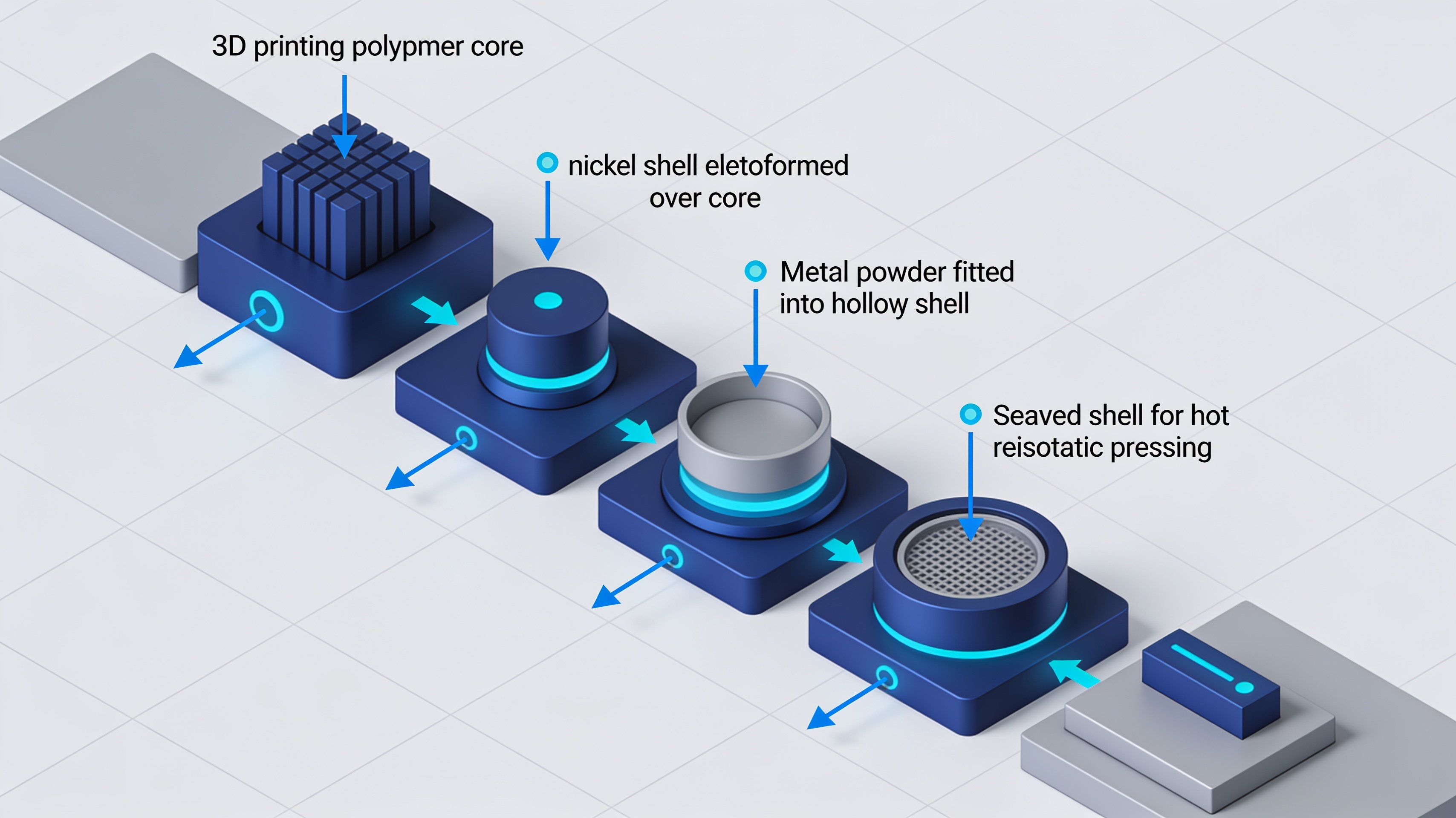
The process is structured in precise sequential steps. First, a polymer mandrel is 3D printed to serve as a form. This is then immersed in an electrolytic bath where a dense nickel shell with a thickness of 2-3 millimeters is deposited.
Phases of the hybrid process
- 3D Printing: Creation of the polymer mandrel with the desired geometry.
- Electroforming: Deposition of metallic nickel to form the outer shell.
- Dissolution: Removal of the polymer via acid.
- Filling and HIP: The hollow structure is filled with metal powder, sealed, and processed.
Advantages over traditional methods
The new approach reduces material costs and simplifies post-processing compared to direct metal 3D printing, while maintaining high precision and no losses.
The technology simplifies the traditional powder metallurgy method with hot isostatic pressing (PM-HIP). It offers greater design flexibility than conventional processes.
The economic advantages are significant. The process reduces material costs and post-processing needs typically associated with direct metal 3D printing. This makes it more accessible for large components.
- Reduction of material costs compared to direct metal printing
- Lower post-processing requirements
- Greater design flexibility for complex geometries
- Production of completely leak-tight HIP containers
- Reduction of supply chain criticalities
Results of the first phase and prospects
The team has already produced five leak-tight cylindrical HIP containers, demonstrating the feasibility of the process for advanced nuclear applications.
In the first phase of the project, researchers used electroforming to produce five leak-tight cylindrical HIP containers. The dimensions were 6 inches in height and 4 inches in diameter.
“This project demonstrates that electroforming can successfully produce leak-tight HIP containers for advanced nuclear applications,” said Vanshika Singh, associate research scientist at ORNL. The approach could facilitate the production of these components in the United States.
The team has also developed an integrated port design that eliminates separate welding of process tubes. This results in a more robust and simplified approach.
Future applications in the energy sector
The second phase of the project will apply the process to more complex geometries such as impellers and valves for advanced nuclear systems.
The technology lends itself to various energy applications that require large, high-precision metal components. These include pressure vessels for reactors, valves, and turbine systems.
The second phase is now underway. The team will apply the process to more complex geometries such as an impeller or a valve relevant to nuclear energy systems.
The process could reduce supply chain challenges for advanced nuclear energy systems by facilitating domestic production of critical components in the United States.
The collaboration between ORNL and A.J. Tuck Company represents an example of how hybrid additive manufacturing can solve complex problems in the nuclear sector. The integration of different technologies opens new possibilities for components that require both geometric precision and absolute structural integrity.
article written with the help of artificial intelligence systems
Q&A
What does the hybrid process developed by ORNL consist of?
The process combines 3D printing of a polymer mandrel with electroforming to deposit a nickel shell. Subsequently, the polymer is dissolved, and the structure is filled for hot isostatic pressing.
What are the main economic advantages of this technology?
This methodology significantly reduces material costs compared to direct metal 3D printing. Furthermore, it decreases post-processing requirements, making production more accessible for large-scale components.
What specific application is this innovation designed for?
The technology is specifically designed to produce leak-tight containers for hot isostatic pressing (HIP) in the nuclear sector. It is used to create critical components for advanced reactors.
Which metal is deposited during the electroforming phase?
During the process, the 3D-printed mandrel is immersed in an electrolytic bath where a dense nickel shell is deposited. The thickness of this metal layer ranges between 2 and 3 millimeters.
What results did the team achieve in the first phase of the project?
The team has successfully produced five cylindrical HIP containers that are completely leak-tight. These results demonstrate the technical feasibility of the process for energy sector applications.