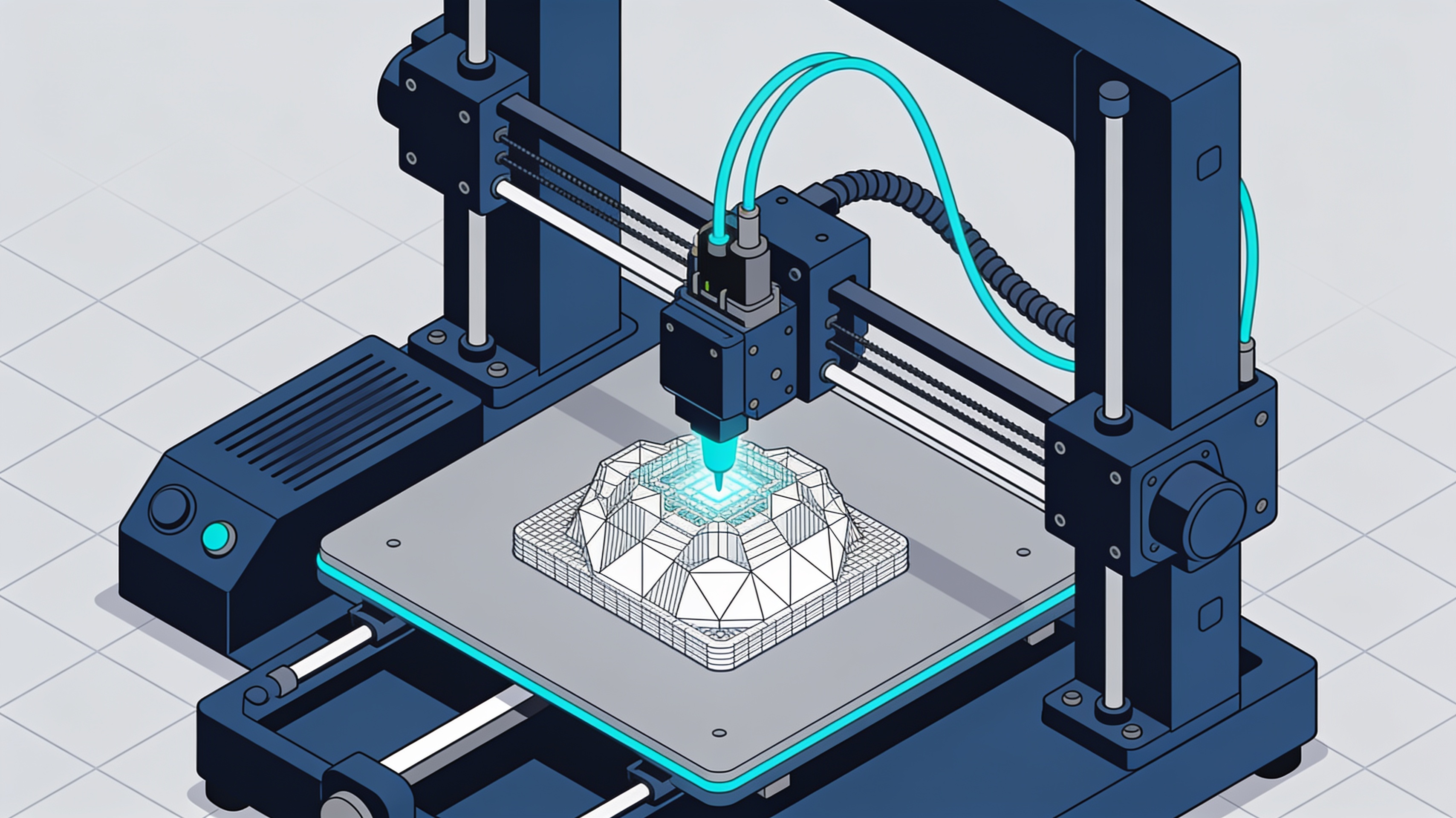
Tripo P2.0 Preview: 3D generation in seconds with Diffusion algorithm
Tripo AI has released Tripo P2.0 Preview, a software that generates 3D models in a few seconds thanks to a new algorithmic approach. The technology abandons the traditional token-by-token method to adopt the Diffusion technique, already known in image generation.
The result is a significantly higher processing speed compared to competing services, which often require several minutes to complete a 3D model.
Technical specifications and resolution
Tripo P2.0 Preview offers advanced generation capabilities with native support for high-density quad and triangular meshes.
The software can generate models with up to 25,000 quads natively. Alternatively, it supports triangular meshes up to 50,000 triangles.
- Generation in seconds instead of minutes
- Up to 25,000 quads per model
- Support for triangular meshes up to 50,000 elements
- Diffusion-based algorithm instead of token-by-token
The distinction between quads and triangles is relevant for different sectors. Triangular meshes are the standard for 3D printable assets, while the visual asset community prefers quads.
The P Series algorithm and the native 3D approach
The heart of the innovation lies in the P Series algorithm, which treats 3D models as holistic spatial entities instead of linear sequences.
Traditional methods serialize a 3D mesh into a long sequence of tokens. The AI predicts them one by one, like a language model writing a sentence.
This approach has intrinsic limitations. The faces of a mesh have no intrinsic order, but imposing an arbitrary sequence causes error accumulation.
Efficiency drops and output quality degrades as complexity increases. Long sequences lead to “deformities” caused by the AI losing orientation.
3D models are holistic and unordered, unlike linear text. Forcing them into a sequence leads to low efficiency and visual artifacts.
The Diffusion technique applied to 3D
Tripo adapts to 3D a process already consolidated in image generation, with clear advantages in terms of speed.
In image generation, Diffusion starts from a panel of “noise” with random pixels. Then it iterates slowly, processing the entire panel simultaneously.
At each iteration, the image gradually emerges from the noise. This is much faster than pixel-by-pixel generation.
Diffusion process for images
- Initialization: Panel of random pixels (noise).
- Iteration: Simultaneous processing of the entire panel.
- Emergence: The image gradually forms from the noise.
Tripo applies the same principle to 3D models. The P Series algorithm encodes discrete 3D topology into a continuous and “diffusible” representation.
This allows the model to be treated as a single spatial entity. Simultaneous processing of all elements eliminates the problems of linear sequences.
Implications for the industry
Generation speed opens up new possibilities for iterative workflows and rapid prototyping.
Reducing times from minutes to seconds radically changes the approach to generating 3D assets. Designers and engineers can iterate more quickly on concepts.
For 3D printing, the availability of high-density triangular meshes ensures direct compatibility with slicing software. No intermediate conversions or optimizations are required.
Native quad support benefits those working with assets for visualization and rendering. A single tool covers both workflows.
Tripo P2.0 Preview Generates 3D Models With Up to 50,000 Triangles, Fabbaloo
article written with the help of artificial intelligence systems
Q&A
What is the main difference between Tripo P2.0 and traditional methods?
Tripo P2.0 abandons the token-by-token method in favor of Diffusion technology, which processes the entire model simultaneously instead of sequentially. This approach avoids accumulation errors typical of long sequences and drastically improves speed.
How long does it take Tripo P2.0 to generate a 3D model?
The software generates 3D models in a few seconds, offering significantly faster processing speeds compared to competing services. Traditional methods often require several minutes to complete the same process.
What resolution specifications are supported by Tripo P2.0 Preview?
The software natively supports mesh generation with up to 25,000 quads. Alternatively, it offers support for triangular meshes with a density of up to 50,000 triangles.
Why are quad meshes preferred over triangles in certain industries?
The visual asset community prefers quad meshes for their modeling quality, while triangular meshes remain the standard for assets intended for 3D printing. Tripo P2.0 natively supports both formats to accommodate these diverse needs.
How does the P Series algorithm applied to 3D work?
The P Series algorithm treats 3D models as holistic spatial entities instead of forcing them into arbitrary linear sequences. This eliminates distortions caused by the AI losing orientation during sequential prediction of mesh faces.