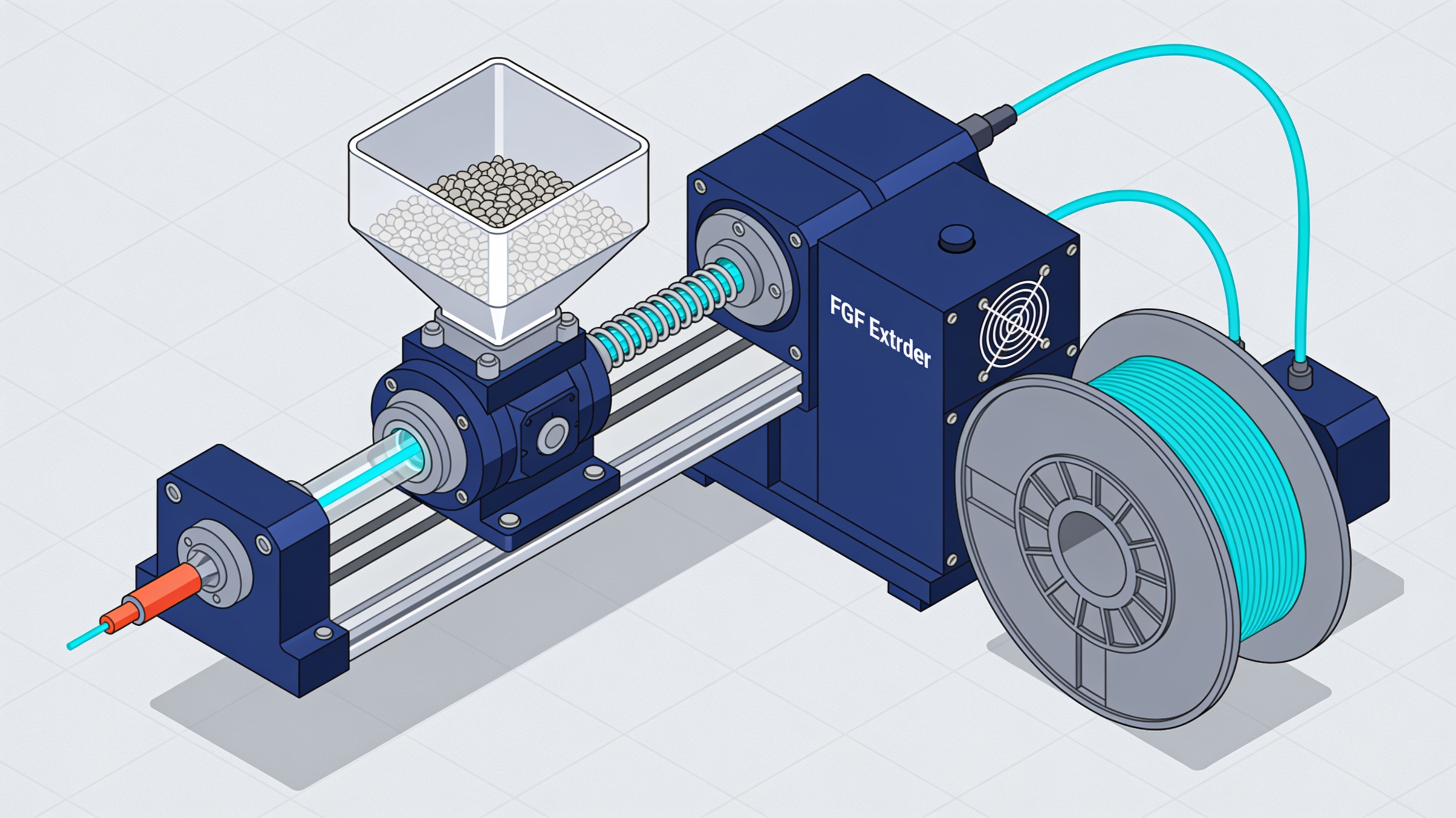
SPELL3D develops a compact extruder to bring FGF printing to desktop printers
A Maltese project aims to revolutionize desktop 3D printing with pellets instead of filament, reducing material costs by up to 90%.
SPELL3D, a collaboration between the University of Malta and the local company Invent 3D, is developing a compact extruder for FGF (Fused Granular Fabrication) technology. The goal is to bring pellet printing to desktop machines, drastically reducing operating costs.
The project represents an ambitious attempt to overcome the technical limitations that have so far confined FGF printing to large industrial systems.
The economic advantage of pellets
Pellets cost about 10 times less than traditional filament, but they present significant technical challenges for use on desktop printers.
The cost difference is substantial. Pellets are the raw material from which filament is produced: they are melted and extruded industrially to create the spools we use in FFF printers.
Skipping this intermediate step eliminates production, packaging, and distribution costs. The savings translate into materials up to 10 times cheaper.
- FFF: uses filament of uniform geometry and predictable flow
- FGF: uses pellets of variable sizes with costs 10 times lower
- Main challenge: ensuring a constant flow despite the irregularity of the pellets
The technical problem of printing with pellets
The irregular geometry of the pellets creates unpredictable flows that compromise print quality, requiring complex engineering solutions.
The pellets have inconsistent sizes and shapes. When they pass through the hot end, the amount of material can vary moment by moment.
This unpredictability generates defects: voids where material is scarce, accumulations where it abounds. The result is prints of unacceptable quality for professional applications.
Industrial FGF systems solve the problem with very long and bulky extruders. The dimensions allow to “mediate” the irregularities of the pellets, stabilizing the flow.
These extruders are too large and heavy for desktop printers. That is why FGF technology has remained confined to the industrial sector.
SPELL3D's innovative approach
The Maltese project eliminates the traditional compression screw, focusing on a compact heating chamber and a modular feeding system.
SPELL3D adopts a radically different solution. Instead of using a screw to compress and melt the pellets, the system introduces them in a controlled manner into a compact heating chamber.
This screwless design reduces the size and weight of the extruder. The proportions become compatible with desktop printers and modular applications.
Eliminating complex mechanics introduces new issues. Pellets do not feed as predictably as filament. The team has developed a modular feeding system and advanced thermal controls to maintain uniform flow and balanced heat distribution.
Prospects and market impact
If the project succeeds, it could democratize access to affordable 3D printing, with significant implications for filament producers and end users.
SPELL3D's approach is technically intriguing and could be well received by the maker and professional community. The only exception would be filament producers, who would see demand for their main product decrease.
It remains to be seen whether the solution will actually guarantee print quality comparable to traditional FFF systems. Field tests and industrial validation will be decisive for the project's commercial success.
The collaboration between university and local industry represents an interesting model for innovation in additive manufacturing, combining academic research and applied know-how.
article written with the help of artificial intelligence systems
Q&A
How much can be saved by using pellets instead of filament in 3D printing?
Using pellets allows reducing material costs by up to 90%, making them about 10 times cheaper than traditional filament. This saving comes from eliminating intermediate production, packaging, and distribution processes for filament.
What is the main technical challenge of FGF printing on desktop printers?
The main challenge is ensuring a consistent material flow despite the irregular sizes and shapes of pellets. This unpredictability can cause printing defects such as voids or material buildup if not properly managed.
How do industrial FGF systems solve the flow problem?
Industrial systems use very long and bulky extruders that average out pellet irregularities by stabilizing the flow. However, these dimensions make such systems incompatible with desktop printers.
What is the innovation of the SPELL3D project?
SPELL3D eliminates the traditional compression screw by adopting a compact heating chamber and a modular feeding system. This design enables controlled introduction of pellets directly onto desktop machines.
Who is developing the SPELL3D project?
The project is a collaboration between the University of Malta and the local company Invent 3D. Their shared goal is to revolutionize desktop 3D printing by making FGF technology accessible.