Dalla plastica al cibo: il progetto NASA che stampa in 3D biscotti proteici dai rifiuti
Un gruppo di ricercatori della Southern Illinois University Carbondale ha sviluppato μBites, un biscotto proteico stampato in 3D ottenuto trasformando rifiuti plastici e agricoli in ingredienti alimentari. Il progetto, finanziato con 25.000 dollari dalla NASA Deep Space Food Challenge, punta a creare sistemi alimentari autonomi per le missioni spaziali di lunga durata.
I risultati sono stati presentati il 24 agosto 2026 all’ACS Fall 2026 dell’American Chemical Society. Il progetto ha ricevuto anche il supporto del programma CAREER della National Science Foundation.
- Lieviti programmati convertono PET e biomasse agricole in ingredienti alimentari
- La tecnologia di dissoluzione idrotermale ossidativa scompone le catene molecolari
- Il biscotto μBites viene formato mediante stampa 3D
- Applicazione prevista per missioni spaziali e ambienti isolati
Dal PET alle molecole assimilabili
Il processo non inserisce plastica direttamente nel cibo, ma scompone le catene molecolari in composti organici utilizzabili dai microrganismi.
The raw material is polyethylene terephthalate (PET), the polymer of water and beverage bottles. The long molecular chains of PET are broken down into smaller carbon-containing molecules that can be assimilated by yeasts.
The process combines PET with plant residues such as corn stalks and leaves. Plastic and plant material are ground, homogenized, and transformed into a liquid rich in organic molecules.
Oxidative hydrothermal dissolution
Ken Anderson, professor of geology and director of the Advanced Energy Research Center, has developed the proprietary technology that makes the process possible.
The initial phase uses oxidative hydrothermal dissolution. Water, oxygen, temperature, and pressure break down the resistant structures of plastic and biomass, yielding soluble compounds.
This step is crucial: it prevents yeasts from having to directly attack PET fragments, an operation too slow and inefficient for practical applications.
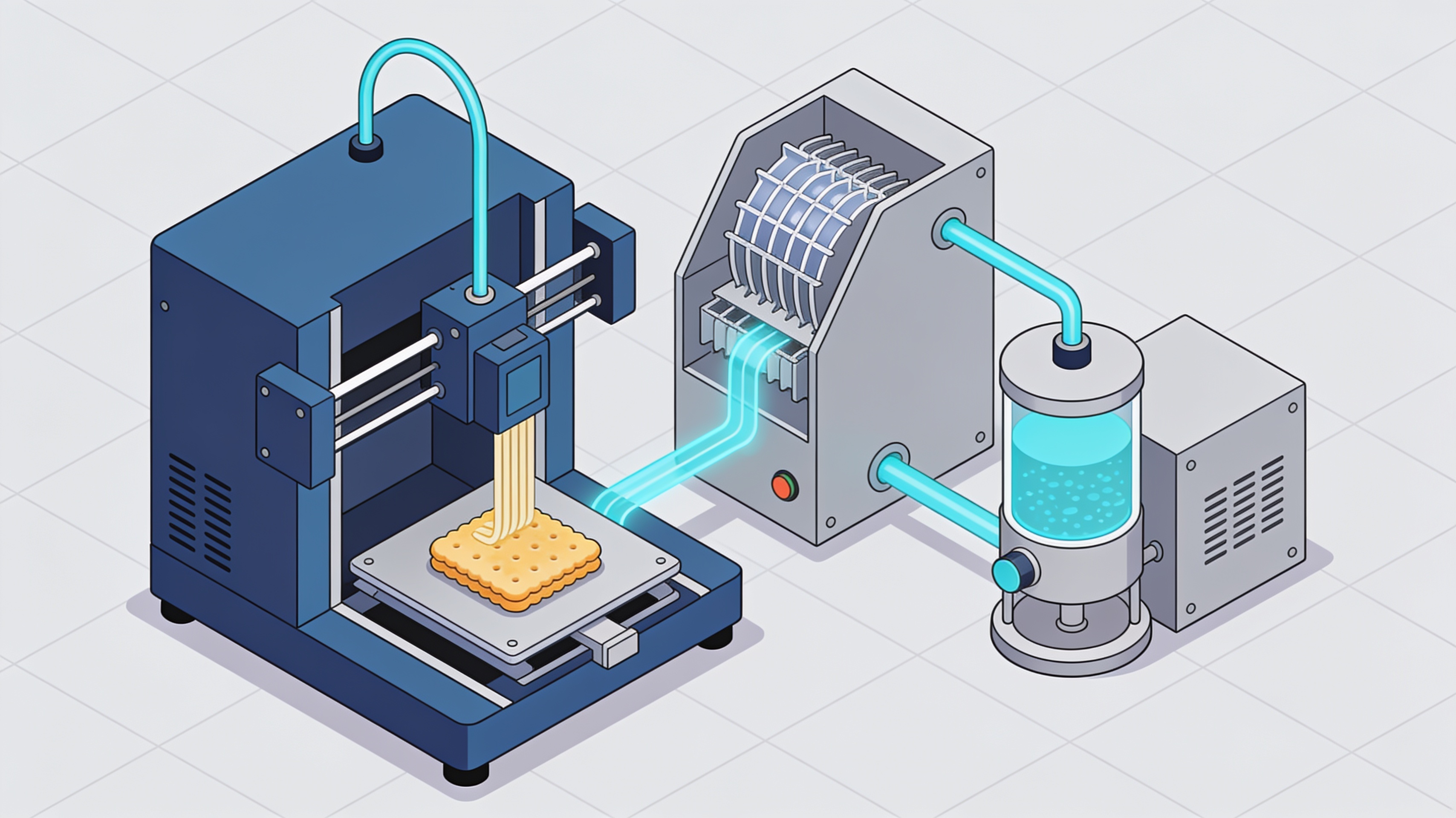
The conversion process
- Preparation: PET and agricultural biomasses are ground and homogenized.
- Dissolution: Oxidative hydrothermal treatment breaks down molecular structures.
- Fermentation: Programmed yeasts convert compounds into food ingredients.
- 3D Printing: The ingredients are formed into the final product μBites.
Programmed yeasts for specific ingredients
The modified microorganisms represent the biological core of the system, converting waste-derived compounds into proteins and flavors.
The project employs programmed yeasts to transform compounds derived from waste into ingredients intended for food production. Lahiru Jayakody leads the development of these modified microorganisms.
Sandhya Jayasekara, a team researcher, has developed a specific yeast for the production of vanillin, demonstrating the possibility of obtaining aromatic components as well.
The project is not linked to 3D printer manufacturers or food companies. The parties involved are exclusively research institutions and government agencies: Southern Illinois University Carbondale, NASA, National Science Foundation, and American Chemical Society.
Applications for deep space
The space context requires fully autonomous food systems, capable of regenerating resources without external supplies.
The NASA Deep Space Food Challenge funding indicates the primary objective: long-duration space missions where food supply is impossible. The system could transform crew waste into new food resources.
Terrestrial applications include isolated environments or emergency situations where food logistics are complex. 3D printing allows customization of shape, texture, and nutritional composition of the final product.
The μBites project demonstrates how additive manufacturing can integrate with advanced biotechnologies to create circular production systems. The combination of chemical dissolution, microbial fermentation, and 3D printing represents a multidisciplinary approach to food sustainability.
article written with the help of artificial intelligence systems
Q&A
What is the NASA-funded μBites project?
μBites is a Southern Illinois University Carbondale project creating 3D-printed protein biscuits by transforming plastic and agricultural waste. Funded by the NASA Deep Space Food Challenge, it aims to ensure autonomous food systems for long-duration space missions.
How is plastic treated in the production process?
PET plastic is not directly added to food but undergoes oxidative hydrothermal dissolution to break molecular chains. This process transforms the polymer into soluble organic compounds assimilable by microorganisms.
What is the role of engineered yeasts in the μBites system?
Engineered yeasts convert organic compounds derived from plastic and agricultural biomass into specific food ingredients like proteins. They represent the biological core of the system, enabling the transformation of waste into food.
What raw materials are used to create the space biscuits?
Raw materials include polyethylene terephthalate (PET) from bottles and plant residues such as corn stalks and leaves. These materials are ground and processed together to obtain a liquid rich in organic molecules.
How is the final shaping of the food product carried out?
After fermentation generates nutritious ingredients, the mixture undergoes 3D printing to form the final biscuit called μBites. This technology allows precise food shaping tailored to mission requirements.