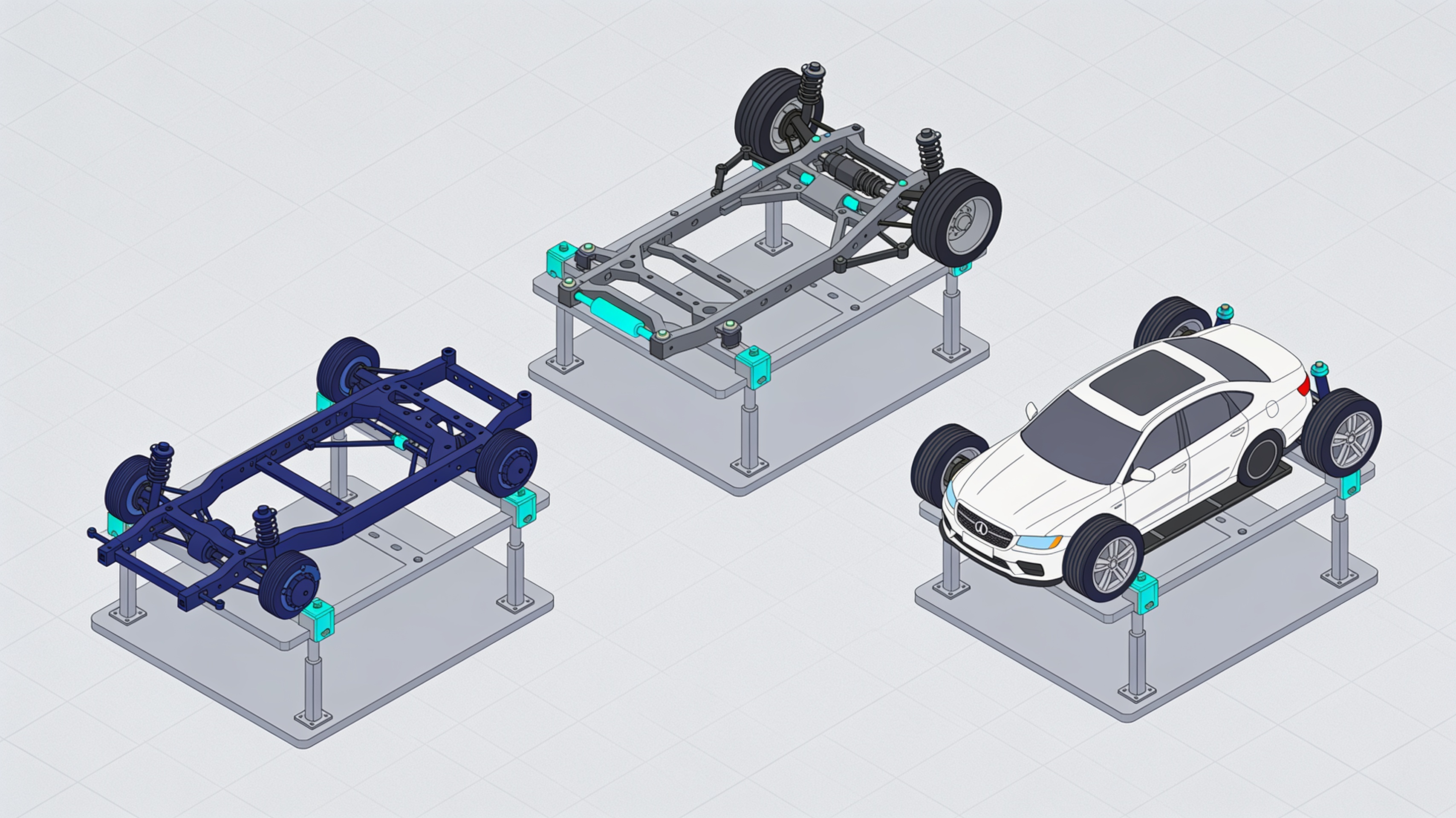
Subaru uses color 3D printing to reduce errors in production
Subaru of Indiana Automotive has introduced a color-coding system for 3D-printed tools, turning color into an error prevention tool. The solution uses Onyx GF material from Markforged and addresses a concrete problem: on multi-model lines, nearly identical tools can differ by a few millimeters, making selection errors easy.
The color is not decorative. It serves to immediately identify which tool corresponds to which vehicle model, even before reading the identification code.
The problem of multi-model lines
*When a line produces multiple vehicle variants, tools may appear identical but have minimal geometric differences that make them incompatible with each other.*
The Lafayette plant produces three Subaru models: Ascent, Crosstrek, and Forester. Each variant requires specific jigs and equipment.
A wrong tool can look correct at first glance. The differences are often limited to a support point or a few millimeters of geometry.
Reading identification codes requires time and attention. In an environment with over 1,600 robots and 2,000 components assembled per vehicle, the efficiency of every operation matters.
- Subaru of Indiana Automotive prints tools in Onyx GF with different colors for each model
- The color is integrated into the material, not applied later
- The solution reduces the risk of using the wrong tool on multi-model lines
- The plant produces over 32,000 vehicles per month across three different models
The solution: structural color
*Subaru has chosen to integrate the color directly into the printing material, using the color variants available for Markforged's Onyx GF.*
The tools are produced on the Markforged printers already present in the plant. They do not require painting, coating, or labeling after manufacturing.
The color is part of the object's structure. This eliminates the typical problems of paints that scratch and adhesives that deteriorate during daily use.
An operator recognizes the correct tool before approaching the workstation. A tool placed in the wrong position becomes immediately visible.
The material: Onyx GF
*Onyx GF is a glass fiber-filled nylon developed by Markforged, available in several colors.*
The material combines the mechanical properties of nylon with the reinforcement of glass fiber. This composition makes it suitable for tools, jigs, and fixtures that must withstand repeated use.
The availability in multiple colors allows visual coding without compromising structural characteristics. Each color maintains the same mechanical properties as the standard version.
Markforged also offers the Continuous Fiber Reinforcement process, which adds continuous carbon fiber reinforcements for applications requiring superior mechanical strength.
The Lafayette plant
*The production site of Subaru of Indiana Automotive represents one of the main North American plants of the Japanese manufacturer.*
The plant occupies over 330 hectares and employs more than 6,500 people. It includes stamping, body assembly, painting, final assembly, and mechanical component production departments.
The declared capacity exceeds 32,000 vehicles per month, calculated on eight-hour shifts. The body assembly department uses more than 1,600 robots.
The simultaneous management of three models requires operational flexibility. 3D-printed tools allow for the rapid production of the necessary equipment for each variant, maintaining color coding as a visual safety system.
Implications for the automotive industry
*Subaru's approach demonstrates how 3D printing can solve organizational as well as technical problems.*
The color coding of tools represents an application of visual management, a principle widespread in lean production. Color becomes an immediate signal that reduces dependence on the operator's memory and traditional identification systems.
Integrating color into the material eliminates the need for secondary processes. This reduces production times and maintains the durability of the visual indication for the entire useful life of the tool.
The solution applies to any multi-model or multi-variant production context, where similarity between components or equipment can generate selection errors.
article written with the help of artificial intelligence systems
Q&A
What is the main problem Subaru solved with color 3D printing?
In multi-model lines, nearly identical tools differ by only a few millimeters, making selection errors easy. Color allows immediate identification of the correct tool before reading the code.
Which material does Subaru use to produce these colored tools?
Subaru uses Markforged's Onyx GF, a glass-fiber-reinforced nylon available in various colors. This material combines mechanical strength with structural color-coding capabilities.
Why is color integrated into the material preferable to painting?
Color is part of the object's structure, eliminating issues with scratching paint or deteriorating adhesives during daily use. This ensures permanent durability of visual identification.
Which vehicle models are produced at the Lafayette plant involved in the project?
The plant produces three Subaru models: Ascent, Crosstrek, and Forester. Each variant requires specific jigs and fixtures that operators must distinguish quickly.
How is color applied during the tool manufacturing process?
Color is integrated directly into the printing material using the available color variants for Onyx GF. No post-processes such as painting, coating, or labeling are required.