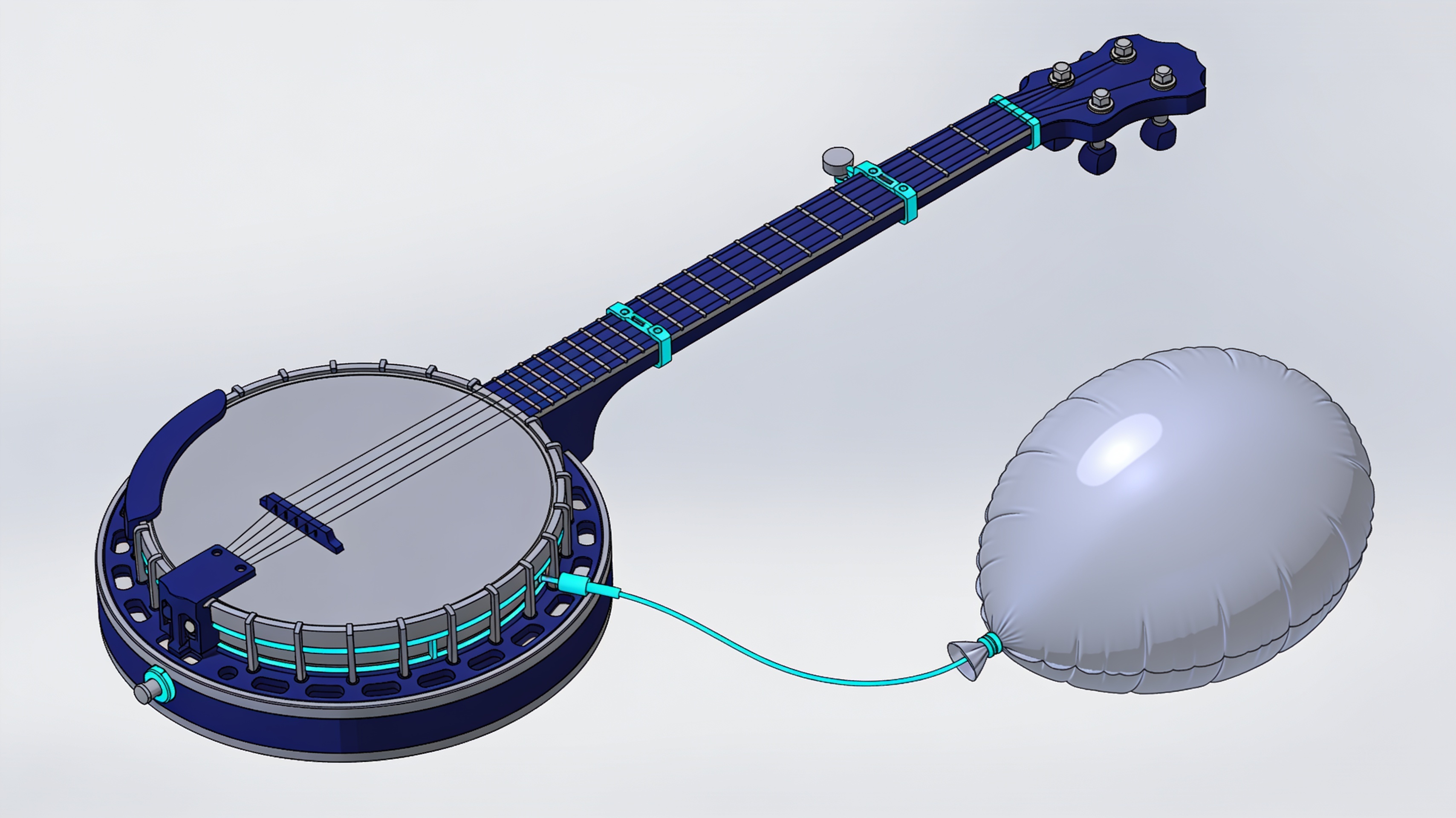
Balloon Banjo: the 3D-printed instrument that explores the physics of resonance
A 3D-printed banjo that uses an inflatable balloon as a resonance chamber. The project by Co:Creation Lab in Singapore turns a musical instrument into an accessible acoustics experiment.
A banjo without metal or glue
The Balloon Banjo replaces the traditional skin membrane with an inflatable balloon, creating a fully hand-assemblable instrument.
Co:Creation Lab has developed a musical instrument that breaks traditional construction patterns. The Balloon Banjo eliminates the stretched skin typical of conventional banjos. In its place, a simple inflatable balloon serves as the resonance chamber.
The entire instrument consists of 19 pieces, seven of which are 3D-printed in PLA. The structure includes a neck, right and left flanges, two bridge components, seven pegs, and seven peg housings. The strings are made of nylon or fishing line.
- 7 parts printed in PLA with snap-fit system
- Inflatable balloon as resonant membrane
- Nylon strings or fishing line
- Hand-tightenable plastic screws
Tool-free assembly
All components fit together without the need for adhesives, metal screws, or tools.
The design uses a snap-fit assembly system that completely eliminates the use of glue or metal hardware. The plastic components fit together. The plastic screws are tightened by hand, without the need for screwdrivers.
This design choice is not random. The instrument is designed to be assembled, disassembled, modified, and reassembled repeatedly. The accessibility of the design allows continuous experiments on the physics of sound.
The physics of resonance in hand
By varying the pressure of the balloon and the tension of the strings, the instrument becomes a tangible acoustic laboratory.
“Pluck a string and the note resonates inside the balloon,” explains the description on Gumroad, the platform where the project is available. Two variables modify the sound: the volume of air in the balloon and the tension of the strings.
Changing the volume of air modifies the resonance. The effect is perceptible tactilely in the hands of the player. This aspect transforms the Balloon Banjo from a simple musical instrument into an educational experiment on sound propagation.
Conventional banjos use a skin membrane stretched over a rigid body, similar to a drum. The fifth peg is positioned at the fifth fret of the neck, not on the headstock. The Balloon Banjo maintains the five-string configuration but replaces the skin with compressed air.
A project between education and experimentation
The open design fits into a line of 3D-printed musical instruments, with a focus on understanding acoustic principles.
3D printing has already produced guitars, ukuleles, and violins. The Xenomorph guitar by Olaf Diegel is a well-known example in the industry. Other 3D-printed banjos already exist, but the Balloon Banjo stands out for its experimental approach.
The stated goal is to explore “the physics of resonance” through a low-cost device. The project demonstrates how additive manufacturing can democratize not only the production of objects, but also access to understanding complex physical phenomena.
The availability on Gumroad suggests an open distribution model. Anyone with access to a 3D printer can replicate the instrument and conduct their own acoustic experiments.
Implications for STEM education
The instrument represents a use case of 3D printing for hands-on science education.
The Balloon Banjo is configured as a teaching tool for physics and acoustics laboratories. The ability to modify physical variables in real time offers immediate feedback on the principles of resonance.
The absence of complex or expensive components lowers the entry threshold. Schools and maker spaces can produce the instrument with minimal investments. The modular nature facilitates repairs and customizations.
The Co:Creation Lab project demonstrates how 3D printing can go beyond rapid prototyping. It becomes a means to create functional objects that integrate learning and hands-on experimentation.
article written with the help of artificial intelligence systems
Q&A
How many pieces is the Balloon Banjo made of?
The instrument consists of 19 total parts, seven of which are 3D printed in PLA. The other components include pegs, housings, and bridge parts.
What material replaces traditional skin in the Balloon Banjo?
Instead of the stretched leather membrane typical of conventional banjos, this project uses a simple inflatable balloon. The compressed air inside the balloon acts as a resonating chamber.
Is glue or tools required to assemble the instrument?
No, the design adopts a snap-fit system that allows hand assembly without glue, metal screws, or tools. Even the included plastic screws can be tightened by hand.
How can the sound of the Balloon Banjo be modified?
The sound varies by adjusting two main factors: the volume of air inside the balloon and the tension of the strings. These changes alter the resonance perceivable through touch.
What materials are recommended for the instrument's strings?
The Balloon Banjo strings can be made using nylon wire or common fishing line. These materials allow easy tension adjustment for the acoustic experiment.