Settore Industriale: Aerospace

Metrology in 3D Scanning: How Integrated Processing Works and Its Industrial Applications

Metrology in 3D Scanning: How Integrated Processing Works and Its Industrial Applications

Integrated metrology in 3D scanners enables real-time quality control, reducing time and costs. Thanks to advanced sensors, geometric algorithms, and connectivity, these systems process dimensional data directly during scanning, integrating with metrology platforms and production processes. Despite some technological limitations, they represent a breakthrough for high-

Polyamide for 3D printing: why traditional PA is no longer enough (and what to use today)

Polyamide for 3D printing: why traditional PA is no longer enough (and what to use today)

Technical polyamides offer excellent performance, but their printing complexity often makes them impractical. SP4 CF15 from 3DBooster was created to solve this paradox: 8.5 GPa rigidity, thermal resistance up to 180°C, and open-air printability without advanced setups.

High-temperature ceramics: which AM process to choose?

High-temperature ceramics: which AM process to choose?

Additive manufacturing of high-temperature resistant ceramics requires careful selection of the process: melt-infiltration, CVI, or PIP, each with advantages and limitations in terms of cost, speed, and complexity. Cellular structures reduce weight and material but can compromise structural integrity. Advanced materials such as SiC and multi-oxide composites offer high performance but at

Who wins in 2026 among FDM toolchangers?

Who wins in 2026 among FDM toolchangers?

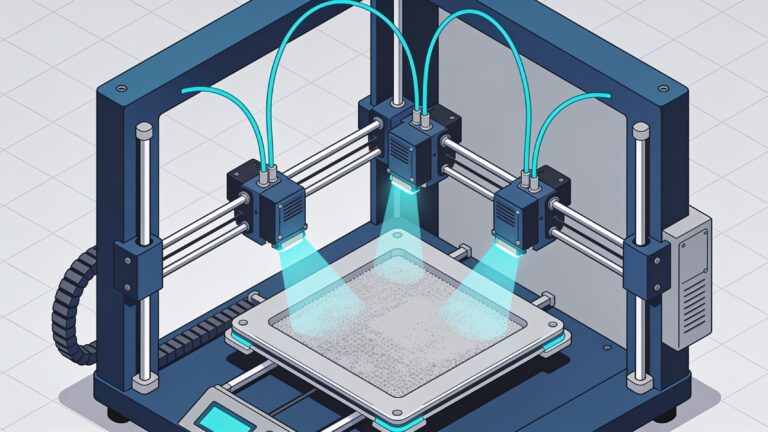
In 2026, the FDM toolchanger market has consolidated: here is the solution that stands out for performance, reliability, and software integration. The best choice depends on the specific workload.

Real-time correction: how patents promise to revolutionize 3D printing

Real-time correction: how patents promise to revolutionize 3D printing

New real-time quality control systems promise to revolutionize 3D printing by correcting errors during the production process. Optical and thermal sensors monitor printed calibration elements alongside the component, enabling immediate corrections to parameters. This reduces waste and improves precision, especially for complex geometries such as aerospace ones. The patent

How Lightweight Reticulated and Foamed Structures Work: A Technical Overview of Advanced Composite Materials

How Lightweight Reticulated and Foamed Structures Work: A Technical Overview of Advanced Composite Materials

New IFAM technique combines foam and 3D structures for lightweight, high-performance, low-cost composites, with energy absorption up to 10x higher.

Functional and Adaptive Filaments: Mechanisms of Failure and Thermomechanical Stability

Functional and Adaptive Filaments: Mechanisms of Failure and Thermomechanical Stability

Composite filaments for FDM 3D printing, enriched with carbon or glass fibers, exhibit brittleness and risk of breakage during printing due to poor integration between additives and the polymer matrix. Chamber heating does not improve the situation and may worsen the problem. Structural discontinuities generate localized stresses, especially in the filament path curves

Beyond Traditional Slicing: Advanced Architectures for Path Planning in Industrial 3D Printing

Beyond Traditional Slicing: Advanced Architectures for Path Planning in Industrial 3D Printing

The article explores how advanced software architectures, such as 64-bit systems and modern geometric libraries, are revolutionizing path planning in slicers for industrial 3D printing, improving precision, reliability, and efficiency.

From Maker Lab to Real Production: How Desktop 3D Printers Are Scaling in the Consumer and Industrial Markets

From Maker Lab to Real Production: How Desktop 3D Printers Are Scaling in the Consumer and Industrial Markets

3D desktop printers are becoming concrete production tools, no longer just for makers. In 2025, China exported over 5 million units, with a 331% growth. Technological improvements make them more reliable, easier to use, and suitable for professional sectors like cinema and racing drones. Adoption is growing among professionals, schools, and small businesses, with concrete cases of pr

Resilience and Hidden Costs: How Geopolitics Is Redesigning Global Supply Chains

Resilience and Hidden Costs: How Geopolitics Is Redesigning Global Supply Chains

The resilience of global chains is becoming crucial for economic sustainability. Geopolitics reveals hidden costs related to distances, logistics, and systemic fragility. Companies are reconsidering production localization and additive manufacturing to reduce risks and improve self-sufficiency.

Two wires instead of one: how multi-wire deposition is accelerating metal 3D printing

Two wires instead of one: how multi-wire deposition is accelerating metal 3D printing

Double-wire metal 3D printing accelerates production times by doubling the deposition speed without compromising quality. Thanks to a mathematical model that controls wire feeding in real time, the process reduces defects and allows the use of different alloys in the same component. Ideal for sectors such as aerospace and energy, this technology improves efficiency and

How Functional Grading Works in Industrial Additive Processes

How Functional Grading Works in Industrial Additive Processes

Functional grading in industrial additive processes enables the creation of components with variable properties in a controlled manner, modulating the thermal energy during deposition. Thanks to sensors and real-time feedback, the process allows gradual and precise transitions of mechanical characteristics, without interruptions or the need for assembly. This innovative technology finds app

/