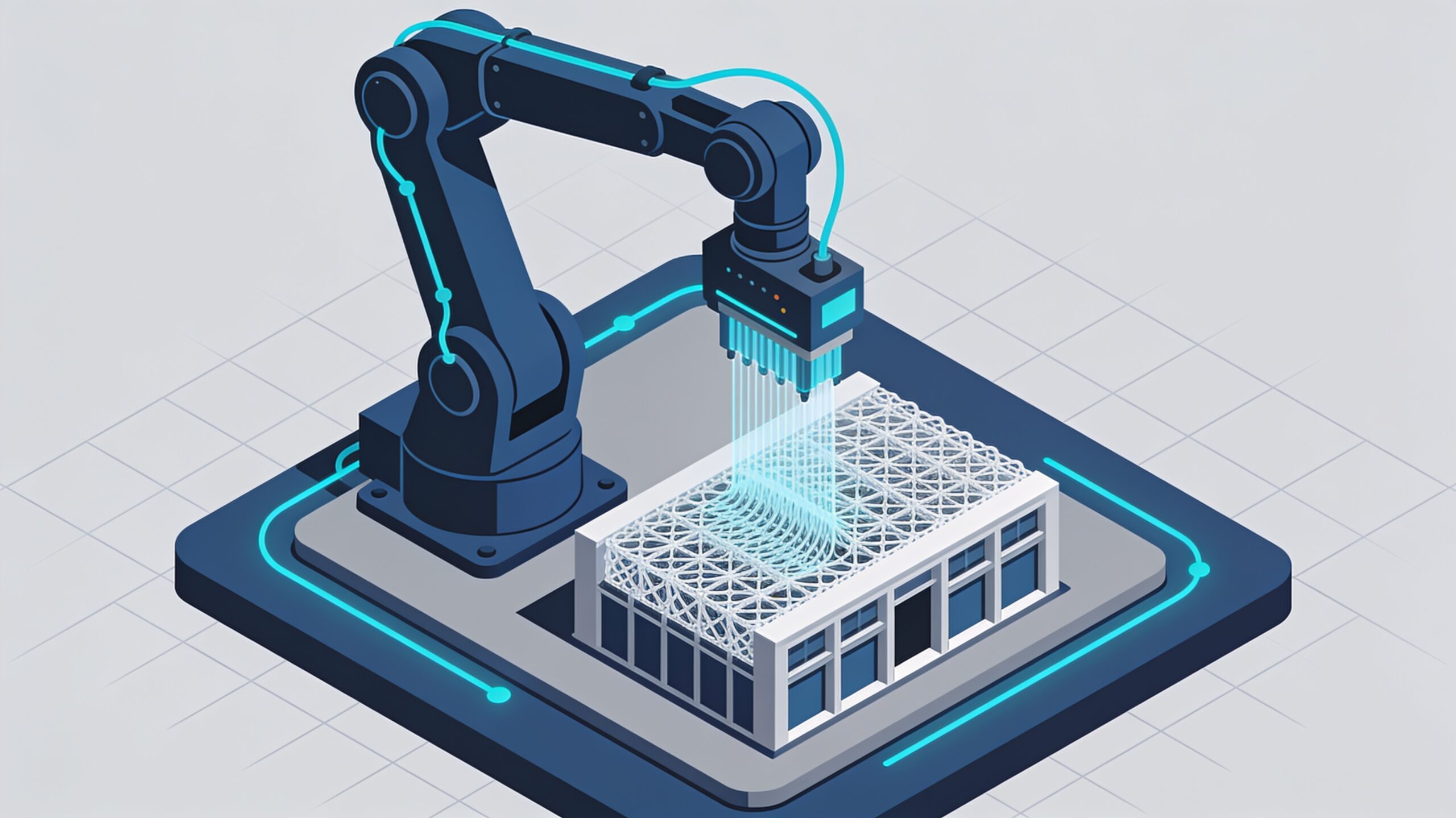
Branch Technology brings 3D printing compliant with standards to the commercial construction sector
Branch Technology, an American company specialized in additive construction technologies, is applying 3D printing to the building sector with a significant competitive advantage: compliance with the International Building Code (IBC). The company has developed a proprietary technology called Cellular Fabrication (C-Fab®) that allows the creation of structures and architectural components with geometries impossible to achieve with traditional methods.
The company currently has a team of 30 people and 18 robots dedicated to direct digital production. It collaborates with government agencies such as NASA, the US Air Force, and the National Science Foundation for advanced research projects.
From architectural frustration to technological innovation
The genesis of Branch Technology stems from the founder's direct experience with the limitations of conventional construction methods.
Platt Boyd, founder and Chief Innovation Officer of the company, left his career as an architect to develop a solution to the design constraints imposed by traditional construction techniques. Boyd was fascinated by how nature generates shapes and structures, and saw in emerging 3D printing technologies the potential for unprecedented geometric customization.
This vision led to the invention of Branch's Freeform 3D technology and Cellular Fabrication. The result is a system that allows architects to design complex shapes previously unattainable.
- Branch Technology is compliant with the International Building Code (IBC), a fundamental standard for the construction industry
- C-Fab® technology enables impossible geometries with traditional methods
- The company collaborates with NASA, the US Air Force, and the National Science Foundation
- Team of 30 people and 18 robots dedicated to production
The Advanced Concepts Team and strategic partnerships
The ACT team manages research and development projects with government and corporate partners to expand the applications of C-Fab® technology.
David Goodloe, a member of Branch Technology’s Advanced Concepts Team (ACT), coordinates projects with innovative organizations. Goodloe has a background in physics and is completing an MBA at Vanderbilt University.
ACT is specifically dedicated to advancing cutting-edge applications of cellular fabrication. These research and development projects are typically funded through partnerships with government or corporate entities.
The collaboration with NASA and the US Air Force indicates the aerospace and military sector’s interest in this technology. The involvement of the National Science Foundation underscores the scientific value of the approach developed by Branch.
Impact on the construction industry
3D printing is transforming architecture, offering new possibilities for materials, shapes, and production processes.
In recent years, additive manufacturing has become a strategic ally for the construction industry. The technology opens up possibilities for creating prototypes, components, and entire buildings with diverse materials.
Branch Technology has developed BranchClad, a line of Freeform architectural cladding products for commercial buildings. These products implement the company's Freeform 3D technology.
IBC (International Building Code) compliance is a fundamental requirement for the adoption of new construction technologies in the North American commercial market. This standard ensures structural safety and reliability.
Branch Technology's ability to meet IBC standards represents a crucial bridge between technological innovation and practical applicability. Many 3D printing technologies for construction remain experimental precisely due to the lack of certifications compliant with building codes.
Branch Technology's journey demonstrates how 3D printing is maturing from experimental technology to an industrial solution for the commercial construction sector. The combination of technological innovation, regulatory compliance, and strategic partnerships positions the company in a rapidly expanding market segment.
article written with the help of artificial intelligence systems
Q&A
What is Branch Technology's competitive advantage in the construction sector?
The main advantage is compliance with the International Building Code (IBC), a fundamental industry standard. This allows 3D printing to be directly applied to commercial constructions with regulatory assurance.
What is Cellular Fabrication (C-Fab®) technology?
It is a proprietary technology developed by Branch Technology that enables the creation of structures and architectural components. It allows for complex geometries impossible to achieve with traditional construction methods.
Which government entities does Branch Technology collaborate with?
The company actively collaborates with NASA, the US Air Force, and the National Science Foundation on advanced research projects. These partnerships highlight the interest of the aerospace, military, and scientific sectors in their technology.
What is Branch Technology's current operational structure?
The company currently has a team of 30 people dedicated to development and production. Additionally, it utilizes 18 specific robots for the direct digital manufacturing of components.
Who founded Branch Technology and what was their motivation?
The company was founded by Platt Boyd, a former architect frustrated by the limitations of conventional methods. His vision was to leverage 3D printing to create nature-inspired forms previously unachievable.