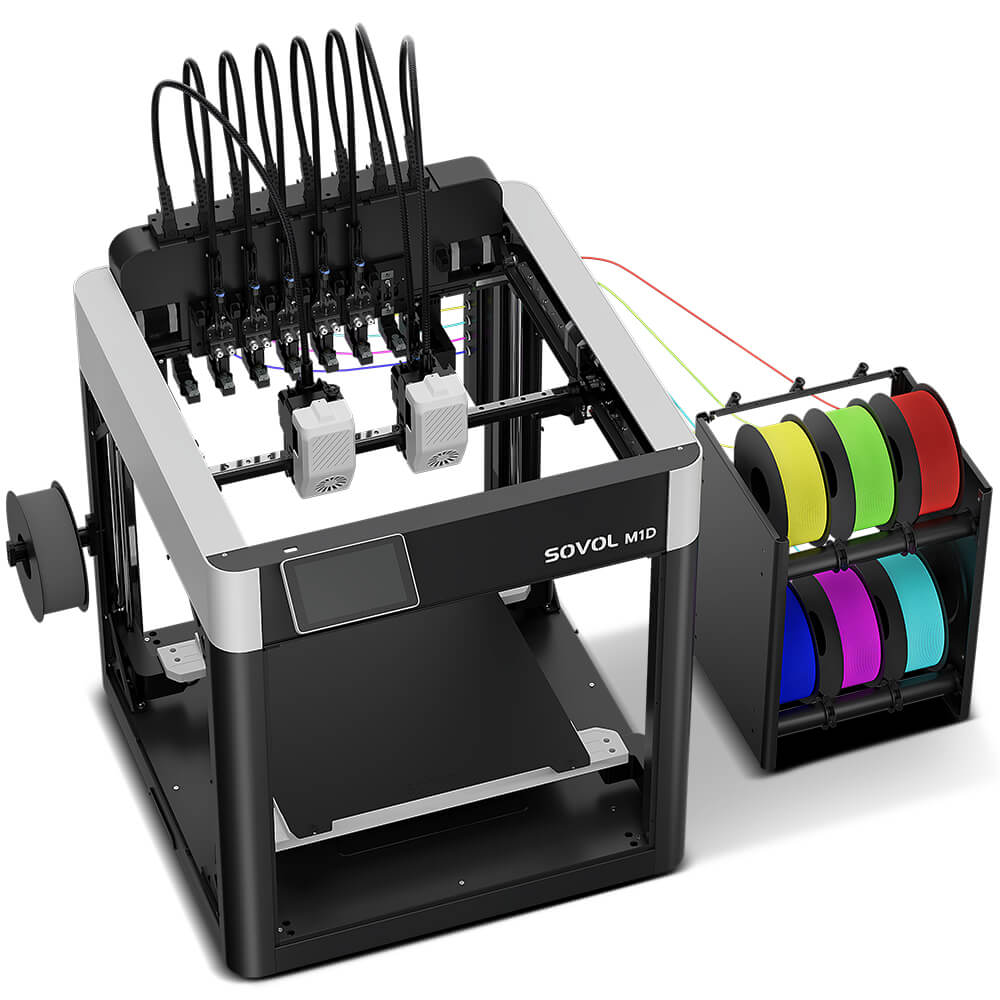
Sovol M1D: the Kickstarter success that marks the end of filament-swapping printers
The crowdfunding campaign for Sovol's IDEX 3D printer raises $3 million in just a few days, confirming the decline of multicolor systems with high material waste.
The desktop 3D printing market has spoken clearly. The Kickstarter campaign for the Sovol M1D raised nearly $3 million from about 2,000 backers within days of launch. A success that goes beyond the numbers: it represents a paradigm shift in the home additive manufacturing industry.
IDEX architecture and rapid tool change
The M1D combines IDEX technology with an innovative tool-changing system, enabling multicolor prints with almost zero waste.
The printer uses an IDEX (Independent Dual Extruders) architecture with a unique configuration. One extruder is fixed, while the second can host any one of six interchangeable tools. The result: seven colors or materials simultaneously in a single print job.
The extruders move independently along the X-axis. On the Y-axis they travel together. Each head maintains its own temperature, ensuring immediate availability after tool change.
- Up to 7 simultaneous colors/materials
- Tool change in 5 seconds
- Almost zero material waste
- Two independent extruders (IDEX)
Tool changing takes only five seconds. A huge advantage over traditional systems that must continuously heat and cool the nozzles.
The end of the filament-swapping era
The success of the M1D, following that of the Snapmaker U1, confirms that the market rejects systems with high material waste.
For two years, filament-swapping printers have dominated the desktop market. These systems feed and retract filament from a single hotend to change color. They work, but with a devastating hidden cost.
Every color change requires a nozzle purge. It serves to ensure the purity of the next color. With prints that require hundreds of purges, the material cost becomes prohibitive.
Filament-swapping printers are “silently expensive”: the material wasted in purges can exceed what is actually used for the print, making many multicolor projects economically unsustainable.
The massive demand for low-waste systems like the Snapmaker U1 and now the Sovol M1D has changed the game. The market has decided: low-waste systems are simply superior.
Economic and operational advantages
Low-waste systems offer reduced operating costs and faster printing times compared to traditional alternatives.
Material savings are only one part of the equation. Rapid tool changes drastically reduce overall printing times. Less waiting, less waste, more productivity.
Filament-swapping printers require minutes for each color change. The M1D completes the operation in five seconds. On complex prints with dozens of changes, the difference becomes hours of saved time.
Market implications
The success of crowdfunding campaigns for IDEX systems suggests a rapid decline of filament-swapping technologies in the desktop segment.
The M1D campaign has not yet reached the record numbers of the Snapmaker U1, but it has only been live for a few days. The trend is clear: users are looking for efficient solutions for multicolor printing.
Manufacturers of filament-swapping printers will have to adapt. The market has shown a preference for systems that reduce waste and speed up processes. Wasteful technologies are destined to gradually disappear.
Desktop additive manufacturing is entering a new phase. Efficiency and economic sustainability become absolute priorities. The M1D and its competitors are redefining industry standards.
Q&A
How much funding did the Kickstarter campaign for Sovol M1D raise?
The crowdfunding campaign raised nearly $3 million from about 2,000 backers within days of launch. This success confirms a major shift in the desktop 3D printing market.
How does the IDEX architecture of the Sovol M1D work?
The printer uses two independent extruders (IDEX) that move separately on the X-axis but travel together on the Y-axis. One extruder is fixed while the second holds interchangeable tools, maintaining distinct temperatures.
How many colors or materials can the M1D handle simultaneously?
Thanks to its unique configuration with one fixed extruder and six interchangeable tools, the M1D allows using up to seven different colors or materials in a single print job.
What is the tool change time on the Sovol M1D?
Tool changing takes only five seconds, a significant advantage over traditional systems. This speed is possible because each head maintains its own temperature, ensuring immediate readiness.
Why are filament swapping systems considered disadvantageous?
Filament swapping systems require nozzle purging at every color change to ensure purity, generating material waste often exceeding what is used for the print itself. This makes multi-color projects economically unsustainable.