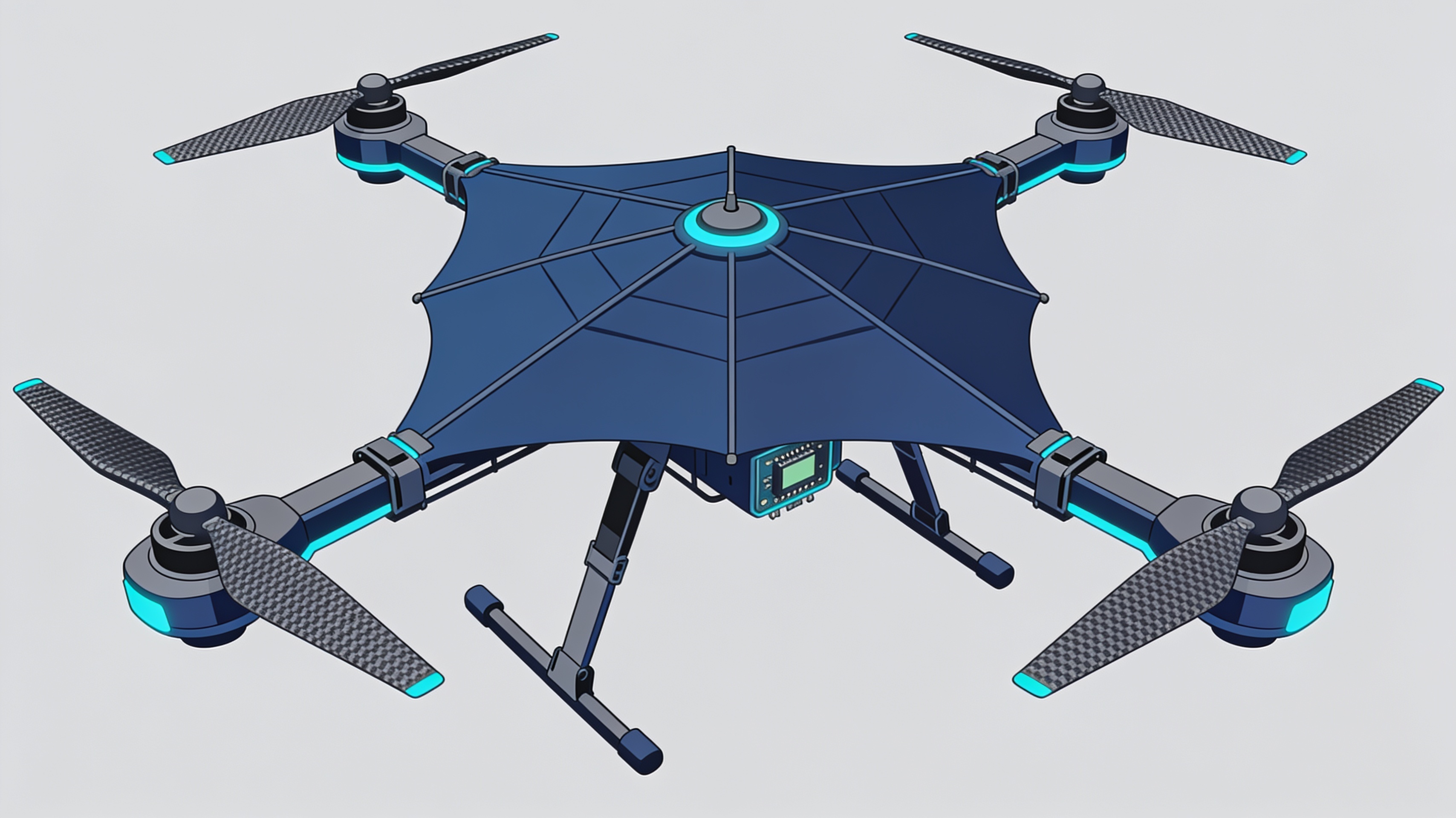
The 3D printed flying umbrella that autonomously follows you
An umbrella that flies on its own and follows the owner without needing to hold it. It's not science fiction, but the result of an additive manufacturing project developed by John Xu, creator of the YouTube channel I Build Stuff.
The second version of this device represents a significant evolution compared to the initial prototype. The first model required a radio control for piloting, while the current system is completely autonomous and allows you to walk in the rain or sun hands-free.
- Autonomous umbrella with four propellers and advanced tracking system
- Structural components printed in carbon fiber reinforced nylon
- ToF camera and Raspberry Pi for real-time tracking
- Successfully tested even under heavy rain
Structural design and additive manufacturing
3D printing enabled the iterative development of complex structural components, optimized through successive tests to reduce vibrations.
The heart of the system is a central 3D-printed core that connects the electronics to the umbrella. Four foldable arms house the propellers: when the umbrella is closed they fold, while upon opening a locking mechanism fixes them in a stable position.
Hinges, mounting plates, and other components required numerous iterations of design, printing, and testing. The goal was to reduce vibrations that interfered with the flight controller.
The structural parts were made of carbon fiber-filled nylon. This engineering material provides the necessary rigidity to maintain stability in flight.
Evolution of printing tools
Switching to a printer with a heated chamber solved the warping issues of engineering materials.
John Xu started the project with a Bambu Lab X1C and completed it with an H2D. The heated chamber of the latter allowed printing engineering materials without part warping.
This change in technology highlights how the choice of 3D printer directly affects the quality of the final components, especially when working with composite materials.
Autonomous tracking system
After testing various technologies, the time-of-flight camera proved to be the most effective solution for precise user tracking.
The real technological leap concerns the tracking system. John built a test drone to experiment with different solutions: conventional cameras, GPS with 3-meter accuracy (insufficient), and finally a time-of-flight camera.
The ToF camera continuously emits light and measures the phase shift of the reflected wave. This calculates the distance and generates a three-dimensional depth map.
Operation of the tracking system
- Acquisition: The ToF camera emits light and detects the phase shift of the reflected wave.
- Processing: A Raspberry Pi processes the data in real time and locates the user's head.
- Control: The system sends instructions to the flight controller to keep the umbrella centered.
A Raspberry Pi processes this data in real time, locates the user's head, and sends the necessary instructions to the flight controller. The umbrella thus remains centered on the person.
Field tests and results
After numerous setbacks and redesign phases, the umbrella managed to take off and follow the user autonomously. The system also passed the most critical test: operating under heavy rain.
The project demonstrates how 3D printing enables rapid development cycles: designing, printing, testing, and redesigning becomes an efficient iterative process for complex functional prototypes.
This project represents a concrete example of how additive manufacturing enables the development of innovative devices. The ability to rapidly iterate the design and print customized components in technical materials has made possible a product that would have been difficult to achieve with traditional methods.
article written with the help of artificial intelligence systems
Q&A
What material are the structural components of the umbrella made from?
The structural parts, including the central hub and arms, are 3D printed in carbon-fiber-reinforced nylon. This technical material was chosen to ensure the rigidity needed to maintain stability during flight.
How does the device's autonomous tracking system work?
The system uses a time-of-flight (ToF) camera mounted on a Raspberry Pi to track the user in real time. This technology measures the phase shift of reflected light to calculate precise distance, overcoming the limitations of GPS and conventional cameras.
What are the differences between the first and second versions of the flying umbrella?
The first version required a manual radio controller to be piloted by the user. The second version is fully autonomous, allowing hands-free walking under rain or sun without direct intervention.
Why was it necessary to change the 3D printer during the project's development?
The project moved from a Bambu Lab X1C to an H2D to leverage the latter's heated chamber. This eliminated part warping caused by printing technical composite materials like carbon-filled nylon.
What was the goal of the numerous design iterations for the hinges and plates?
The printing and testing iterations specifically aimed to reduce mechanical vibrations that interfered with the proper functioning of the flight controller. The final optimized design now ensures stable flight even with moving propellers.