TE Connectivity automates catheter shaft production with 3D printing
TE Connectivity has developed an automated 3D printing process for manufacturing medical catheter shafts. The technology, announced on July 27, 2026, aims to replace traditional manual operations in the construction of these devices.
The process was developed by the Advanced Technology Group of the Medical division at the PROPELUS Prototype Center in Galway, Ireland.
- Direct deposition of polymer sections onto the shaft during component rotation
- Reduction of production steps compared to conventional methods
- Greater flexibility in creating variable geometries and mechanical properties
- Application intended for cardiovascular, neurovascular, endoscopic, and electrophysiological catheters
How the deposition process works
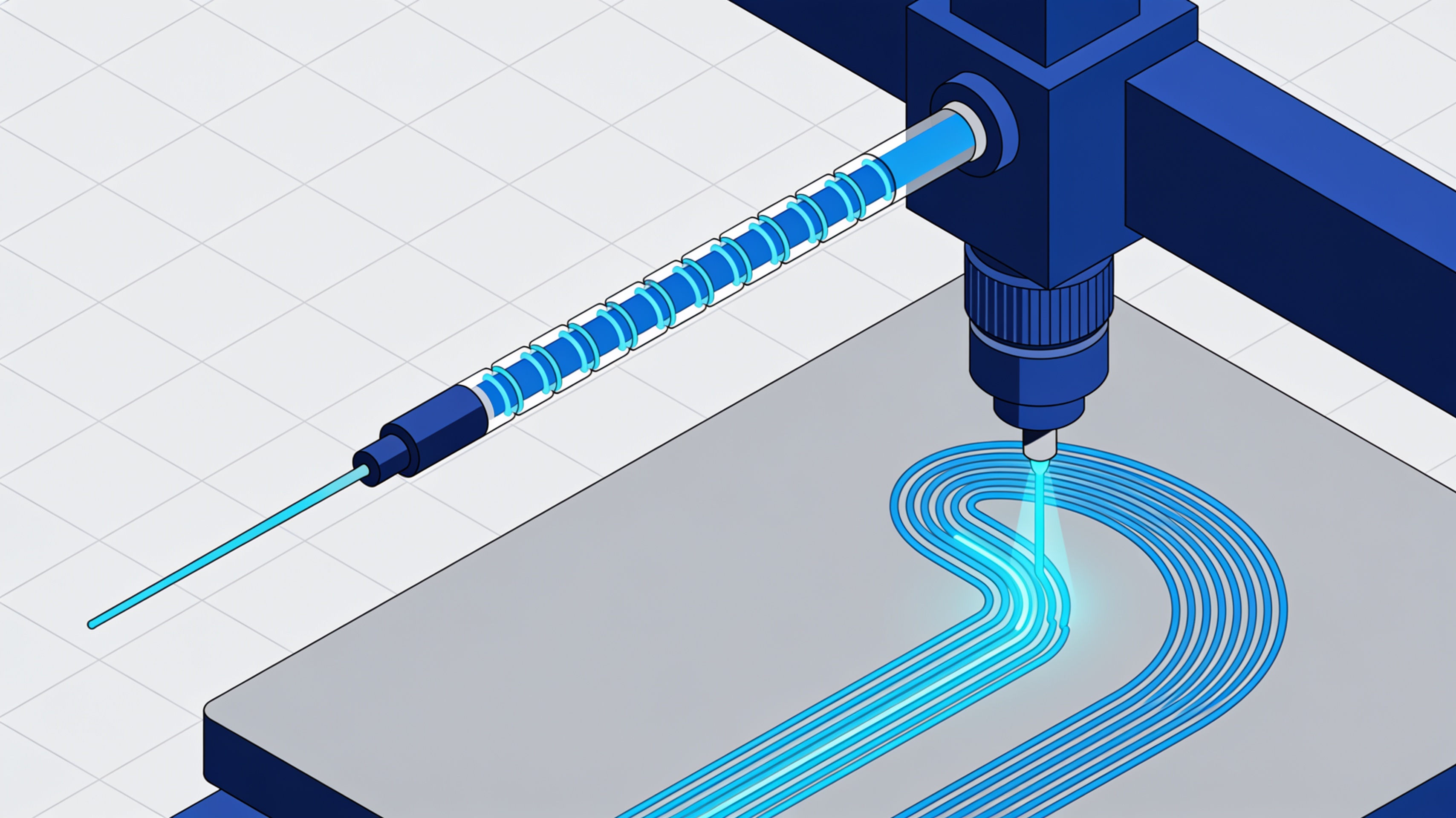
The technology does not print the entire catheter, but directly applies the polymer sections that form the outer coating of the shaft.
During processing, the component is rotated while the polymer material is deposited in the areas specified by the design. This automated approach reduces the number of necessary production steps.
The system makes it easier to create configurations with variable geometries, thicknesses, and mechanical properties along the length of the shaft.
Why shafts require multiple sections
Catheters for invasive procedures are not uniform tubes: their characteristics must change along the length to adapt to anatomy and clinical function.
The proximal part, controlled by the physician outside the body, requires sufficient rigidity to transmit push and pull forces. The distal zone, which advances into vessels or other anatomical regions, must be more flexible to follow tortuous paths and limit tissue damage.
Between these ends, intermediate sections are inserted, made with different polymers or with the same material at different hardness levels. The transition between sections must be precisely controlled to avoid stress concentrations or unwanted bending.
The most advanced shafts integrate low-friction inner linings, braided metal structures, control wires, electrical conductors, and multiple lumens to carry instruments, fluids, optical fibers, or sensors.
Comparison with conventional methods
Traditional production of shafts requires separate preparation of sections and subsequent manual assembly.
In conventional manufacturing, the different sections of the outer coating are prepared separately and then placed on the shaft. This process involves multiple manual steps and limits design flexibility.
The new direct deposition approach eliminates some of these manual operations, simplifying the production chain. The technology also allows for more complex transitions between sections with different mechanical characteristics.
Target clinical applications
The process is intended for catheters used in various medical specialties that require devices with graduated mechanical properties.
The main applications involve cardiovascular, neurovascular, endoscopic, and electrophysiology procedures. In these areas, the ability to precisely control stiffness and flexibility along the shaft is critical for the safety and effectiveness of the procedure.
The technology is supplied to medical device manufacturers who assemble complete catheters by integrating the shafts with other functional components.
Development at the Irish center
The PROPELUS Prototype Center in Galway represents the innovation hub for TE Connectivity's medical technologies.
The Irish center hosted the development of the process by the Advanced Technology Group. The facility focuses on prototyping and validating new technologies for medical devices before their industrialization.
The choice to automate the deposition of polymer sections responds to the need to increase repeatability and reduce the variability typical of manual operations in the production of precision medical devices.
article written with the help of artificial intelligence systems
Q&A
Where was TE Connectivity's new 3D printing process developed?
The process was developed by the Advanced Technology Group of the Medical division at the PROPELUS Prototype Center in Galway, Ireland. This location enabled the creation of a specific solution for medical devices.
What exactly does the deposition technique involve?
The technology does not print the entire catheter but directly applies polymer sections onto the shaft as it rotates. This method allows material to be deposited only in areas specified by the specific design.
What advantages does this process offer over conventional methods?
The automated approach significantly reduces the number of production steps required compared to traditional manual assembly. Furthermore, it simplifies the creation of configurations with variable geometries and mechanical properties along the shaft.
Why do catheter shafts require sections with different characteristics?
The proximal section must be rigid to transmit push and rotation, while the distal section must be flexible to follow anatomy without damaging tissue. Intermediate sections connect these ends using different polymers or varying hardness levels.
Which types of catheters is this innovative application designed for?
The solution is designed for cardiovascular, neurovascular, endoscopic, and electrophysiological catheters. These devices often integrate complex structures such as control wires, electrical conductors, and multiple lumens.