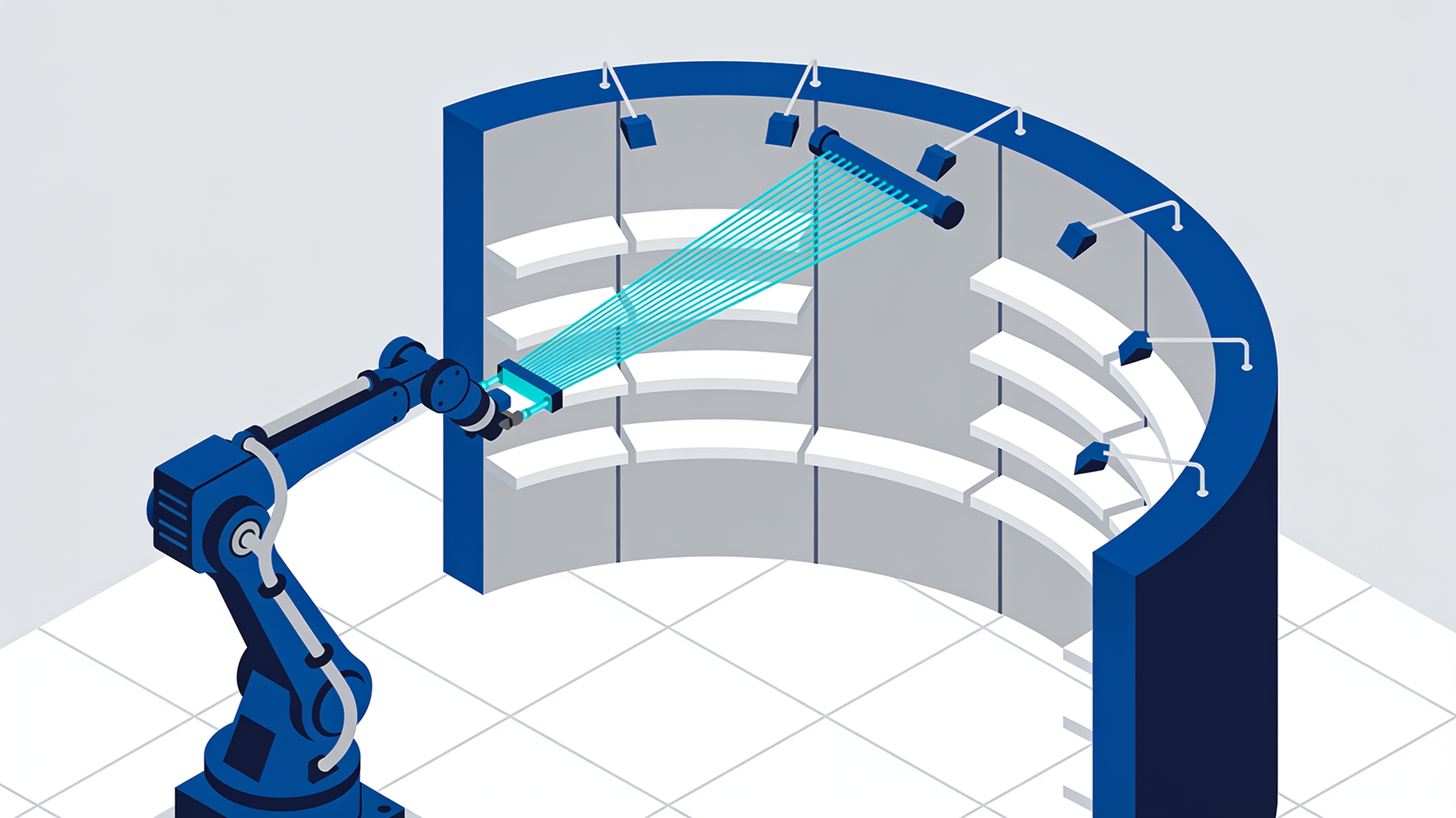
UPM Group creates a 100-square-meter trade fair stand with robotic 3D printing
UPM Group presented at EuroShop 2026 a stand of over 100 square meters built mainly with large-format 3D printing. The project demonstrates how additive manufacturing can integrate into trade fair and retail design processes.
- 100+ sqm stand built with robotic 3D printing for EuroShop 2026 in Düsseldorf
- Collaboration between UPM Group, WASP (extruders), KUKA (robotics) and FormFutura (materials)
- Demonstration project for temporary setups and customized furniture in retail
- Curved surfaces and organic geometries created without dedicated molds
A complete additive manufacturing project for retail
UPM Group used EuroShop 2026 as a test bench to demonstrate the integration of 3D printing in commercial setup processes.
The stand presented at Messe Düsseldorf from February 22 to 26 is not a simple technological demonstration. UPM Group showed a complete process that includes design, engineering, manufacturing, plant integration, and final assembly.
The project involves specialized technology partners. WASP provided the extrusion systems, KUKA the robotic arms, and FormFutura the reinforced thermoplastic material. This combination made it possible to produce large-format architectural structures and furniture elements.
From traditional craftsmanship to additive manufacturing
UPM Group, founded in 1940 as a craft workshop, has expanded its expertise to 3D printing for retail branding.
The company started with signage and advertising communication. Over time it integrated woodworking, carpentry, large-format digital printing, and custom furniture. In 2025 it launched Mosso, an offering dedicated to large-format 3D printing for retail, trade fairs, and experience design.
The EuroShop stand represents the first demonstration project of the production capabilities developed through Mosso. The trade fair, now in its sixtieth anniversary, brings together companies active in store design, lighting, visual communication, and exhibition space construction.
Organic design and direct digital production
The project by architect Christopher G. Ward uses curved surfaces and continuous volumes that are difficult to achieve with traditional methods.
The stand design uses geometries that would require dedicated molds or complex milling with conventional technologies. 3D printing made it possible to transform the digital model directly into physical components.
This approach eliminates the need to build jigs and specific equipment for each shape. The method is particularly suitable for customized and temporary setups, where the production of dedicated molds is not economically sustainable.
EuroShop is the leading European trade fair dedicated to retail design and commercial fittings. The 2026 edition took place in Düsseldorf, with UPM Group present in Hall 11.
Implications for the fittings sector
The project opens concrete prospects for the application of additive manufacturing in commercial spaces and temporary events.
Large-format 3D printing offers specific advantages for trade fair and retail fittings. It allows the creation of complex shapes without geometric constraints, reduces production times, and enables extensive customization.
Temporary fittings represent an ideal use case. The need for customized structures, reduced production times, and the impossibility of amortizing dedicated molds make additive manufacturing competitive compared to traditional methods.
UPM Group has demonstrated that the technology is mature for real applications. The project integrates skills in architectural design, structural engineering, additive manufacturing, and trade fair site management into a single operational flow.
article written with the help of artificial intelligence systems
Q&A
Where and when was the UPM Group booth presented?
The booth was presented at EuroShop 2026 at Messe Düsseldorf from February 22 to 26. The event served as a testing ground to demonstrate the integration of 3D printing in commercial displays.
Which technology partners collaborated on the booth project?
The project involved collaboration between UPM Group, WASP for extrusion systems, KUKA for robotic arms, and FormFutura for supplying reinforced thermoplastic material.
What advantages does robotic 3D printing offer for trade show displays?
This technology enables the creation of curved surfaces and organic geometries without the need for dedicated molds or specific equipment. It also allows direct transformation of digital models into large-format physical components.
What is Mosso and what is its role in the UPM project?
Mosso is an offering launched by UPM Group in 2025 dedicated to large-format 3D printing for retail, trade shows, and experience design. The EuroShop booth represents the first demonstrative project of the production capabilities developed through this initiative.
How did UPM Group evolve before adopting 3D printing?
Founded in 1940 as a craft workshop for signage and communication, the company gradually integrated woodworking, metalworking, and digital printing. This evolution led to the development of advanced skills in additive manufacturing for retail branding.