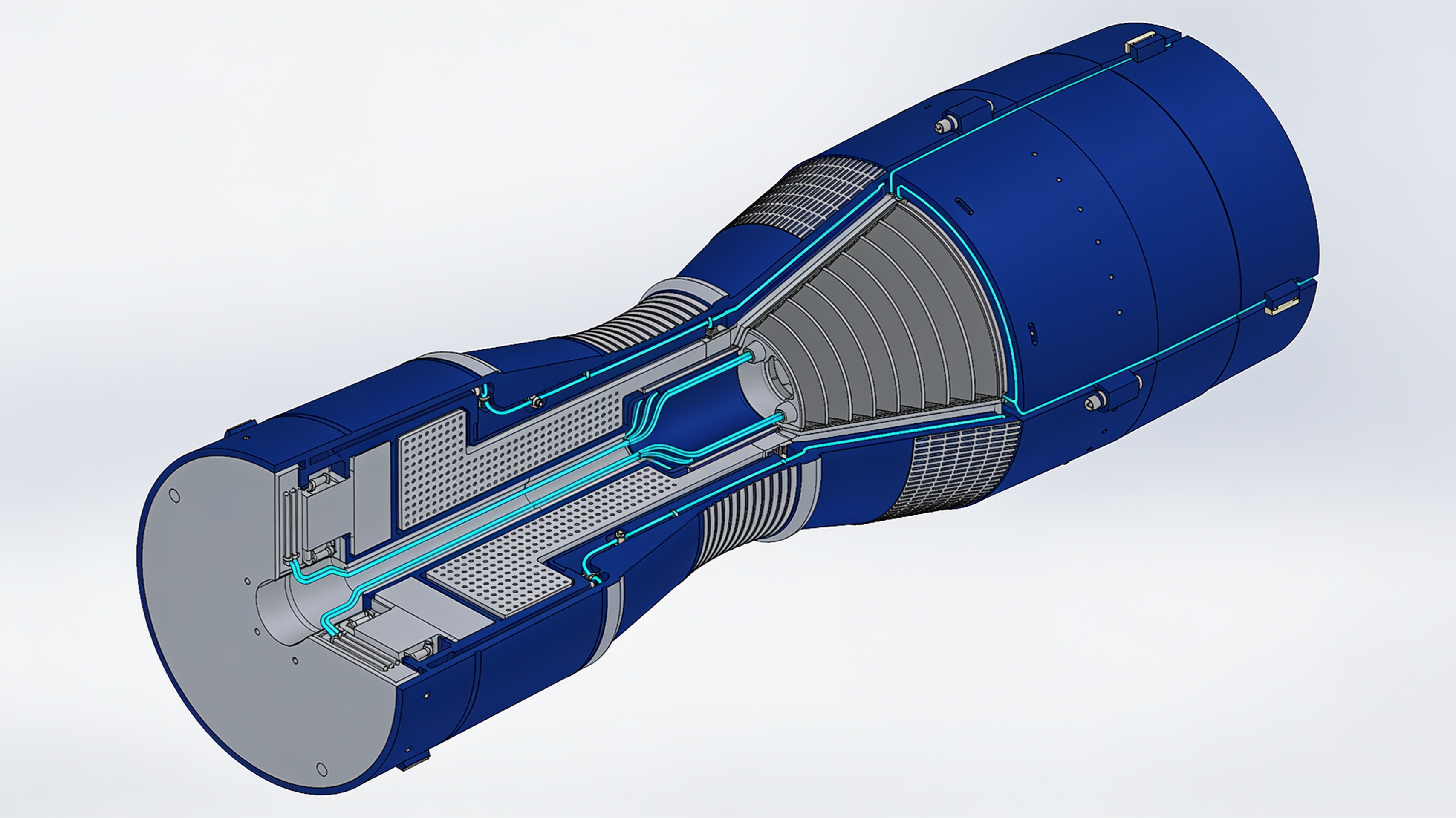
3D-printed rocket engines: Venus Aerospace raises $91 million
by Mercury Fund with participation from Lockheed Martin Ventures, PEAK6 and Draper Associates, represents further recognition for additive manufacturing in the aerospace sector.
The investment will be used to transform the Rotating Detonation Rocket Engine (RDRE) from a flight-proven prototype into an operational system for defense and space applications in the short term.
Additive manufacturing at the heart of hypersonic propulsion
Venus Aerospace uses laser powder bed fusion to build components impossible to manufacture with traditional methods, integrating complex geometries essential for thermal management.
The Houston-based company builds its RDRE using laser powder bed fusion, a metal 3D printing process that allows the integration of complex internal structures. This technology enables the creation of customized cooling channels and injector orifices that would be impossible to manufacture with traditional machining.
- Venus Aerospace raises $91 million for 3D-printed RDRE engine
- Laser powder bed fusion enables complex geometries impossible with traditional methods
- Use of NASA GRCop-42 and GRX-810 alloys for extreme thermal resistance
- Modular architecture for multiple applications: ammunition, space launches, orbital transfers
NASA special alloys for extreme temperatures
The propulsion system employs advanced materials developed by NASA to withstand the extreme conditions generated by supersonic detonation waves. GRCop-42 offers high thermal conductivity, while GRX-810 ensures resistance to extreme temperatures.
These materials are essential for managing the heat and pressure-rise combustion characteristic of continuous rotating detonation waves that generate engine thrust.
RDRE technology: rotating detonation for efficiency
At the heart of the system is a circular combustion chamber that exploits continuous rotating supersonic detonation waves, a radically different approach from conventional rocket engines.
The RDRE's circular combustion chamber generates thrust through supersonic detonation waves that continuously rotate within the structure. This propulsion architecture is designed to combine efficiency, thrust controllability, reusability, and manufacturability.
The Rotating Detonation Rocket Engine uses rotating supersonic detonation waves instead of conventional combustion, potentially offering greater efficiency and thrust density compared to traditional engines.
A modular architecture for multiple applications
Venus Aerospace is developing a common propulsion architecture rather than engines specific to each application. This flexible, 3D-printed design is intended for use in munitions, space launches, orbital transfers, and landing vehicles.
The modular approach reduces development costs and accelerates deployment timelines for different mission classes. Additive manufacturing is key to this strategy, enabling rapid customization while maintaining a common base architecture.
Implications for aerospace additive manufacturing
Venus Aerospace's funding confirms growing investor confidence in additive manufacturing technologies for critical applications. Lockheed Martin Ventures' participation signals the defense sector's interest in advanced propulsion solutions made with 3D printing.
The ability to integrate multiple functions into single components and use high-performance alloys positions laser powder bed fusion as an enabling technology for the next generation of propulsion systems.
article written with the help of artificial intelligence systems
Q&A
How much did Venus Aerospace raise in its Series B round?
The Texas-based startup closed a $91 million Series B round. The financing was led by Mercury Fund with participation from investors such as Lockheed Martin Ventures.
What 3D printing technology does Venus Aerospace use?
The company uses powder bed laser fusion to build RDRE engine components. This process enables the integration of complex geometries and cooling channels impossible with traditional methods.
What special materials are used in RDRE engines?
The propulsion system employs NASA GRCop-42 and GRX-810 alloys developed to withstand extreme temperatures. These materials ensure high thermal conductivity and resistance to supersonic detonation waves.
How does RDRE rotating detonation technology work?
The engine leverages a circular combustion chamber where supersonic detonation waves continuously rotate to generate thrust. This architecture offers greater efficiency, throttling capability, and reusability compared to conventional engines.
What are the intended applications for the RDRE engine?
The engine is designed for multiple applications including munitions, space launches, and orbital transfers. The investment will help transform the prototype into an operational system for the defense and space sectors.