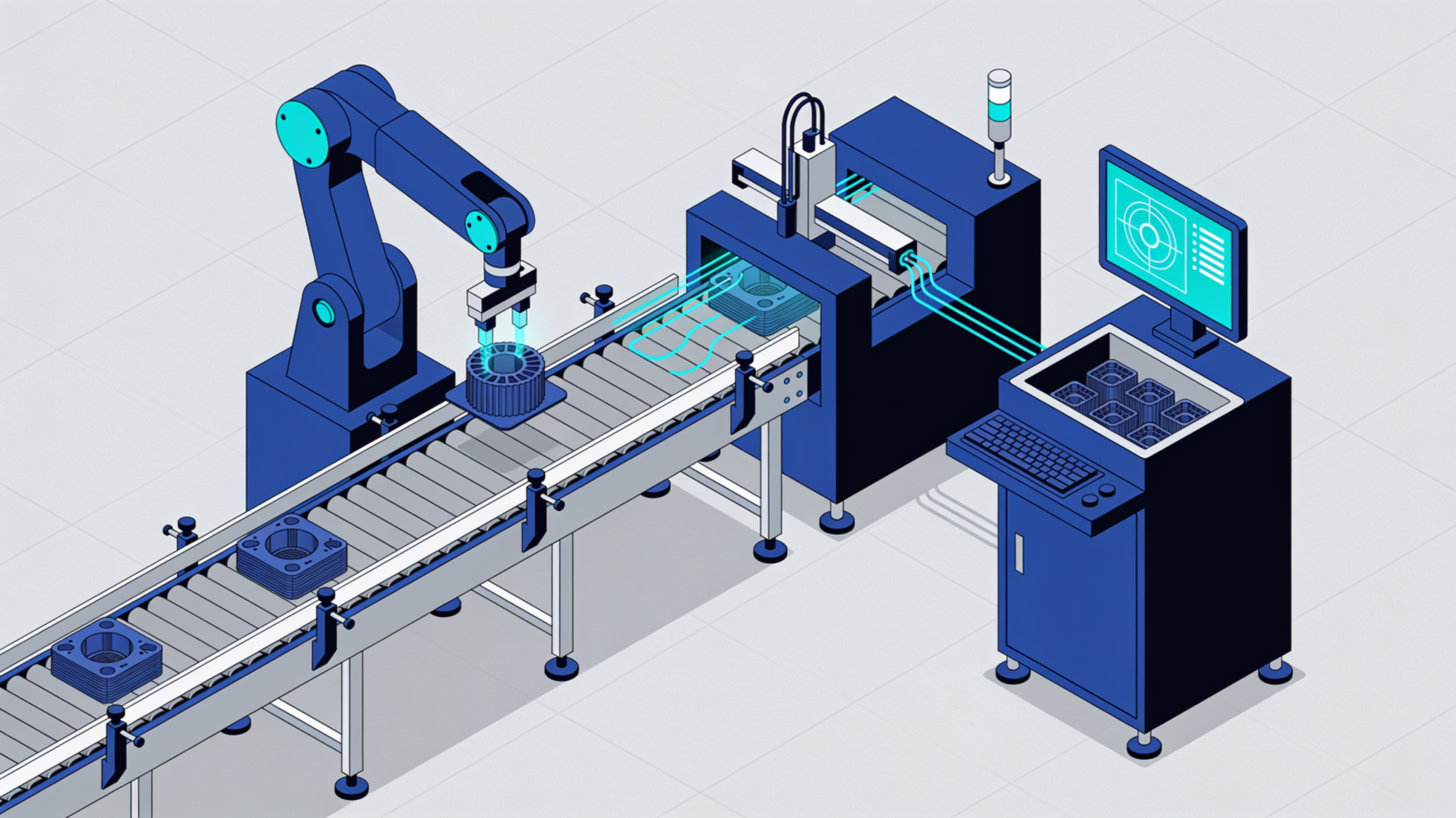
3iD automates the sorting of 3D printed components with AM-Flow technology
The Belgian additive manufacturing service 3iD has introduced an automated line developed by the Dutch company AM-Flow to manage the identification and sorting of components after printing. The investment aims to solve one of the most critical bottlenecks of serial additive manufacturing: separating and recognizing dozens or hundreds of different parts from the same production batch.
The configuration includes the AM-Feed, AM-Vision, and AM-Sort modules, designed to recognize components without labels or codes applied to the part and direct them to the correct processing or destination.
The sorting problem in additive manufacturing
In powder bed technologies, a single print cycle can contain hundreds of components belonging to different orders. Identifying them manually slows down the entire production chain.
The productivity of an additive factory depends not only on the speed of the printers. At the end of each cycle, the components must be cooled, extracted, cleaned, identified, and assigned to the planned processes.
In technologies such as HP's Multi Jet Fusion, the same build volume can contain dozens or hundreds of different components. The parts can belong to multiple orders, have similar sizes, or require different treatments such as sandblasting, smoothing, or coloring.
- Visual comparison with digital files and production lists
- Slowdown of the production chain with the increase in volumes
- Risk of incorrect assignment to wrong operations or shipments
When this activity is performed manually, the operator must compare the parts with images, digital files or lists displayed on the management system. The process can be manageable with few components, but becomes complex with the increase in volumes and geometric variety.
The AM-Flow solution for 3iD
The introduced automation creates a continuous flow between the output of preliminary operations and the subsequent production phases, eliminating manual intervention in the identification of components.
For companies like 3iD, which simultaneously work with different geometries and orders belonging to different customers, the ability to recognize and sort each individual component directly impacts delivery times and process reliability.
The investment does not concern a new 3D printer, but the organization of post-production operations. The three modules of the AM-Flow line manage one of the most challenging phases of serial additive manufacturing: separating the components from a print batch, recognizing them without applying labels or codes on the part, and directing them to the correct order, operation or destination.
Operation of the AM-Flow line
- AM Feed: Feeds the components into the system after preliminary operations.
- AM-Vision: Recognizes each component through artificial vision, without the need for labels.
- AM-Sort: Automatically sorts parts to the correct destination based on the order or required processing.
The production context of 3iD
The Belgian service operates as a provider of 3D printing services for prototypes and components, managing production volumes that require complex logistics organization.
3iD uses technologies such as Multi Jet Fusion and works with materials like PA 12 and TPU. Founder Dave Vanhove chose to invest in post-production automation to maintain competitiveness and reliability in delivery times.
Stefan Rink, CEO of AM-Flow, developed a specific solution for the needs of industrial additive manufacturing, where geometric variety and customization are intrinsic characteristics of the process.
The AM-Vision system uses visual recognition algorithms to identify components by comparing the detected geometry with the digital models in the production database, eliminating the need for physical markings on the parts.
Implications for serial additive manufacturing
Sorting automation is a necessary step to transform 3D printing from a prototyping technology to a scalable industrial solution.
The time spent on sorting can slow down the entire production chain, while an incorrect assignment can send a part to the wrong finishing or include it in another customer's shipment.
The introduction of automated systems like AM-Flow's demonstrates that competitiveness in additive manufacturing does not depend only on printing speed or material quality. Efficient management of post-production operations becomes a determining factor to ensure sustainable operating margins and meet customer commitments.
3iD automates the management of 3D printed components with AM-Flow technology – 3D Printing
article written with the help of artificial intelligence systems
Q&A
What is the main bottleneck that 3iD solved with AM-Flow?
The system resolves the critical issue of manually sorting and identifying dozens or hundreds of different parts from the same print batch. This process previously slowed down the entire production chain, increasing the risk of errors.
How does component recognition work in the AM-Flow line?
The AM-Vision and AM-Sort modules recognize components without needing labels or codes applied directly to the part. The system automatically compares geometry to direct each part to the correct processing or destination.
Which modules make up the configuration installed by 3iD?
The automated line includes three specific modules: AM-Feed for feeding, AM-Vision for optical recognition, and AM-Sort for physical sorting. Together, they create a continuous flow, eliminating manual intervention.
Why is manual sorting problematic in Multi Jet Fusion?
In powder bed technologies like Multi Jet Fusion, a single cycle can contain hundreds of components from different orders with similar dimensions. Manual visual comparison with digital files becomes unsustainable as volumes increase.
What advantages does automation offer for companies like 3iD?
Automation directly impacts delivery times and process reliability by simultaneously handling different geometries and customers. It eliminates the risk of incorrect assignment to processes such as sandblasting or coloring.