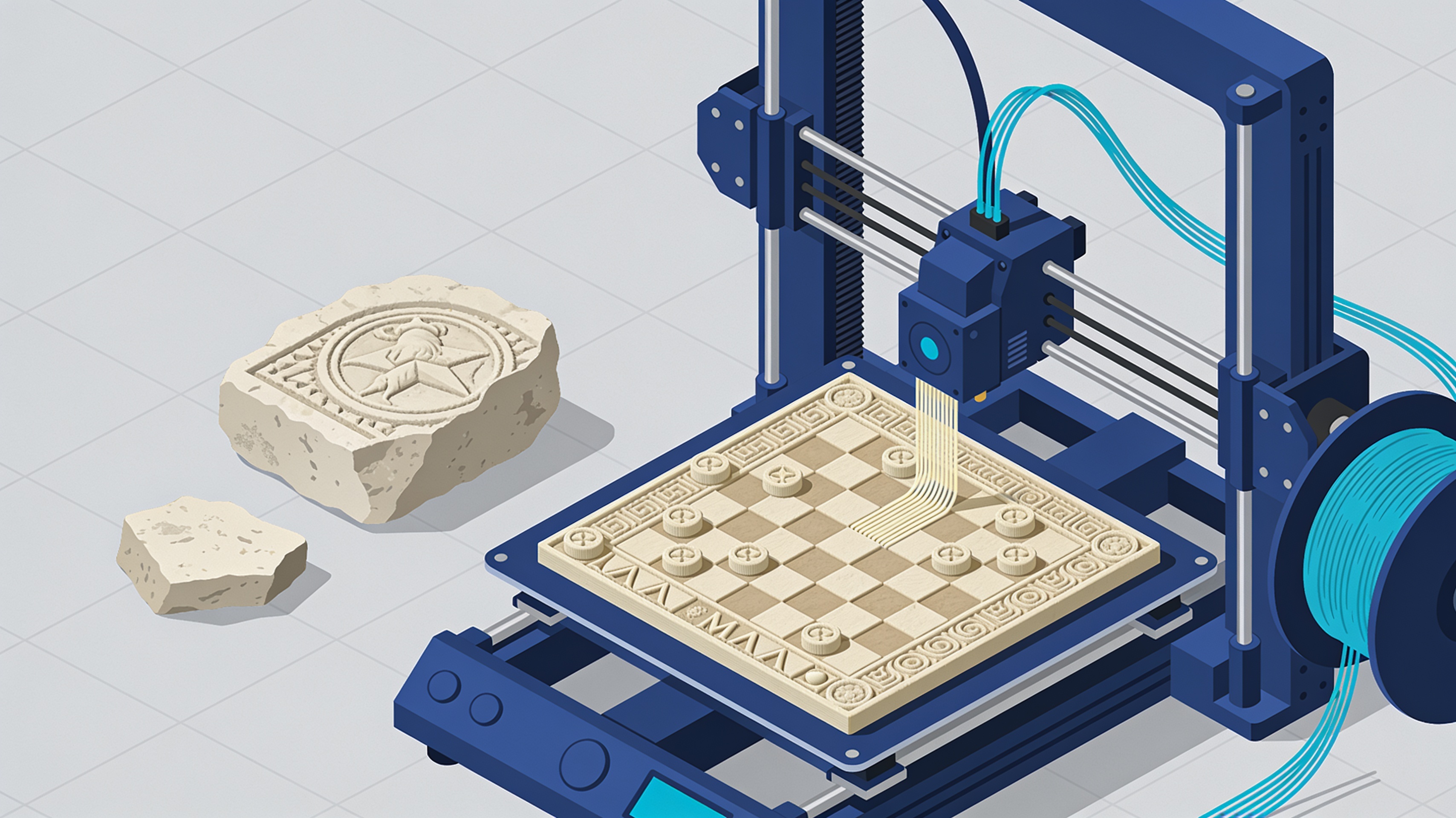
3D scanning and printing bring a 1,700-year-old Roman game board back into play
The project by Newcastle University and the Vindolanda Charitable Trust has allowed the creation of a faithful replica of the archaeological find before its departure for an international exhibition in Canada.
The original game board dates back almost two millennia and was discovered in 2019 during excavations at Vindolanda, one of the most important archaeological sites in northern England.
From discovery to digitization
*Archaeologists have identified the find as a game board for Ludus Latrunculorum, the most popular strategy game in ancient Roman Britain.*
The game board is composed of five stone fragments. Before its departure for Canada, the Vindolanda team decided to preserve a copy as faithful as possible.
Specialists from Newcastle University used a 3D scanner to digitize each fragment. This process allowed them to capture every detail of the stone surface.
- 1,700-year-old Roman game board discovered in 2019 at Vindolanda
- 3D scanning of the five stone fragments
- PLA printed replica for conservation and museum use
- Interactive digital model for virtual exploration
The PLA replica
*Starting from the digital models, engineers created a physical replica using additive printing.*
The copy was 3D printed using PLA as material. In addition to the physical replica, the project produced an interactive digital model that allows examining the game board from any angle.
This dual solution ensures both physical conservation and digital accessibility of the artifact.
Ludus Latrunculorum: Roman strategy
*The exact rules of the game have been lost over time, but historians have partially reconstructed its functioning through literary references and archaeological finds.*
Ludus Latrunculorum was a two-player strategy game. The mechanics had similarities with modern strategy games, where participants had to surround and capture the opponent's pieces.
Several Roman authors have left literary references that have helped scholars understand its dynamics.
Beyond the walls of the fort
*The location of the discovery has revealed unexpected information about daily life in Roman Britain.*
The archaeologists found the game board outside the defensive structures of the fort, in an area frequented by the civilian population. This discovery has changed previous hypotheses.
For a long time it was thought that Ludus Latrunculorum was a primarily military pastime. The discovery at Vindolanda instead suggests that women, children, merchants, and other civilian inhabitants also participated in this game.
The position of the game board reinforces the hypothesis that entertainment was widespread among different segments of the Roman population in Britain.
From the display case to active play
*The printed replica will not only have an exhibition function.*
The goal of the project is to allow museum visitors to interact with the game board. The PLA copy can be touched and used without risking damage to the original.
This approach represents a concrete example of how 3D printing can democratize access to cultural heritage. Visitors will be able to directly experience an object from Roman daily life.
3D Technologies for Cultural Heritage
*The Vindolanda project demonstrates the potential of additive manufacturing in archaeological conservation and dissemination.*
The combination of 3D scanning and additive printing offers multiple advantages. It allows permanent digital preservation of artifacts, the creation of copies for multiple exhibitions, and direct public interaction with faithful reproductions.
PLA confirms itself as a versatile material even in the museum context. Its ease of printing and low cost make it ideal for large-scale cultural dissemination projects.
article written with the help of artificial intelligence systems
Q&A
What is the Ludus Latrunculorum found at Vindolanda?
It is an ancient Roman strategy game for two players, similar to chess, where the objective was to surround and capture opponent pieces. The stone board discovered in 2019 consists of five fragments.
How was the replica of the Roman board made?
Specialists from Newcastle University first digitized the five original fragments using 3D scanning. Subsequently, they printed a faithful physical copy using additive technology and PLA material.
Why was a 3D-printed copy of the artifact created?
The replica was produced to preserve a physical version of the board at Vindolanda while the original was transported to Canada for an international exhibition. Additionally, an interactive digital model was created for virtual study.
Where exactly was the stone board found?
The artifact was unearthed outside the defensive structures of Fort Vindolanda, in an area frequented by the civilian population. This location has modified previous hypotheses about daily life at the site.
How old is the Roman board reproduced in 3D?
The original board dates back approximately 1,700 years to the era of Roman Britain. Its discovery during the 2019 excavations allowed this important historical artifact to be studied through new technologies.