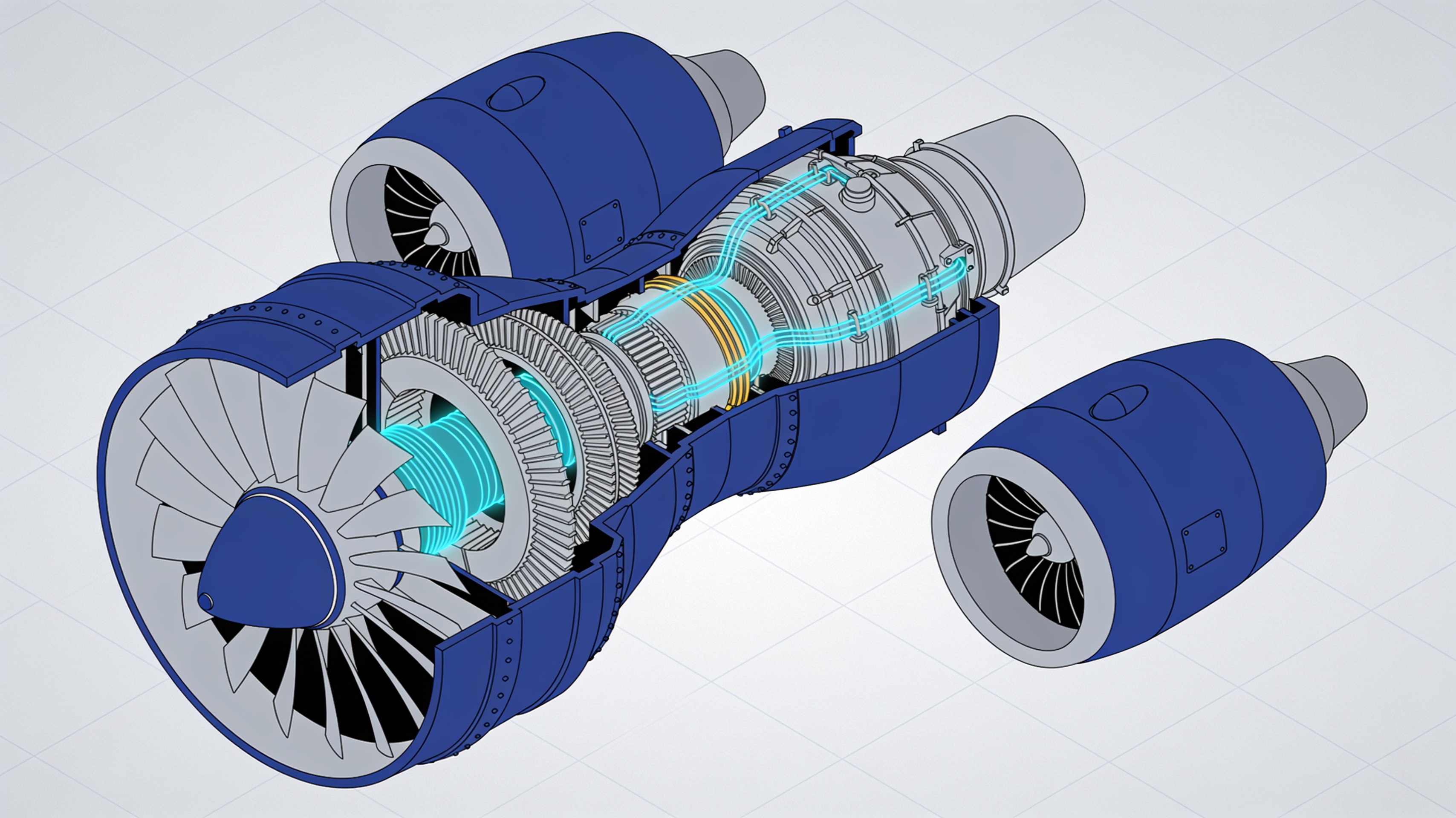
Pratt & Whitney tests TJ150 with 60% of volume produced additively
The aircraft engine manufacturer has completed tests on a configuration of the TJ150 turbojet in which almost 60% of the total volume was produced using additive manufacturing. The test includes static and rotating components under real operating conditions.
Pratt & Whitney, a company of the RTX group, announced on July 20, 2026 during the Farnborough International Airshow the completion of a series of demonstration tests on the TJ150 engine. The tested configuration represents a significant milestone in the application of additive manufacturing to propulsion systems.
- Almost 60% of the TJ150 volume produced with additive technologies
- Tests conducted on static and rotating components under operating conditions
- Transition from qualification of individual parts to verification of the entire system
Volume, not number of components
Pratt & Whitney specified that the stated percentage refers to the volume of the engine, not the number of parts or total weight.
Pratt & Whitney clarified that the 60% figure refers to the engine volume. The distinction is technically significant: a single large component can account for a substantial share of the total volume, whereas many small parts contribute less.
The percentage therefore does not correspond to the number of components, the mass, or the production cost. This clarification avoids misinterpretations about the actual characteristics of the tested configuration.
Critical components under operational stress
The configuration includes rotating and static parts subjected to high temperatures, rotational speeds, and intense mechanical stresses.
Pratt & Whitney has extended the use of additive manufacturing beyond traditional applications. The tested TJ150 does not only mount brackets, ducts, or secondary elements. It includes components subjected to severe operating conditions.
The tests aimed to verify the behavior of materials in a real environment and the ability of the components to meet the durability requirements. The company did not publish the exact parameters: duration of ignitions, temperatures, rotation speed, or measured performance.
Rotating components present greater difficulties than static structures. They must maintain balance, geometric precision, and mechanical strength while rotating at high speeds and being traversed by hot gases.
From the turbine wheel to the complete system
The program marks the transition from the qualification of individual parts to the evaluation of an integrated configuration where a substantial portion of the engine depends on additive.
In June 2025, Pratt & Whitney had completed tests on a 3D-printed turbine wheel for the TJ150. The wheel had operated at the expected operating speeds and temperatures, achieving the durability required by the program.
The July 2026 test expands the evaluation scope. The company verified static and rotating components together, observing their behavior within the propulsion system. In an engine, the performance of one part depends on the interaction with the others.
Implications for propulsion development
The approach allows evaluating not only the individual parts but the entire system, considering the interactions between different components.
The test represents a methodological advancement. Pratt & Whitney has shifted verification from the individual part to the integrated system. This approach allows identifying issues that emerge only from the interaction between different components.
The TJ150 is a compact turbojet used in applications such as the MALD missile and Leidos Dynetics' Black Arrow. The massive integration of additive components in an operational engine provides useful data for future programs.
Pratt & Whitney has not communicated whether the tested configuration will enter production or whether it represents a demonstrator platform for subsequent developments.
article written with the help of artificial intelligence systems
Q&A
What exactly does the 60% percentage indicate in the TJ150 engine?
The percentage refers to the volume occupied by components made with additive manufacturing, not the number of parts or total weight. This distinction is technical since single large elements impact volume more than many small details.
Which types of components were included in the TJ150 tests?
The tested configuration includes both static and rotating components subjected to real operating conditions. The goal was to verify material behavior under mechanical stress, high temperatures, and intense rotation speeds.
When and where was the test completion announced?
Pratt & Whitney announced the completion of demonstrative tests on July 20, 2026, during the Farnborough International Airshow. This event marked a significant milestone in applying additive manufacturing to propulsion systems.
Why do rotating components represent a greater challenge in 3D printing?
Rotating components must maintain balance, geometric precision, and mechanical strength while spinning at high speeds and exposed to hot gases. These requirements make their qualification more complex than that of static structures.
What is the main objective of this testing program for Pratt & Whitney?
The program marks the transition from qualifying individual parts to evaluating an integrated configuration where a significant portion of the engine is additive. It serves to demonstrate the components' ability to meet durability requirements in a complete system.