CarbonForm develops 3D Fiber Tethering technology for continuous fiber composites
A Delaware startup brings additive manufacturing of thermoset composites beyond the limits of traditional techniques, targeting drone frames and high-performance aerospace components.
CarbonForm, a spin-off of the University of Delaware, has developed an additive manufacturing process called 3D Fiber Tethering (3DFiT) that allows depositing continuous fiber thermoset composite materials onto three-dimensional structures. The technology, currently in the commercialization phase, aims to produce complex, high-performance components for applications such as drone frames.
The startup, founded by university professor Kelvin Fu together with Ismail Mujtaba Khan, Md. Habib Ullah Khan, and Kaiyue Deng, is currently hosted at the university's Center for Composite Materials. The goal is to move to a dedicated facility as the business grows.
The 3DFiT process: deposition on a scaffold
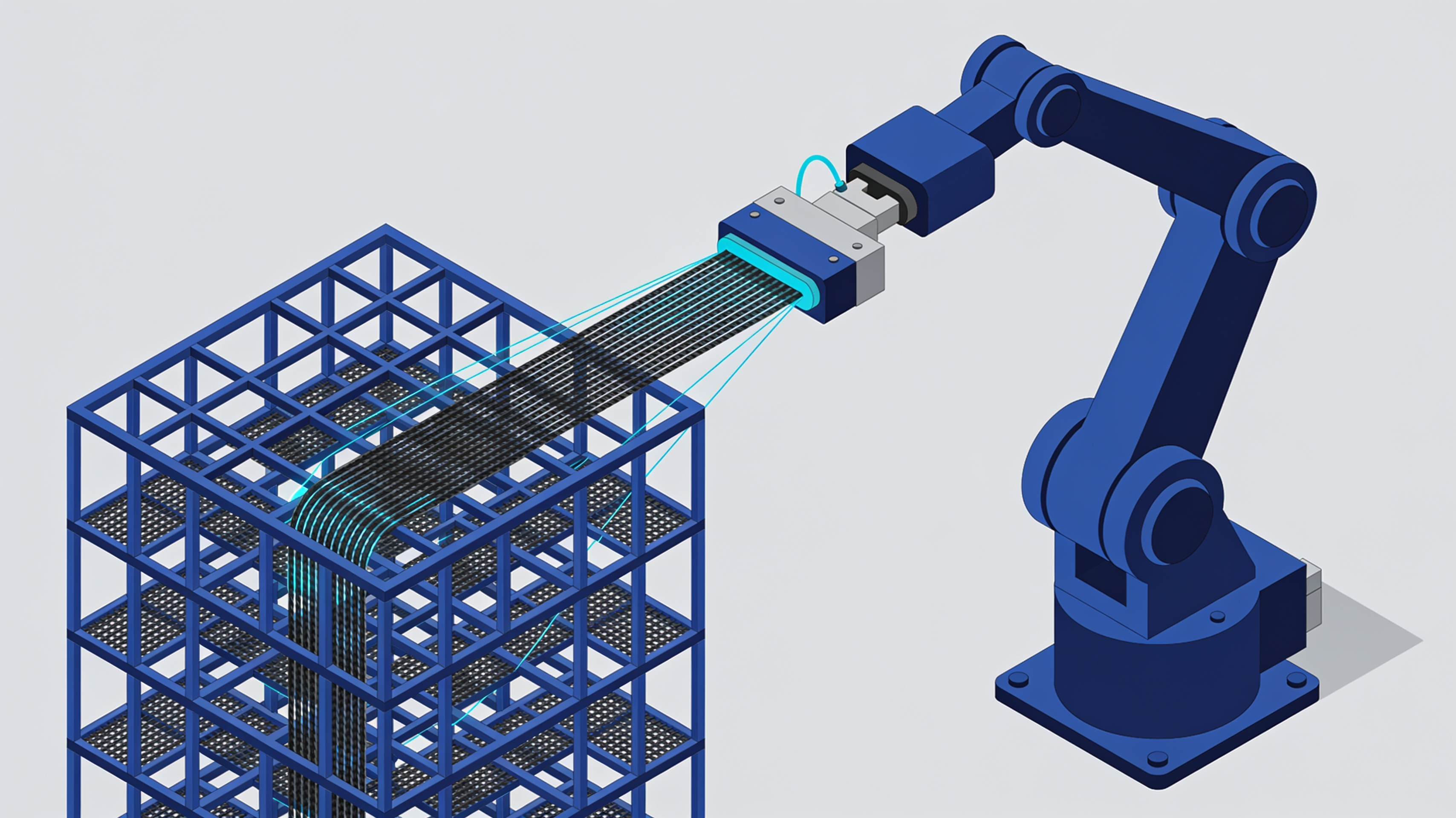
The 3DFiT process uses three-dimensional support structures to deposit composite material, overcoming the limitations of the two-dimensional layers typical of traditional 3D printing.
The 3DFiT process involves depositing continuous fibers in a thermoset matrix onto a three-dimensional scaffold. The print head is mounted on a robot, allowing freedom of movement in space.
“This process gives us 3D spatial positioning to create high-strength three-dimensional monolithic structures… in minutes,” explains the CarbonForm team.
- Continuous fiber deposition on 3D scaffold
- Thermosetting composite materials
- Print head mounted on robot
- Production of monolithic structures in minutes
- Topology optimization of design
According to Ismail Khan, the technology arises from the need to combine the high mechanical performance of continuous fiber thermosetting composites with the speed and automation of additive manufacturing. The goal was to eliminate the limitations through the thickness that compromise conventional 3D printed laminates.
Drone frames: first commercial application
CarbonForm targets the drone market, where the demand for complex, high-performance components is growing rapidly.
The first commercial application of 3DFiT technology involves small, complex, high-performance components such as drone frames. With the growth of the drone market, the need for technologies capable of producing repeatable, scalable, and high-performing components increases.
The Delaware startup positions itself in this segment by offering a solution for low-volume, on-demand production of complex parts. The process leverages both topologically optimized design and the intrinsic properties of the continuous fiber composite material.
The 3DFiT process conceptually approaches 3D printing with sacrificial support structures or the use of “rafts” in sintering of metal parts produced by binder jetting, but applies these principles to continuous fiber composites.
Government support and technological development
The process was co-developed with support from the U.S. Department of Energy's ARPA-E program.
The 3DFiT technology was developed by the CarbonForm team with support from the U.S. Department of Energy's ARPA-E OPEN’21 program. This funding enabled the research and development of the patented process.
The technology represents an extension of the traditional boundaries of additive manufacturing. As Stephanie Hendrixson notes, the process “pushes the boundaries of what we might typically consider ‘additive manufacturing’.”.
CarbonForm's positioning in the high-performance composites market could open new opportunities for applications requiring complex geometries, high mechanical strength, and reduced production times. The ability to produce three-dimensional monolithic structures in minutes represents a potential competitive advantage over traditional lamination methods.
article written with the help of artificial intelligence systems
Q&A
What is 3D Fiber Tethering (3DFiT) technology?
3DFiT is an additive manufacturing process developed by CarbonForm that deposits continuous-fiber thermoset composite materials onto three-dimensional scaffolds. It uses a robot-mounted print head to create complex monolithic structures, overcoming the limitations of two-dimensional layers.
What are the main advantages of the 3DFiT process compared to traditional 3D printing?
The technology enables true 3D spatial positioning, eliminating the through-thickness limitations typical of conventional laminates. This allows for the production of high-strength monolithic structures in minutes with topological design optimization.
Who founded the startup CarbonForm and where is it based?
CarbonForm is a spin-off from the University of Delaware, founded by faculty member Kelvin Fu along with Ismail Mujtaba Khan, Md. Habib Ullah Khan, and Kaiyue Deng. The startup is currently hosted at the university's Center for Composite Materials.
What is the first planned commercial application for 3DFiT technology?
The first commercial application involves producing drone frames: small, complex, high-performance components. The solution aims to meet the growing demand for low-volume, on-demand manufacturing in the drone sector.
What type of materials does CarbonForm's robotic printing system use?
The system uses continuous-fiber reinforced thermoset composite materials deposited onto three-dimensional support structures. This combination merges the high mechanical performance of composites with the speed and automation of additive manufacturing.