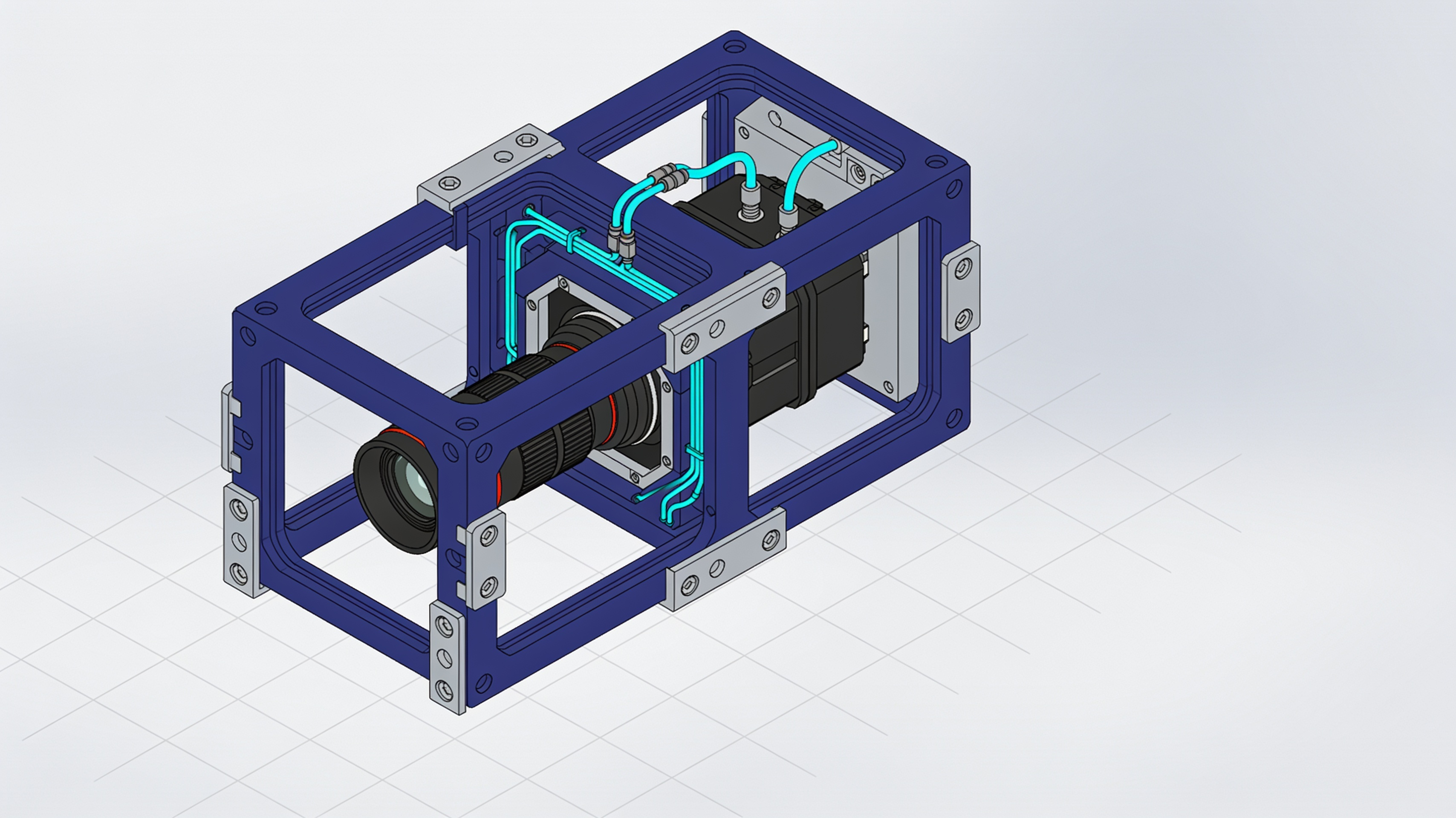
3D Printing for Automotive Crash Tests: Composite Material Solutions for Data Acquisition
Automotive crash tests require equipment capable of withstanding extreme impact forces. The Japanese agency Photron has found in additive manufacturing an effective answer to protect cameras and instrumentation during the tests, collaborating with a specialized German company.
Data loss during crash tests is a critical problem for the automotive industry. Often the damage does not come from the impact itself, but from the inadequate positioning of the measurement equipment.
APS's additive solution
Andy Schaefer, founder of Additive Printing Solutions (APS), has developed a series of 3D printed components that solve specific crash test problems.
Schaefer founded APS five years ago in Germany. Today the company offers design and 3D printing services, as well as workshops on additive manufacturing to train manufacturers in “AM thinking”.
For Photom's needs, APS uses Markforged composite polymer printers and Onyx material. This combination guarantees the durability and mechanical strength required for the extreme environment of crash tests.
- Protective housings for cameras
- Cable adapters of different lengths
- Cable management equipment
Camera housings: maintaining focus
Cameras mounted inside vehicles during crash tests must remain stable to capture clear images at the critical moment of impact.
Tests use small cameras placed under seats or behind the steering wheel to monitor movements. However, the impact can disturb the focus, producing blurry images at the most important moment.
APS has designed housings that can be installed around cameras with cable ties. These components protect the camera and keep it steady, preserving image quality during impact.
Cable adapters: modularity and standardization
The diversity of cable lengths represented a compatibility problem that required flexible solutions without modifying existing housings.
Cameras connect to a data collection console, usually located in the trunk or rear of the vehicle. The camera housings are identical, but the cable connections change based on length.
“If they have a 3-meter or 8-meter cable, they need different adapters,” explains Schaefer. “They don’t want to have to create a new housing for the cameras, so I produce adapters that allow them to always use the same housing.”.
The adapters are disc-shaped and guarantee a reliable connection. Schaefer produces them in three different sizes for the most common cable measurements used by Photron.
3D printing allows the production of components specific to each test configuration without investments in dedicated equipment or warehouse stock.
Cable management: completing the system
In addition to housings and adapters, APS provides equipment to organize and protect the cables that connect the various measurement devices.
The source mentions that APS also produces cable management equipment that integrates the data acquisition system. These components complete the overall solution for crash tests.
Materials and technologies: the choice of Onyx
Markforged's Onyx material combines nylon with short carbon fibers, offering mechanical strength and impact absorption capability.
The choice of material is crucial for applications that must survive high-energy impacts. Onyx guarantees the necessary mechanical properties while maintaining the dimensional precision required for fastening and connection components.
APS's approach demonstrates how additive manufacturing can solve specific problems in critical sectors. The ability to quickly produce customized components reduces development times and improves test reliability.
The collaboration between Photron and APS highlights a growing trend: the use of 3D printing not to produce final vehicle parts, but to create equipment and supports that improve development and validation processes.
article written with the help of artificial intelligence systems
Q&A
What materials are used to 3D print protective housings for crash tests?
To ensure the necessary mechanical strength and durability, APS uses Markforged composite polymer printers employing Onyx material. This combination is ideal for withstanding the extreme impact forces of automotive testing.
Why is it crucial to protect cameras during crash tests?
Cameras must remain stable to capture sharp images at the critical moment of impact, preventing vibrations or displacement from causing blurred photos. The loss of this visual data represents a critical issue for automotive industry analysis.
How does 3D printing solve the problem of varying cable lengths?
The solution involves creating disc-shaped adapters that allow the same camera housing to be used regardless of cable length. This approach ensures modularity and eliminates the need to design new housings for every configuration.
Who developed the additive solutions for Photron's crash tests?
The components were developed by Andy Schaefer, founder of the German company Additive Printing Solutions (APS). The company collaborates with Photron, providing specific design and 3D printing services to protect instrumentation and cameras.
What types of components were produced via additive manufacturing?
Developed applications include protective camera housings secured with zip ties, adapters for cables of different lengths, and dedicated equipment for cable management. These elements ensure the proper functioning of instrumentation during impact.