3D-LINE: 3D printed concrete and plastic for architecture and design
The French company V-Concept, through the brand 3D-LINE, combines 3D printing in concrete and plastic to create innovative solutions in the fields of furniture, design and architecture. President Frédéric Vigier recounts the evolution from plastic processing to additive manufacturing with cementitious materials.
From plastic background to 3D printing in concrete
Frédéric Vigier brings over 20 years of experience in plastic injection molding. His journey towards additive manufacturing with concrete stems from a vision: producing large pieces in small batches while optimizing costs and productivity.
Vigier began to take an interest in 3D printing as early as 2005-2006, when the technology was being hailed as revolutionary. His goal was to use assemblies of plastic resins and mineral fillers to optimize production.
In 2016 he made the decisive leap: replacing resin with concrete. At the time, 3D printing in concrete was not sufficiently developed, forcing him to build everything from scratch.
- Founded in 2017, it operates through the brand 3D-LINE
- Specialization in 3D printing of concrete and plastic for design, furniture and architecture
- Hybrid technology combining cementitious and plastic materials
- Possibility of coextrusion with carbon and glass fibers for structural reinforcement
The birth of 3D-LINE and the company mission
The 3D-LINE brand was born from Vigier's passion for 3D printing and the desire to explore the potential of concrete in furniture design. The core business focuses on the production of concrete furniture made with additive manufacturing.
V-Concept was founded in 2017 as the parent company of the 3D-LINE brand. The company positions itself among the emerging players in the field of 3D concrete printing, particularly in the renewable energy sector.
The company mission is based on the design and production of 3D-printed concrete furniture. This specialization allows serving three main sectors: design, furniture, and architecture.
The integration between concrete and plastic
The peculiarity of 3D-LINE lies in the hybrid approach that combines 3D printing in concrete and plastic. This combination allows exploiting the advantages of both materials in complementary applications.
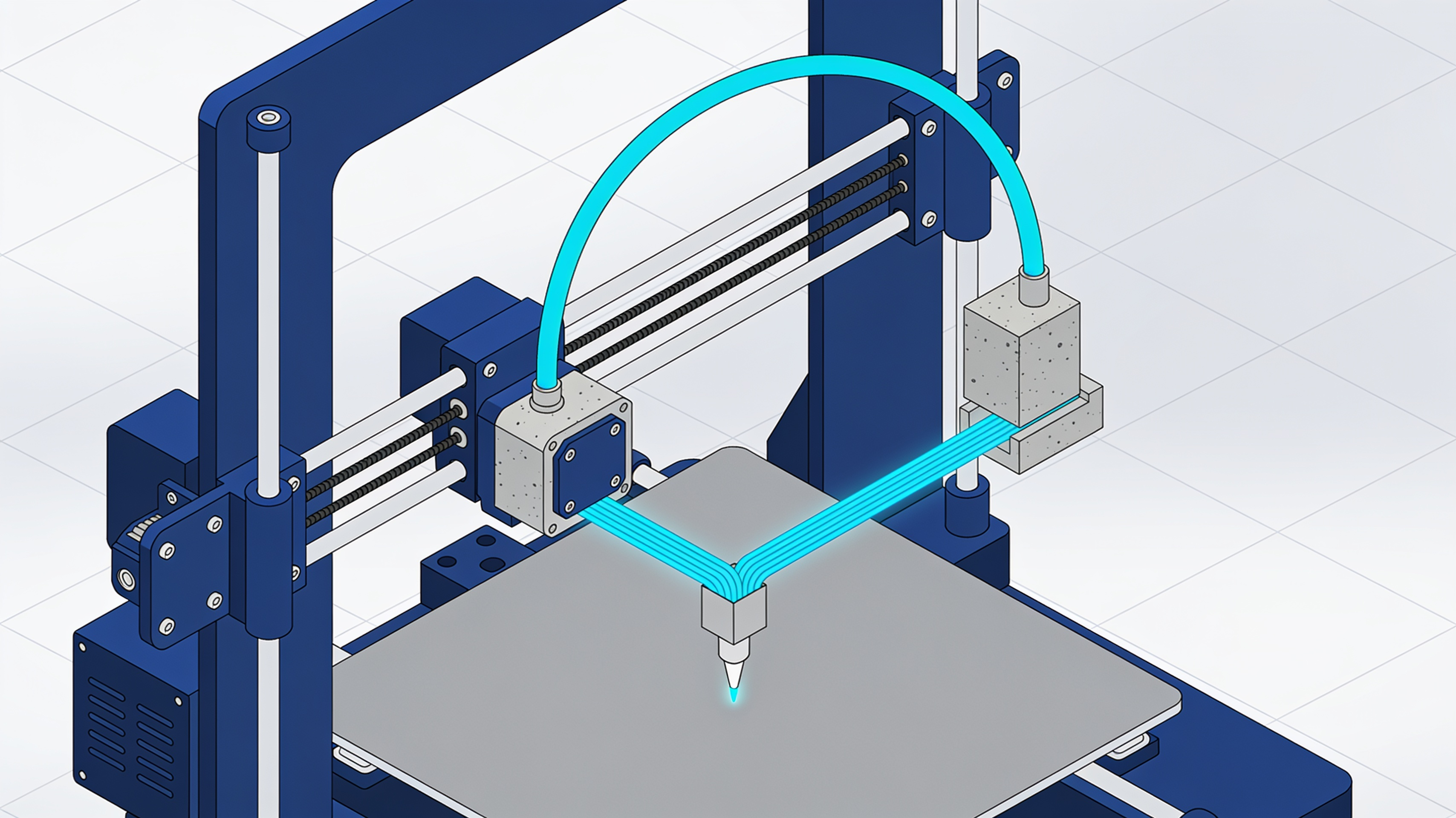
The company uses coextrusion technologies to add continuous fibers during the printing process. This allows integrating carbon fibers or glass fibers as structural reinforcement materials.
The production of large decorative pots represents one of the main use cases. The process is divided into several phases that combine the two printing technologies.
Co-extrusion with continuous fibers improves the mechanical properties of 3D printed components, increasing strength and durability of concrete structures.
Applications in the renewable energy sector
3D-LINE positions itself among the active players in the renewable energy sector, where 3D concrete printing finds specific applications thanks to the ability to create complex and customized structures.
The renewable energy sector benefits from the unique characteristics of additive manufacturing with cement. The ability to produce custom components in small batches proves particularly advantageous.
Vigier's twenty years of experience in injection molding and product industrialization translates into a pragmatic approach to 3D printing. The goal remains the optimization of productivity and cost price.
Future perspectives
The path of 3D-LINE represents an example of how traditional skills in plastic processing can evolve towards innovative applications in additive manufacturing with cementitious materials.
Vigier defines 3D concrete printing as “a formidable challenge” that pushes to explore new perspectives. The company continues to develop applications that open unprecedented opportunities in the field of manufacturing.
The combination of 3D printed cement and plastic offers unique design possibilities for architects and designers. The company's future focuses on expanding these hybrid technologies in the reference sectors.
article written with the help of artificial intelligence systems
Q&A
Who is the founder of V-Concept and what is their background?
The founder is Frédéric Vigier, who boasts over 20 years of experience in plastic injection molding. His journey has taken him from plastic processing to additive manufacturing with cementitious materials.
When was V-Concept founded and under which brand does it operate?
V-Concept was founded in 2017 as a parent company. The business operates specifically under the 3D-LINE brand, specializing in hybrid solutions for design.
What reinforcement materials does 3D-LINE's technology use?
The company employs co-extrusion technologies to integrate continuous fibers during printing. Specifically, carbon fibers and glass fibers are used to ensure structural reinforcement of the parts.
In which key sectors does the 3D-LINE brand operate?
The company's mission focuses on producing furniture and components for three key sectors: design, furnishings, and architecture. This approach enables the creation of large-scale pieces in small batches.
How did the printing technology used by Vigier evolve?
After becoming interested in 3D printing for resin assemblies in 2005-2006, Vigier decided in 2016 to replace resin with cement. He had to develop the technology from scratch, as concrete printing was not yet mature.