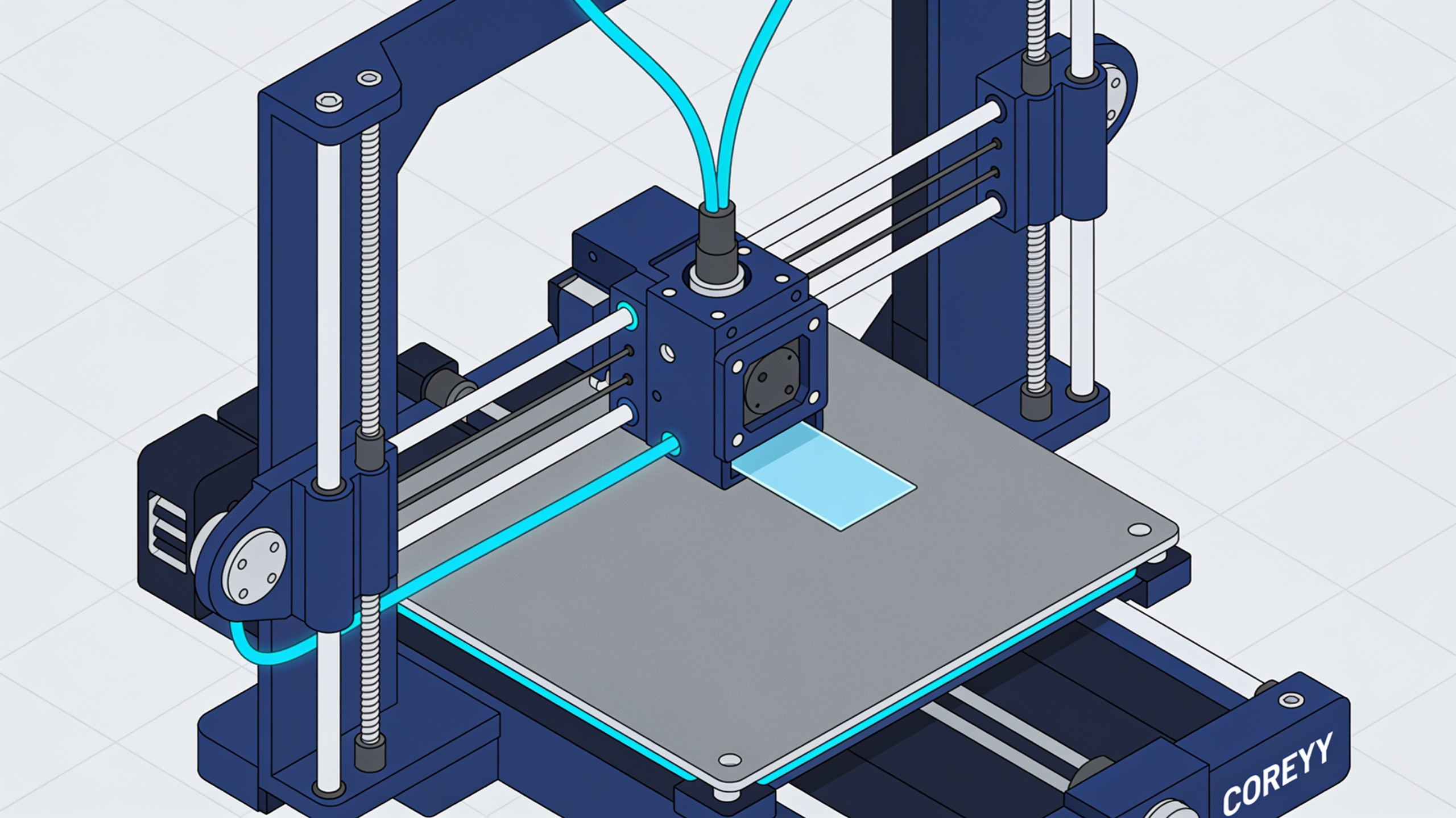
Rat Rig V-Core 4.1: automatic nozzle cleaning for more precise True Zero calibration
Automatic Z-axis calibration is one of the most critical steps in preparing a 3D print. Maker Noizie Works has developed a solution to improve the reliability of the True Zero system on the Rat Rig V-Core 4.1 printer, integrating a software-controlled automatic nozzle cleaning device.
- Printable bracket with silicone nozzle wiper insert for Rat Rig V-Core 4.1
- Klipper macro for automatic cleaning before True Zero calibration
- Solution adaptable to other CoreXY printers with parameter modifications
- Nozzle residues can alter calibration by up to 0.1 mm
The problem: residues compromising calibration
The precision of the True Zero system depends on the cleanliness of the nozzle tip. Even small residues can falsify the Beacon sensor measurements.
The Rat Rig V-Core 4.1 uses the Beacon sensor with the Beacon Contact function to determine the exact position of the nozzle relative to the print bed. The system detects physical contact between the metal tip of the nozzle and the surface.
RatOS implements a function called Beacon True Zero Correction that performs multiple measurements to compensate for local surface variations. The system analyzes six points distributed around the reference position and applies a statistical method to calculate a more stable correction.
RatOS documentation states that measurements taken on points separated by only one millimeter can differ by up to 0.1 millimeters on textured PEI sheets. A significant variation when compared to a standard first layer of 0.2 millimeters.
The True Zero system assumes that the first element to contact the bed is the metal part of the nozzle. A drop of molten material can come into contact first, compress during the measurement, or adhere to the surface, generating a Z reference higher than the real value.
The solution: printable bracket and Klipper macro
Noizie Works has designed a system consisting of printable hardware and software to automate nozzle cleaning before each calibration.
The hardware component consists of a 3D-printed bracket that houses a silicone nozzle cleaning pad produced by QIDI Tech. The bracket is specifically designed for the Rat Rig V-Core 4.x series.
Control is handled through a Klipper macro that manages the automatic cleaning sequence. The system can be integrated into the standard workflow before executing the True Zero calibration.
Adaptability to other platforms
The system logic can be transferred to other CoreXY printers, but requires modifications to machine-specific parameters.
Noizie Works specifies that the project is adaptable to other CoreXY printers by modifying coordinates, movement spaces, and safety parameters. The solution is not limited to the Rat Rig ecosystem, but requires technical skills for adaptation.
The modular approach separates the mechanical component (bracket and insert) from the software logic (Klipper macro), facilitating the necessary modifications for different hardware configurations.
Why contact calibration requires more attention
Systems that use physical contact of the nozzle are more sensitive to the presence of residues than traditional proximity sensors.
Unlike systems that only measure the distance between a sensor and the metal bed, contact calibration determines the exact point where the nozzle tip reaches the print surface. This superior precision requires optimal conditions to ensure reliable measurements.
The multi-point strategy implemented by RatOS compensates for surface variations, but cannot correct systematic errors caused by residues on the nozzle. Automatic cleaning eliminates this variable before the calibration process begins.
Implications for the print workflow
The integration of automatic cleaning reduces manual interventions and improves the repeatability of calibrations.
The system proposed by Noizie Works fits into the trend towards full automation of the print preparation process. By eliminating the need for manual nozzle cleaning, it reduces the risk of human error and standardizes the procedure.
For users who perform consecutive prints or use the printer in production environments, the solution represents a significant improvement in terms of reliability and consistency of results.
Rat Rig V-Core 4.1 automatic nozzle cleaning improves True Zero calibration – 3D Printing
article written with the help of artificial intelligence systems
Q&A
Why is nozzle cleaning critical for the True Zero system?
The True Zero system relies on physical contact between the nozzle's metal tip and the print bed. Molten material residues can touch the surface before the metal, skewing Z measurement by up to 0.1 mm.
What does the solution developed by Noizie Works consist of?
The solution integrates a 3D-printable bracket housing a silicone nozzle wiper insert and a dedicated Klipper macro. This system automates nozzle cleaning immediately before calibration.
Which hardware component is used to clean the nozzle?
The system uses a silicone nozzle wiper insert produced by QIDI Tech, housed in a printable bracket specifically designed for the Rat Rig V-Core 4.x series.
How does True Zero correction work on RatOS?
RatOS performs multiple measurements at six points distributed around the reference position using the Beacon Contact sensor. It then applies a statistical method to compensate for local surface variations.
Is the solution compatible with printers other than the V-Core 4.1?
Yes, the system logic is adaptable to other CoreXY printers, but requires modifications to bracket parameters and the macro to fit specific dimensions and hardware configurations.