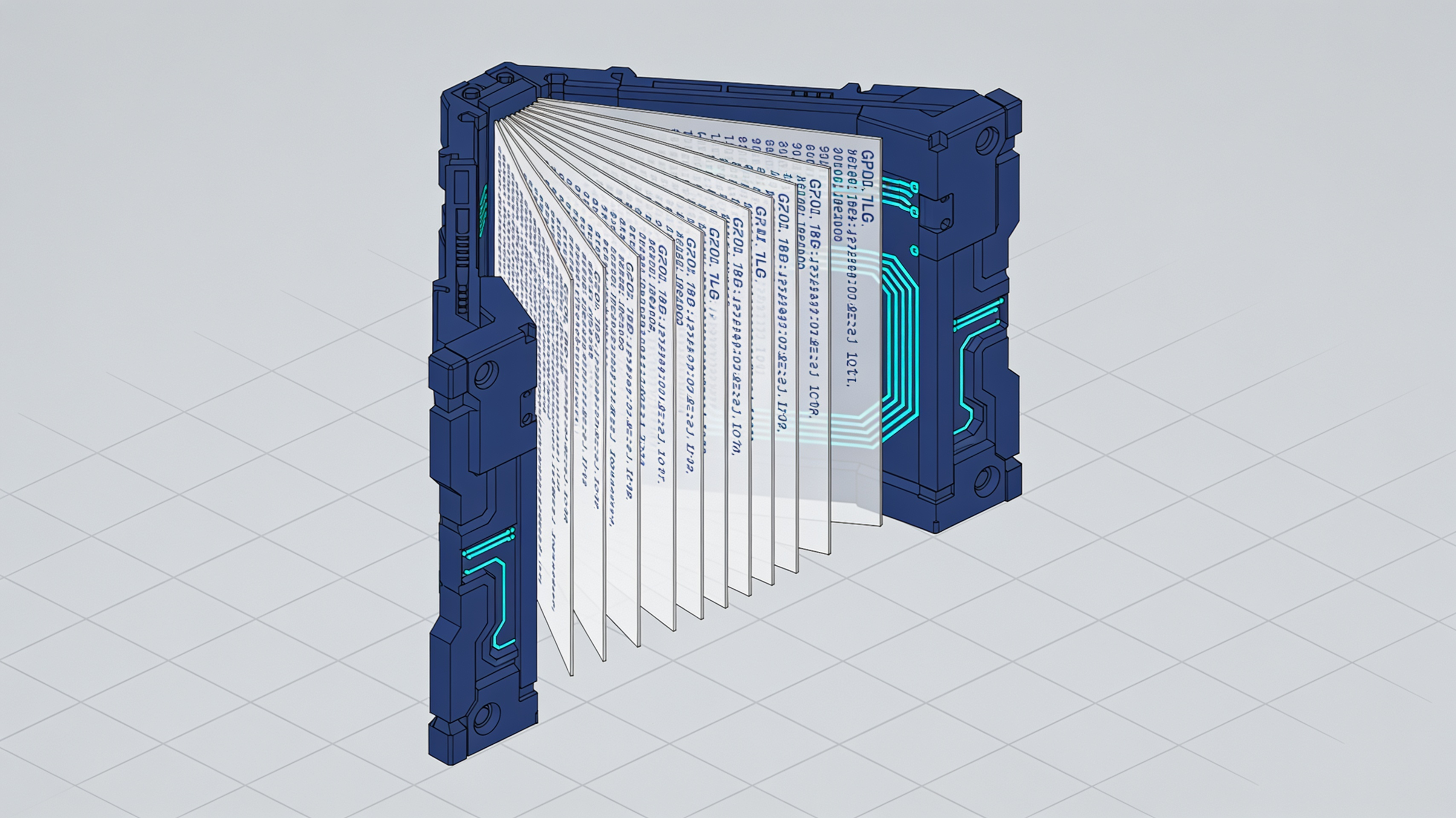
A book that prints itself: Manual and the G-code embedded in its pages
Manual is a 3D-printed book that contains the machine code used for its own production. Made in TPU with an innovative printing method, it represents a radical experiment on the limits of additive manufacturing applied to publishing.
Designers Darius Ou and Benson Chong have created through the Hyperpress research project an object that challenges conventions: a 26-page book in which the text is not narrative, but pure G-code. Looking closely at the pages, one discovers the machine language that controlled the printer during production.
- Manual is printed entirely in TPU, a flexible material difficult to work with in thin layers
- The XY-for-Z method prints the pages vertically, not flat, eliminating post-processing
- Only 2,5% of the total G-code is reported on the pages due to the resolution limits of FFF printing
- It is the sixth book of Hyperpress, but the first with text integrated into the structure of the sheet
A challenging material for an unprecedented result
Thermoplastic polyurethane has never been considered a publishing material. Printing it to paper-like thicknesses required months of experimentation.
Manual is made entirely of TPU, a thermoplastic elastomer known for its flexibility. Obtaining thin and manageable pages required numerous tests to balance three critical parameters: flexibility, durability, and print quality.
The designers faced a fundamental limitation: how small the text could be while remaining legible. The resolution of fused filament fabrication (FFF) printing is not yet fine enough to reproduce microscopic characters on flexible surfaces.
The XY-for-Z method: printing pages vertically
Instead of building layer by layer from the bottom, Hyperpress prints the pages edge-on, keeping them vertical throughout the process.
The book was produced with a Bambu Lab printer using Hyperpress's proprietary XY-for-Z method. The print head works vertically and horizontally to build the pages on their edge, not flat.
This orientation makes possible double-sided pages with readable text on both sides. The entire book – pages, cover, and binding – detaches from the print bed as a single continuous block already finished.
For the first time in a 3D printing project of this complexity, no post-processing phase is foreseen.
Printing tall and narrow walls in TPU held vertically generates deformations during the process. Hyperpress has developed “deckle edge supports” that temporarily connect adjacent pages, stabilizing them during printing.
Frayed edges: a defect that becomes aesthetics
Temporary supports leave visible traces once removed. The result resembles the irregular edges of handmade paper.
Once printing is complete, the deckle edge supports are removed manually. They leave a rough, torn-looking edge, an unintentional reminder of the frayed edges of ancient handmade paper books.
This aesthetic detail was not planned. It emerged as a direct consequence of the production method.
Text as structure, not as decoration
Manual is Hyperpress's sixth book, but the first in which the writing is part of the physical structure of the sheet.
In Hyperpress's previous projects, the text was printed as a separate layer superimposed on the pages. In Manual, the letters are integrated into the very structure of the material.
This approach represents a significant evolution in the project's research. The text is no longer an applied element, but a constitutive one.
The limits of current technology
Only a minimal fraction of the total G-code can be printed on the pages. The FFF resolution is not yet sufficient to contain the entire code.
The manual reports only 2.51% of the G-code used for its production. Hyperpress attributes this limit to the current constraints of fused filament printing.
Today's print resolution is not fine enough. The text must maintain a minimum size to remain legible. Combining these two constraints, the available space on the 26 pages is not enough to contain the entire code.
| Parameter | Value/Detail |
|---|---|
| Material | TPU (thermoplastic polyurethane) |
| Number of pages | 26 |
| Printing method | XY-for-Z (Hyperpress) |
| Printer | Bambu Lab |
| Printed G-code | 2.5% of the total |
| Post-processing | None |
Implications for additive manufacturing
Manual demonstrates that 3D printing can produce complex and functional objects in a single session, without subsequent assembly or finishing.
The project pushes the boundaries of FFF printing beyond conventional applications. It demonstrates that flexible materials can be processed with sufficient precision to create delicate and functional objects.
The complete elimination of post-processing represents a significant milestone. It reduces time, costs, and margins of human error in the production process.
Manual is not a commercial product, but a research experiment. However, the techniques developed to create it could find applications in sectors where customization and on-demand production are critical: medical prosthetics, customized components, intelligent packaging.
article written with the help of artificial intelligence systems
Q&A
What material is the Manual book made of?
The Manual book is entirely made of TPU (thermoplastic polyurethane), an elastomer known for its high flexibility. This material required months of experimentation to be printed at paper-like thin thicknesses.
What is the textual content of the Manual book pages?
The book's 26 pages do not contain a traditional narrative but display the G-code used by the printer for its own production. Due to FFF resolution limits, only 2.5% of the total code is visible on the pages.
What does the XY-for-Z printing method consist of?
The XY-for-Z method developed by Hyperpress allows printing pages vertically on their edge instead of flat layer by layer. This technique enables a finished object with legible front-and-back text without any post-processing.
Is post-processing required to complete the Manual book?
No, thanks to the vertical orientation during printing, the entire book including pages, cover, and binding detaches from the print bed as a single continuous finished block. This completely eliminates any manual post-processing steps.
Which printer was used to realize the project?
The book was produced using a Bambu Lab printer configured with Hyperpress studio's proprietary XY-for-Z method. The machine handled the complexity of printing tall, narrow walls in flexible material.