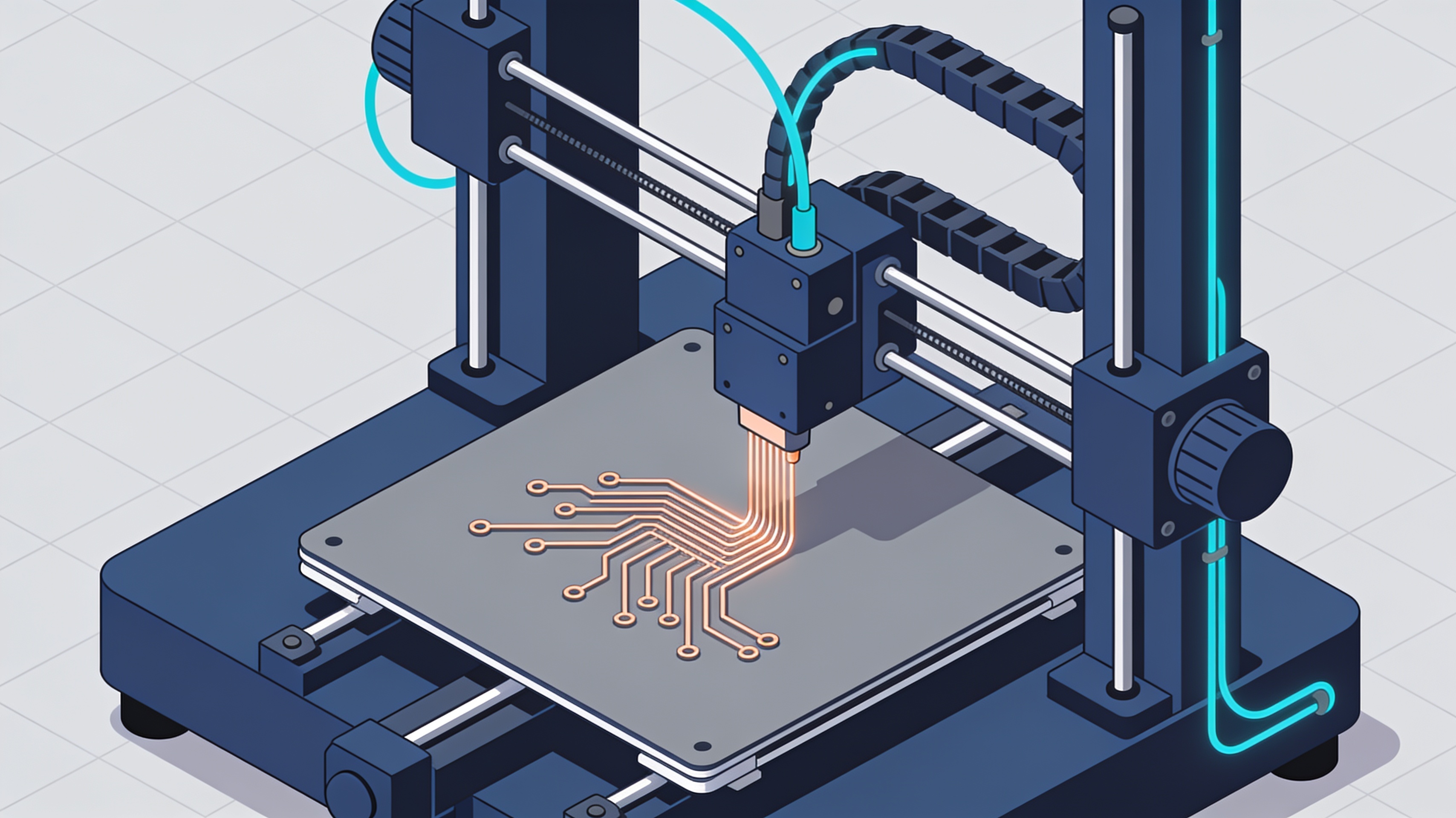
Kupros launches Cu29, the conductive copper filament for desktop FDM printers
The American startup Kupros has developed Cu29, a fully metallic and conductive filament that can be printed on standard FDM 3D printers. The material, defined as “impossible” by some industry experts, has already collected pre-orders from NASA, Boeing and Northrop even before entering production.
Founder Ian Ramsdell faced strong initial skepticism. An expert had told him categorically: “Copper cannot be 3D printed, it will never be 3D printed.” But Ramsdell was already working from a confirmed laboratory experiment.
From the Navy to the commercial market
The technology behind Cu29 originates from military research and aims to integrate conductive electronics directly into printed components.
The technology comes from a US Navy laboratory. Ramsdell attributes the development to scientist Carson Holmes, at the time a technician on additive electronics systems from Optomec, Nano Dimension and nScript.
Those machines cost seven-figure sums and used silver inkjet chemistry. They had concrete limitations related to the porosity of the conductive traces.
- Cu29 is a pure copper filament printable on standard desktop FDM hardware
- NASA, Boeing, and Northrop paid in advance for priority access to the material
- The technology stems from US Navy research on additive electronics
- Tested on common platforms like Bambu Lab A1 Mini and Prusa XL
Pre-orders before production
The market validated the product with concrete financial commitments before it was commercially available.
Kupros was selected as a finalist for the Army xTech at the DMC 2022 conference in Tampa. Ramsdell returned from the event with prepaid orders from three giants: NASA, Northrop, and Boeing.
Other pre-sales came from KBR, US Army DEVCOM, and several universities. “They were willing to pay me in advance to have priority access to the material as soon as it came out of production,” the founder recounts.
Applications beyond printed circuits
The ambition goes beyond simply replacing traditional PCBs, aiming for integrated sensors and conformal conductive geometries.
Cu29 allows creating conductive paths that follow the three-dimensional geometry of a part. They are no longer limited to flat boards.
Applications include integrated sensors, embedded signal routing, and conformal antennas. In the aerospace and defense sectors, the proposal is concrete: fewer cables and connectors, sensors for structural health monitoring integrated into load-bearing components.
Cu29 can be printed on standard desktop FDM machines, breaking down the economic barrier of previous technologies that required systems costing millions of dollars.
Compatible hardware
The material has been tested on consumer and professional platforms already widespread in the market.
Kupros has validated Cu29 on common printers. Among the tested models are the Bambu Lab A1 Mini and the Prusa XL, the latter recommended by the company itself.
This compatibility with hardware already present in most workshops eliminates the need for investments in specialized machinery. The approach democratizes access to 3D printed electronics.
Faster iterations
The ability to evolve electrical and mechanical design in parallel accelerates development cycles.
The competitive advantage is not only in the material's functionality. Cu29 enables faster iterations thanks to the parallel evolution of electrical and mechanical design.
“The fact that someone has been told that something is impossible does not mean it cannot be done,” concludes Ramsdell. A philosophy that has turned widespread skepticism into pre-orders from some of the most demanding organizations in the world.
article written with the help of artificial intelligence systems
Q&A
What is Kupros Cu29 filament?
Cu29 is a fully metallic, conductive pure copper filament developed by the American startup Kupros. It is designed to be printed on standard desktop FDM 3D printers, a feature considered impossible by many industry experts.
Which major companies have pre-ordered Cu29?
Even before commercial production began, giants like NASA, Boeing, and Northrop placed paid pre-orders to secure priority access to the material. KBR, US Army DEVCOM, and several universities have also confirmed similar purchases.
Where does the technology behind Cu29 originate?
The technology stems from military research conducted in a US Navy laboratory, developed by scientist Carson Holmes. The goal was to overcome the porosity and cost limitations of silver inkjet machines previously used for additive electronics.
What are the main applications of printable copper Cu29?
The material enables the creation of conductive pathways following complex three-dimensional geometries, going beyond traditional flat printed circuits. Applications include integrated sensors, conformal antennas, and structural health monitoring in the aerospace and defense sectors.
Which 3D printers can be used with Cu29?
The filament has been tested and works on standard, commercially available desktop FDM hardware. Specific platforms mentioned in the text include the Bambu Lab A1 Mini and the Prusa XL.