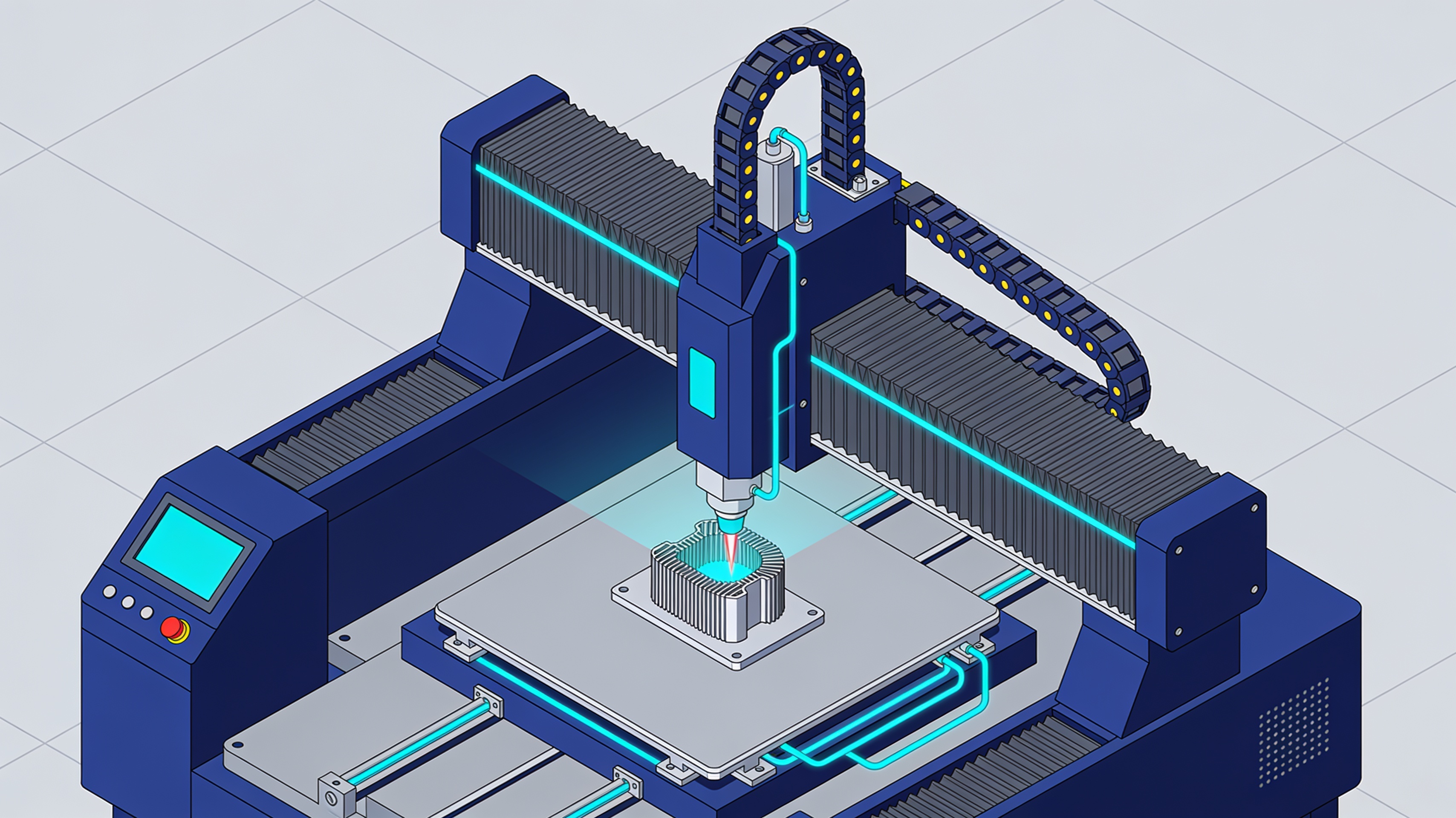
Dewu Technology raises capital for metal 3D printing of microcomponents
A Chinese startup aims to drastically reduce post-processing costs in high-precision metal additive manufacturing, raising tens of millions of yuan.
Suzhou Dewu Technology Co., Ltd. has completed a Pre-A financing round of several tens of millions of yuan. The Chinese company, founded in May 2024 in Suzhou, focuses on high-precision metal additive manufacturing for small-sized components.
The transaction involves the participation of GSR United Capital (Jinsha River United Capital) and Jintou Zhiyuan. The funds raised will be allocated to the development of ultra-high-precision SLM (Selective Laser Melting) equipment, the expansion of production lines, and commercial activities.
An integrated business model
Dewu Technology does not limit itself to selling printers, but builds a complete offering that covers the entire value chain of metal additive manufacturing.
The company is developing an ecosystem that includes equipment, manufacturing processes, software-assisted design, simulation, parameter optimization, and contract manufacturing. This integrated strategy aims to solve the specific challenges of small metal components.
Target markets include consumer electronics, medical devices, aerospace, and thermal management. In these sectors, the main challenge is not geometric complexity, but precision, surface finish, repeatability, and overall cost.
- Consumer electronics
- Medical devices
- Aerospace
- Thermal management
The post-processing problem
Post-print processing represents the most significant cost item in the production of metal microcomponents, a bottleneck that Dewu Technology intends to overcome.
According to founder Wang Zhou, post-processing of components produced with conventional SLM systems can account for approximately 70% of the total cost in the company's target applications. This includes support removal, grinding, CNC machining, polishing, heat treatments, and surface finishing.
For small components, these operations become particularly critical. The smaller the part, the more difficult it is to perform machining without damaging details, thin walls, microholes, or internal geometries.
Dewu Technology claims it can significantly reduce these costs through its optimized process. The approach combines high-precision hardware with advanced software tools, including CFD fluid dynamics simulation and machine learning.
In traditional metal additive manufacturing of microcomponents, post-processing can account for up to 70% of the total cost of the finished part, making the technology uncompetitive compared with traditional processes.
Technology and strategic partnerships
The company develops its technology in collaboration with leading Chinese research institutions, focusing on the integration of advanced hardware and computational optimization.
Dewu Technology collaborates with Suzhou National Laboratory, Shanghai Jiao Tong University, and Northwestern Polytechnical University. These partnerships support the development of solutions that integrate machine learning and CFD fluid dynamics simulation into printing processes.
The goal is to optimize process parameters to obtain components that require minimal downstream processing. This approach differentiates Dewu Technology from traditional metal 3D printer manufacturers, which focus mainly on selling hardware.
Competitive landscape
The Chinese metal 3D printing market sees the presence of established players, but Dewu Technology is targeting a specific high-value-added niche.
The competitive landscape includes companies such as Farsoon Technologies, an established manufacturer of industrial LPBF systems, and BLT, a fast-growing company with partnerships in the consumer electronics sector. Dewu Technology positions itself in a specific segment: microscopic high-precision metal components with minimized post-processing.
The choice to focus on microcomponents represents a differentiation strategy in an increasingly competitive market. Success will depend on the ability to keep cost-reduction promises and on the speed of penetration into target markets.
article written with the help of artificial intelligence systems
Q&A
How much did Dewu Technology raise in the Pre-A round?
The Chinese startup completed a Pre-A funding round, raising several tens of millions of yuan. Funds will come from investors such as GSR United Capital and Jintou Zhiyuan.
What is the main goal of Dewu's technology?
The company aims to drastically reduce post-processing costs in metal additive manufacturing for micro-components. The focus is on precision, surface finish, and repeatability for small-sized parts.
What percentage of the cost does post-processing represent according to Dewu?
According to founder Wang Zhou, post-processing can account for approximately 70% of the total cost in conventional SLM systems for target applications. This includes support removal, CNC machining, and finishing.
In which sectors do Dewu Technology's solutions operate?
Target markets include consumer electronics, medical devices, aerospace, and thermal management. In these areas, the main challenge involves machining very small metal components.
What does the ecosystem offered by Dewu Technology include?
The offering covers the entire value chain, including equipment, manufacturing processes, design software, simulation, and contract production. The approach integrates high-precision hardware with machine learning tools.