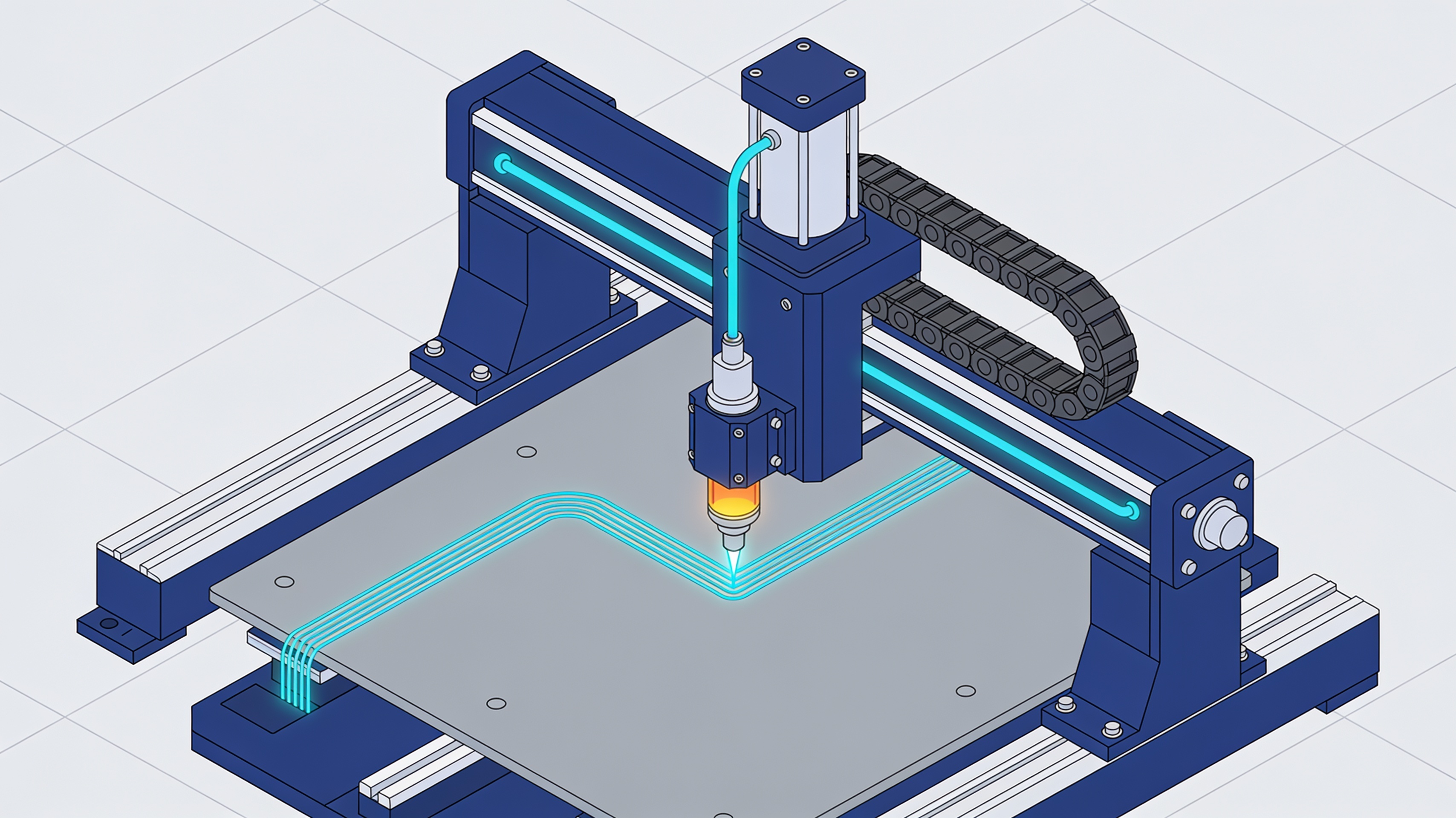
4D liquid crystal actuators: 3D printing that programs movement
Korean and US researchers have developed a 3D printing method that controls the molecular orientation of liquid crystal elastomers during deposition. The result: soft structures that expand or contract when heated, with the behavior programmed directly during the printing phase.
The collaboration between Pusan National University in South Korea and Oak Ridge National Laboratory (ORNL) in the United States has produced a significant advancement in 4D printing. The study, led by Professor Suk-kyun Ahn, was published on July 10, 2026, in Nature Communications under the title “Alignment switching in 3D-printed smectic liquid crystal elastomers”.
- Control of molecular orientation during 3D printing of liquid crystal elastomers (LCE)
- Programming movement through temperature and deposition speed
- Applications in soft robotics and shape-memory materials
From geometry to programmed function
The new approach is not limited to building three-dimensional shapes, but incorporates into the structure itself the instructions on how to deform in response to thermal stimuli.
Liquid crystal elastomers are materials studied for years for actuation systems and soft robotics. The innovation of the research team lies in the ability to modify molecular orientation using parameters of the printing machine itself.
Temperature and deposition speed become programming tools. A printed part is not just a three-dimensional object: it contains encoded information about its future behavior when exposed to heat.
How liquid crystal elastomers work
These materials combine the deformability of elastomers with the ordered molecular structure of liquid crystals, creating a basis for programmable actuators.
LCEs possess elongated molecular units called mesogens. Their orientation directly influences the mechanical behavior of the material.
When the molecular order changes with temperature, macroscopic dimensions also change. A properly oriented LCE can shorten along one direction and expand along the perpendicular one.
Liquid crystal elastomers (LCEs) combine elasticity and molecular order. This dual nature allows controlled deformations in response to external stimuli such as heat.
Programming movement during printing
Deciding the molecular orientation during manufacturing is equivalent to programming the future movement of the component, turning 3D printing into a functional encoding process.
The method developed by the researchers allows controlling where and how to place these molecular orientations. This control is achieved by modifying process parameters during material deposition.
The possibility of varying the molecular alignment layer by layer opens up application scenarios in soft robotics. Complex structures can be designed to perform specific movements when thermally activated.
Application prospects
Potential applications range from actuation systems to shape-memory materials, sectors where precise control of deformation is crucial.
Soft robotics represents one of the most promising fields. Actuators that change shape in response to heat can simplify the design of flexible and adaptable robots.
Shape-memory materials constitute another area of interest. Components that return to predefined configurations after deformation find use in medical devices, aerospace, and automation.
The publication in Nature Communications confirms the level of innovation achieved. Controlling molecular orientation through printing parameters represents a step forward in additive manufacturing of smart materials.
article written with the help of artificial intelligence systems
Q&A
Who developed the new 3D printing method for LCE actuators?
The research is a collaboration between Pusan National University in South Korea and Oak Ridge National Laboratory in the United States. The study was led by Professor Suk-kyun Ahn.
How is movement programmed in 3D-printed structures?
Movement is programmed by controlling the molecular orientation of liquid crystal elastomers directly during the deposition phase. The key parameters used are temperature and printing speed.
What is the physical principle behind the operation of LCEs?
LCEs combine the deformability of elastomers with the molecular order of liquid crystals. When temperature changes, the molecular order shifts, causing macroscopic expansion or contraction of the material.
Where was the study on smectic liquid crystal elastomers published?
The study titled 'Alignment switching in 3D-printed smectic liquid crystal elastomers' was published in the journal Nature Communications. The indicated publication date is July 10, 2026.
What are the main applications of this 4D printing technology?
Primary applications include soft robotics and the creation of shape-memory materials. These structures can perform complex movements in response to thermal stimuli without needing external motors.