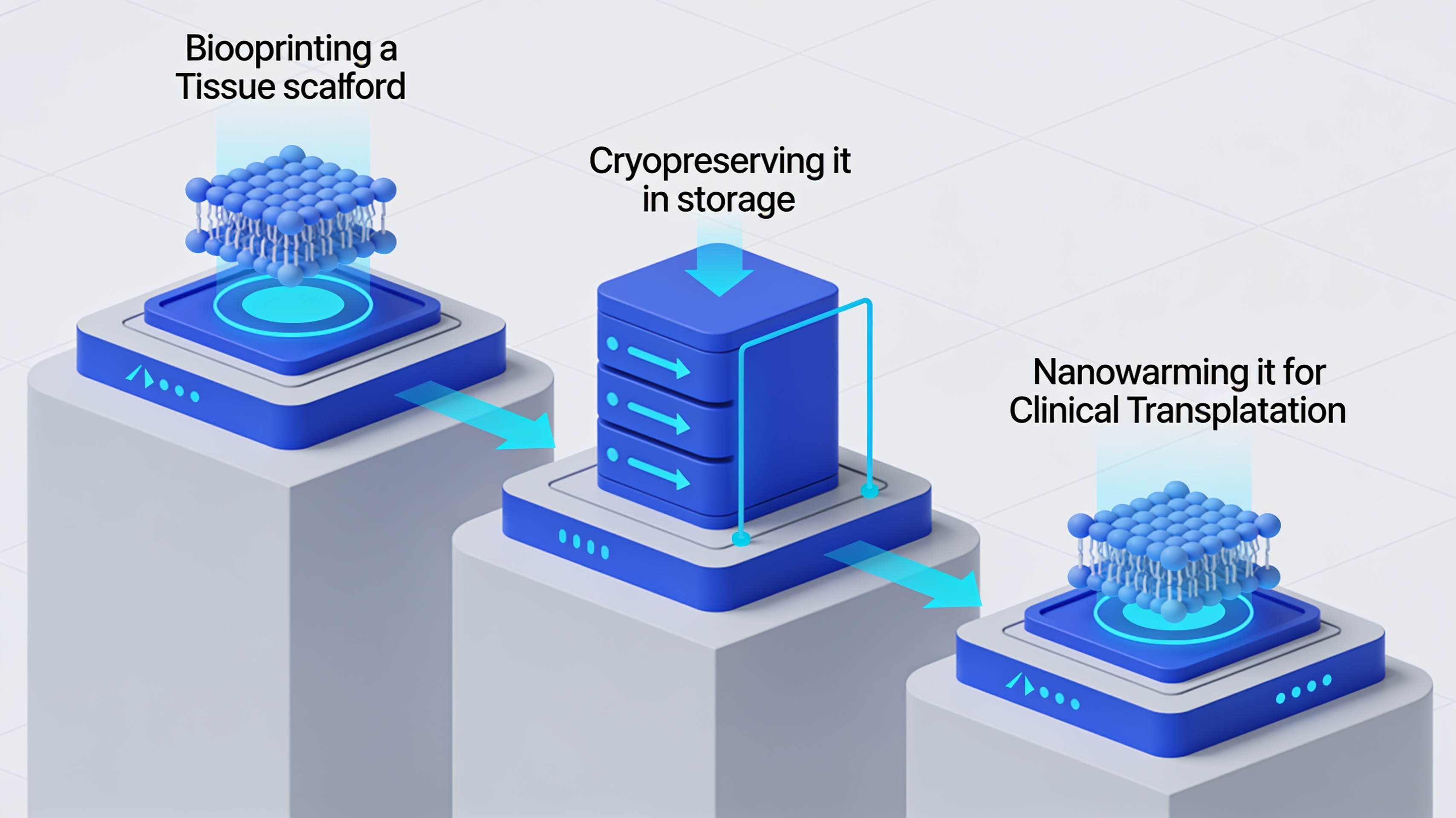
Bioprinting and cryopreservation: towards a supply chain for biological tissues
The convergence between 3D printing of biological tissues and cryogenic preservation technologies is paving the way for a possible logistics chain for living materials. The goal is not yet to produce complete organs ready for transplantation, but to separate the moment of production from that of clinical use.
Companies like Organovo, CELLINK (part of the BICO group) and Aspect Biosystems are developing technologies that could transform regenerative medicine into a process more similar to industrial manufacturing.
- Bioprinting, cryopreservation and nanowarming form the components of a future biological supply chain
- The goal is to separate the place and time of production from the clinical use of tissues
- Cryogenic preservation could eliminate the time pressure that limits current transplants
The problem of time pressure
Transplant medicine operates under time constraints that no traditional logistics can solve. Cryopreservation could change this paradigm.
A donor heart or lung must reach the recipient within a few hours. Even kidneys, which are more resistant, can only be preserved for tens of hours.
This limitation affects the entire system. Medical compatibility is not enough: immediate coordination, short distances, and available operating rooms are needed. Every variable increases the risk of losing the organ.
In the industrial sector, a component is produced, stored for months, transported, and installed when needed. Biological organs do not have this temporal freedom.
From production to preservation
Bioprinting technologies are reaching sufficient levels of complexity for functional tissues. The next problem is keeping them viable over time.
Bioprinting uses bioinks formulated to transport and support cells during three-dimensional printing. Companies like CELLINK have developed dedicated platforms, while Aspect Biosystems applies microfluidic techniques for more complex structures.
Organovo was a pioneer in the commercialization of 3D-printed human tissues. But producing a three-dimensional tissue is only the first step.
Cryopreservation represents the second critical element. Preserving complex tissues at cryogenic temperatures without damaging cells requires advanced techniques such as vitrification, which prevents the formation of ice crystals.
Specific approach to preserve biological material without ice formation, essential for maintaining cellular integrity during cryogenic preservation.
The role of nanowarming
Freezing a tissue is relatively simple. Thawing it without destroying it is the real technical challenge.
The University of Minnesota has explored nano-heating technologies that use magnetic nanoparticles to warm tissues from within. This method, called nanowarming, enables uniform and rapid thawing.
Jennifer Lewis, a professor at Harvard's Wyss Institute, developed the SWIFT technology that integrates these approaches. The system combines bioprinting, perfusion, and preservation techniques into a coordinated workflow.
Toward biological logistics
A supply chain for biological tissues would separate production from use, introducing quality controls and scheduled distribution.
Biological material could be prepared in advance, subjected to verification, stored, and distributed according to clinical needs. This temporal separation would radically change the approach to transplants.
These are not yet warehouses of complete organs. Current bioprinted tissues are relatively simple structures: cardiac patches, skin fragments, vascular segments. But the direction is set.
Digital traceability, already standard in industrial additive manufacturing, would also become essential for biological tissues. Each batch would require complete documentation: printing parameters, bioink composition, storage conditions, cell viability tests.
Industrial prospects
The technologies exist separately. Integration into a functioning supply chain still requires development and clinical validation.
BICO, through CELLINK, already provides bioprinting platforms used in research centers. Aspect Biosystems works on tissues with integrated vascular architectures. Organovo continues to develop tissue models for pharmacological testing.
The transition from research applications to a real biological supply chain will require standardization, regulatory validation, and dedicated infrastructure. But the fundamental technological components are converging.
Regenerative medicine is approaching the logic of industrial production. It is no longer science fiction; it is complex engineering under development.
article written with the help of artificial intelligence systems
Q&A
What is the main goal of combining bioprinting and cryopreservation?
The goal is not yet to produce complete organs ready for immediate transplantation, but to separate the production phase from clinical use. This allows biological tissues to be treated as storable industrial components.
Which companies are developing technologies for this new biological supply chain?
Companies like Organovo, CELLINK (part of the BICO group), and Aspect Biosystems are actively developing these solutions. They aim to transform regenerative medicine into a process similar to industrial manufacturing.
Why is cryopreservation crucial for organ transplants?
Currently, organs like hearts and lungs must be transplanted within a few hours, creating strong logistical constraints. Cryopreservation would eliminate this time pressure, allowing storage and transport without risks of immediate deterioration.
What is vitrification in the context of tissue preservation?
Vitrification is an advanced cryopreservation technique that prevents the formation of ice crystals harmful to cells. This approach is essential to maintain cellular integrity during cooling to cryogenic temperatures.
What role do bioinks play in the described bioprinting process?
Bioinks are materials specifically formulated to carry and support cells during the three-dimensional printing of tissues. They represent the critical first step before preservation technologies like vitrification come into play.