Continuous Composites vs Anisoprint: legal battle over composite 3D printing patents
A lawsuit for infringement of ten US patents brings intellectual property in additive manufacturing with continuous fibers into the spotlight. At the center of the dispute: fundamental technologies and development margins for alternative systems.
Continuous Composites, Inc. (CCI) has initiated legal action against Anisoprint S.a.r.l. and Anisoprint 3D Printing Technology (Suzhou) Limited, companies operating under the Fibre Seek brand. The lawsuit was filed with the United States District Court for the District of Delaware.
The accusation concerns the alleged infringement of ten US patents that would protect fundamental technologies for the additive manufacturing of composite components reinforced with continuous fibers. Among the contested products is the FibreSeeker 3 printer, marketed by Fibre Seek.
The infringements indicated by Continuous Composites represent allegations made by the plaintiff. There is no court decision yet that has established the infringement of the contested patents.
What do the ten contested patents protect?
The patents at the center of the dispute would cover various aspects of additive manufacturing of structural composites, not individual marginal machine components.
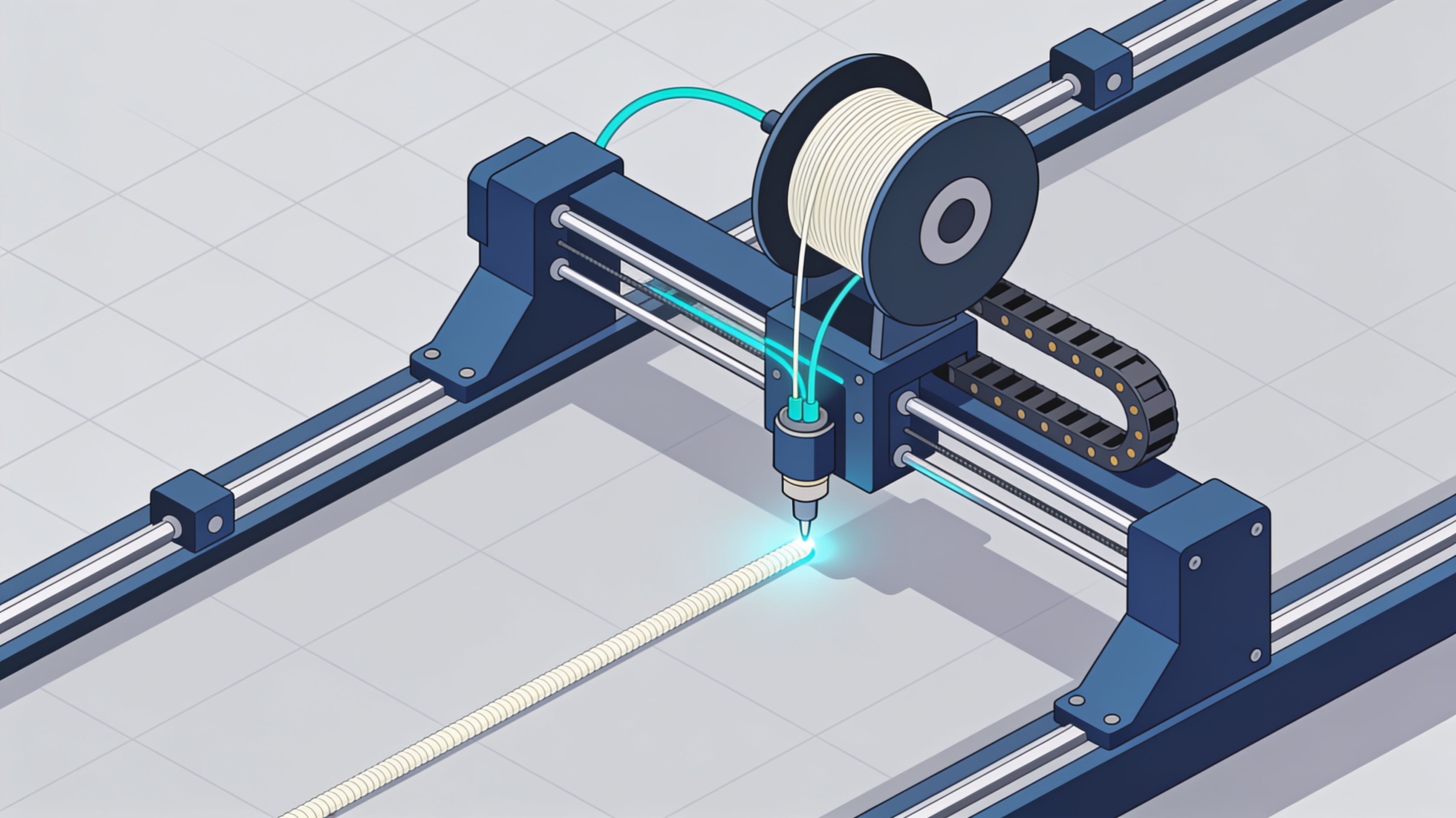
According to Continuous Composites, the cited patents concern the principle of combining a polymeric material with reinforcing fibers that remain continuous for a significant part of the path within the component. The fibers are not fragmented into small segments, as occurs with short-fiber filled materials.
The arrangement of the fibers can be designed according to the stresses that the part will have to withstand. This characteristic represents the main advantage of continuous fiber printing compared to the extrusion of filaments loaded with short fibers.
- Short fiber: carbon, glass, or other reinforcement particles dispersed within the polymer
- Continuous fiber: structural paths in which the reinforcement crosses extended portions of the component
- Advantage: directional control of the reinforcement based on mechanical stresses
The technical parameters under patent protection
To obtain components with continuous fibers, numerous process parameters must be controlled. These very controls would be the subject of the claimed patent protection.
The contested patents would cover aspects such as fiber feeding, polymer impregnation, controlled deposition, and fiber path management. These elements constitute the process chain that distinguishes professional composite 3D printing from simpler systems.
The ability to create structural paths in which the reinforcement traverses extended portions of the component requires precise control of each phase. This level of control represents the core of the CF3D technology developed by Continuous Composites.
Implications for the additive manufacturing industry
The proceeding could define to what extent specific methods of managing continuous fibers can be protected by patents and what margins remain available for the development of alternative systems.
The lawsuit goes beyond the commercial relationship between the companies involved. The outcome could influence the entire composite 3D printing industry, clarifying the boundaries of intellectual property in this technological field.
The technologies involved find application in strategic sectors such as aerospace and defense, where the mechanical properties of composite components are critical. The definition of patent boundaries could therefore also have repercussions on the development of advanced industrial applications.
The case highlights how additive manufacturing with composite materials has reached a maturity that requires regulatory clarification on the protection of process innovations. The ruling could set a precedent for future disputes in the sector.
article written with the help of artificial intelligence systems
Q&A
Who are the parties involved in the patent lawsuit?
The plaintiff is Continuous Composites, Inc. (CCI), and the defendants are Anisoprint S.a.r.l. and its Chinese subsidiary operating as Fibre Seek. The lawsuit was filed in the United States District Court for the District of Delaware.
Which specific products are challenged in the lawsuit?
Among the directly contested products is the FibreSeeker 3 printer, marketed under the Fibre Seek brand. CCI alleges these systems infringe intellectual property rights on continuous fiber technologies.
What exactly do the ten cited patents protect?
The patents cover the principle of combining polymer material with reinforcing fibers that remain continuous for a significant portion of their path within the component. They also address aspects such as fiber feeding, impregnation, and path management.
What is the difference between continuous fiber and short fiber described in the article?
Short fiber consists of particles dispersed in the polymer, whereas continuous fiber creates extended structural pathways within the part. The main advantage of continuous fiber is directional control of reinforcement based on mechanical stresses.
Has patent infringement already been established by a court?
No, the alleged infringements represent only accusations made by the plaintiff, Continuous Composites. There is not yet a court decision officially establishing infringement of the contested patents.