Hybrid Manufacturing Technologies automates the change of additive heads on CNC machines
**The British company has filed a European patent for a system that allows machine tools to automatically alternate subtractive and additive machining, eliminating the need for manual interventions between processes.**
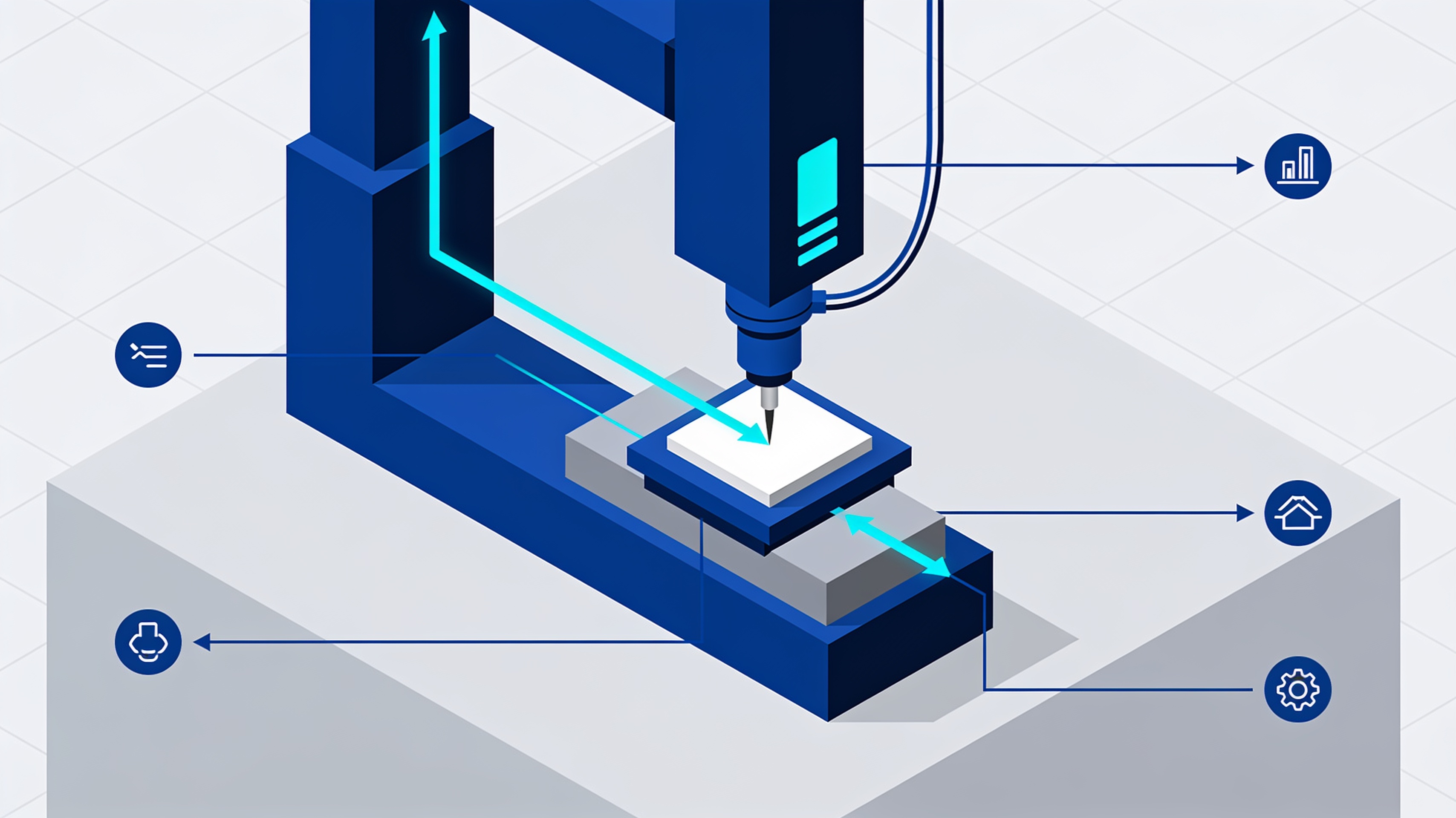
Hybrid Manufacturing Technologies Limited is developing a solution to automate one of the most complex steps in hybrid machines: changing the process head. The European patent application EP4786088A2, published on 5 August 2026, describes an architecture that allows a machine tool to attach an additive deposition head using principles similar to the automatic tool changers of traditional CNCs.
The difference compared to a normal tool change is substantial. A milling cutter mainly requires a precise mechanical connection with the spindle. An additive manufacturing head, on the other hand, requires material, gas, cooling fluids, electrical power, control signals and, in some configurations, laser energy.
- European patent EP4786088A2 published on 5 August 2026
- System for automatic change between CNC machining and additive deposition
- Interface that manages multiple connections: materials, gas, power, signals
- Development started in 2017 with British priority
An interface to eliminate manual connections
*The goal is to create a system that automatically establishes all necessary connections during head docking, drastically reducing downtime between different processes.*
The interface designed by Hybrid Manufacturing Technologies allows these connections to be established during the automatic docking procedure. This eliminates the need to manually connect pipes, cables, or other services when the machine switches from one operation to another.
The result is a CNC machine capable of alternating milling, additive deposition, measurement, and workpiece inspection following a programmed sequence. Operator intervention at each technology change is no longer necessary.
The architecture includes a multi-stage docking system that divides the docking into multiple phases. This approach protects the most delicate connectors during changeover operations.
A patent family dating back to 2017
*The European publication of 2026 represents the evolution of a project started almost ten years earlier, with a British priority filed in March 2017.*
The technology was not born in 2026. The patent family of Hybrid Manufacturing Technologies dates back to a British priority of March 22, 2017.
A related international application, published as WO2018172774A1, and the corresponding US application US20200086424A1 describe a machine tool equipped with a system for transferring energy and process media through an interchangeable head.
Among the inventors listed in the US documentation are Jason Jones, Peter Coates, Peter-Jon Solomon, and Joshua Zadroga. Hybrid Manufacturing Technologies Limited appears as the assignee of the invention.
The new European publication is part of a path of protection and development of an architecture on which Hybrid Manufacturing Technologies has been working for several years, focusing on the integration of additive technologies within traditional CNC machines.
Implications for hybrid manufacturing
*The automation of the head change could accelerate the adoption of hybrid machines in sectors where production flexibility is critical, reducing cycle times and dependence on operator skills.*
The British company has focused part of its activity on the integration of additive technologies within existing machine tools. This approach fits into a market where other manufacturers such as DMG Mori and Okuma have already proposed hybrid manufacturing solutions.
The complete automation of the process change, however, represents a further step. It allows programming complex sequences that alternate addition and removal of material without interruptions, opening new production possibilities for complex components in sectors such as aerospace and energy.
The main technical challenge remains the simultaneous management of multiple connections in an industrial environment where mechanical precision and reliability are non-negotiable requirements. The multi-stage docking system proposed in the patent represents an attempt to respond to this need.
article written with the help of artificial intelligence systems
Q&A
What is the number of the European patent filed by Hybrid Manufacturing Technologies?
The European patent filed by the British company bears the number EP4786088A2. This document was published on August 5, 2026, and describes the architecture of the new system.
How does changing an additive head differ from changing a traditional CNC tool?
While a milling cutter requires only a mechanical connection to the spindle, an additive head needs multiple connections. These include material, gas, cooling fluids, electrical power, control signals, and sometimes laser energy.
When was the original priority for this patent family filed?
The patent family dates back to a British priority filed on March 22, 2017. The 2026 European publication therefore represents the evolution of a project initiated nearly ten years earlier.
How does the multi-stage docking system described in the patent work?
The architecture includes a multi-stage docking system that divides the coupling procedure into several distinct phases. This specific approach serves to protect the most delicate connectors during head-change operations.
What operational advantages does this automatic changeover system offer?
The system eliminates the need to manually connect hoses and cables with every process change, drastically reducing downtime. This allows the machine to alternate between milling and additive deposition following a fully programmed sequence without operator intervention.