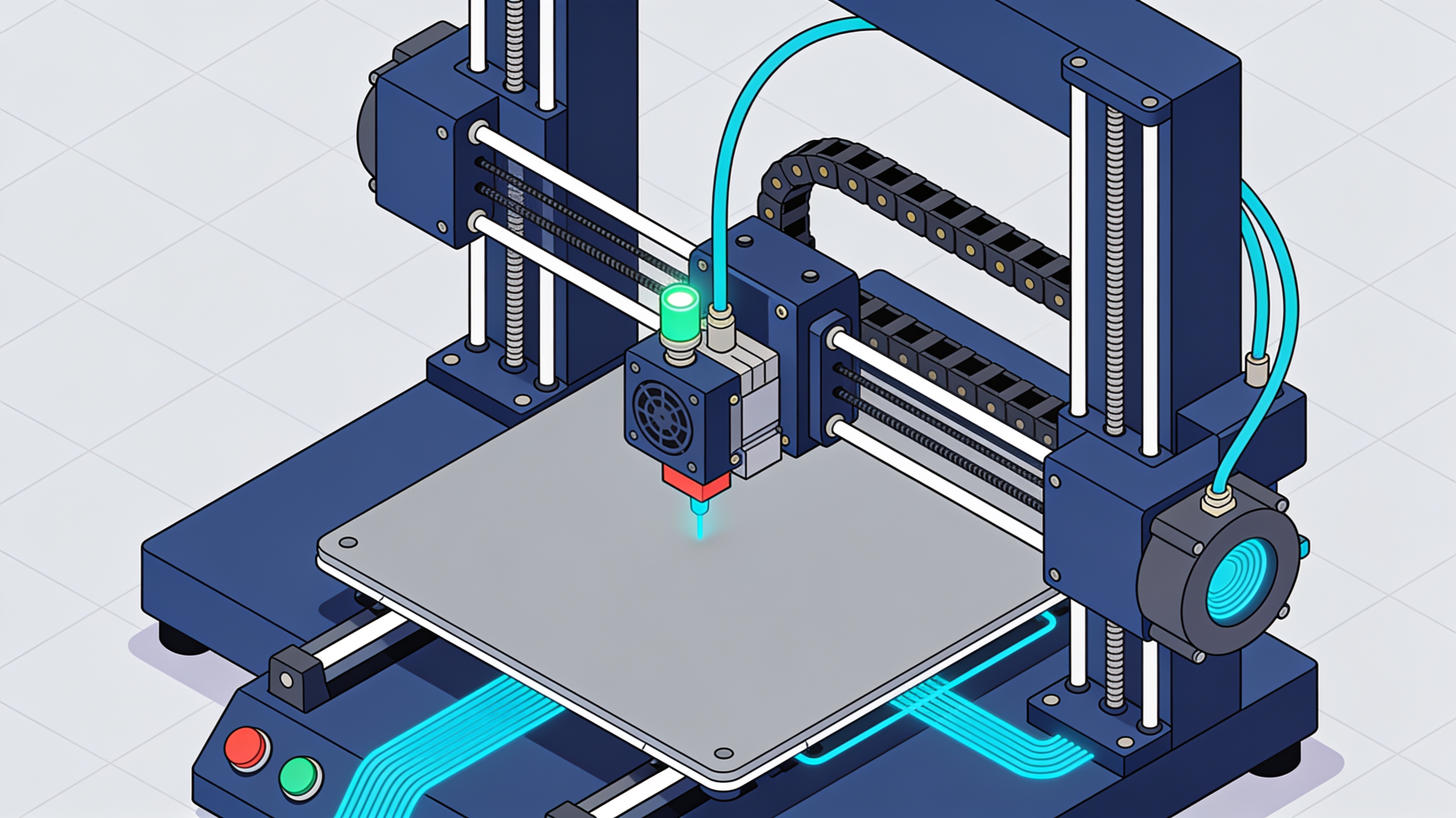
Artificial intelligence optimizes FFF 3D printing parameters: precision and reliability at the center
A model based on Bayesian neural networks developed by researchers at Vanderbilt University and NIST promises to make FFF printing more reliable. The system optimizes temperature, speed, and layer height considering the intrinsic uncertainty of the process.
The problem of parameters in FFF printing
Finding the correct parameters for an FFF 3D printer is not simple. Temperature, speed, and layer height interact in complex and often contradictory ways.
In fused filament deposition printing, every change to a parameter generates chain effects. A higher nozzle temperature improves fusion between adjacent filaments, strengthening the internal bond. But it can also cause geometric deformations or excess deposited material.
Reducing the layer height increases precision and surface finish. The price to pay is longer production time and a greater number of passes. Increasing speed reduces machine time but modifies the thermal behavior of the material during deposition.
- High temperature: improves adhesion but risks deformations
- Thin layers: increase precision but lengthen times
- High speed: reduces times but compromises thermal quality
An approach that considers uncertainty
The method developed by the researchers does not seek a single “perfect” profile, but robust process conditions even in the presence of variations.
The group led by Berkcan Kapusuzoglu, Paromita Nath, Matthew Sato, Sankaran Mahadevan and Paul Witherell developed a system based on Bayesian neural networks and multi-objective optimization. The distinctive element is the attention to uncertainty, often overlooked in traditional calibration procedures.
The study was originally published in 2022 in the ASCE-ASME Journal of Risk and Uncertainty in Engineering Systems, Part B: Mechanical Engineering. It returned to the industry's attention in August 2026 after publication on arXiv.
The goal is not to find parameters that produce an optimal sample a single time. The system seeks conditions capable of generating good-quality parts even when machine, material, and environment introduce inevitable variations.
Methodology: neural networks and optimization
The method combines machine learning techniques with genetic algorithms to efficiently explore the parameter space.
The researchers used Bayesian neural networks to predict geometric accuracy and quality of the bond between filaments. This architecture allows estimating not only the expected result, but also the uncertainty of the prediction.
To efficiently distribute experiments, Latin Hypercube Sampling was employed. This statistical technique ensures representative coverage of the parametric space with a limited number of trials.
Multi-objective optimization was carried out using the NSGA-II genetic algorithm. This approach builds a Pareto front: a set of optimal solutions where improving one objective necessarily requires worsening another.
Set of optimal solutions where it is not possible to improve one objective without worsening another. It allows choosing the most suitable compromise for the specific application.
The Monte Carlo Dropout technique was used to estimate the epistemic uncertainty of the model. This type of uncertainty reflects the limited knowledge of the system and can be reduced by collecting more experimental data.
Implications for production
The method addresses a concrete need: producing reliable components even in the presence of process variability.
In industrial reality, there is not necessarily a single best printing profile. The optimal combination depends on the function of the part. A dimensional template requires tight tolerances. A structural component requires good adhesion between filaments.
One manufacturer might prioritize production speed while accepting wider quality margins. Another might require maximum reliability even at the cost of longer times.
The system developed by the researchers allows identifying robust parameters for each of these scenarios. The approach explicitly considers that each print will be slightly different due to environmental variations, mechanical tolerances, and material variability.
Future perspectives
The integration of artificial intelligence and multi-objective optimization represents a promising direction for additive manufacturing.
Research shows that it is possible to overcome the traditional trial-and-error approach. The use of predictive models that quantify uncertainty provides a more solid basis for process decisions.
The growing attention to this type of methodology reflects the maturation of 3D printing as a manufacturing technology. It is no longer just about making prototypes, but about ensuring quality and repeatability for critical industrial applications.
The work of Vanderbilt University and the National Institute of Standards and Technology provides concrete tools to address this challenge. The availability of the study on arXiv in 2026 has brought attention back to a problem that remains central to the industrial adoption of additive manufacturing.
article written with the help of artificial intelligence systems
Q&A
Who developed the Bayesian AI model for FFF printing?
The model was developed by a team of researchers from Vanderbilt University and NIST, led by Berkcan Kapusuzoglu, Paromita Nath, Matthew Sato, Sankaran Mahadevan, and Paul Witherell.
Which printing parameters are optimized by the proposed system?
The system optimizes three key parameters: nozzle temperature, print speed, and layer height, accounting for their complex interactions.
What is the main advantage of the uncertainty-based approach?
The goal is not to find a perfect profile for a single sample, but to identify robust process conditions that ensure quality even in the presence of inevitable machine or environmental variations.
Where was this study originally published?
The study was published in 2022 in the ASCE-ASME Journal of Risk and Uncertainty in Engineering Systems, Part B: Mechanical Engineering, and regained attention in 2026 via arXiv.
How do temperature and layer height interact in FFF printing?
Higher temperatures improve filament adhesion but risk deformation, while thinner layers increase precision but significantly extend production times.