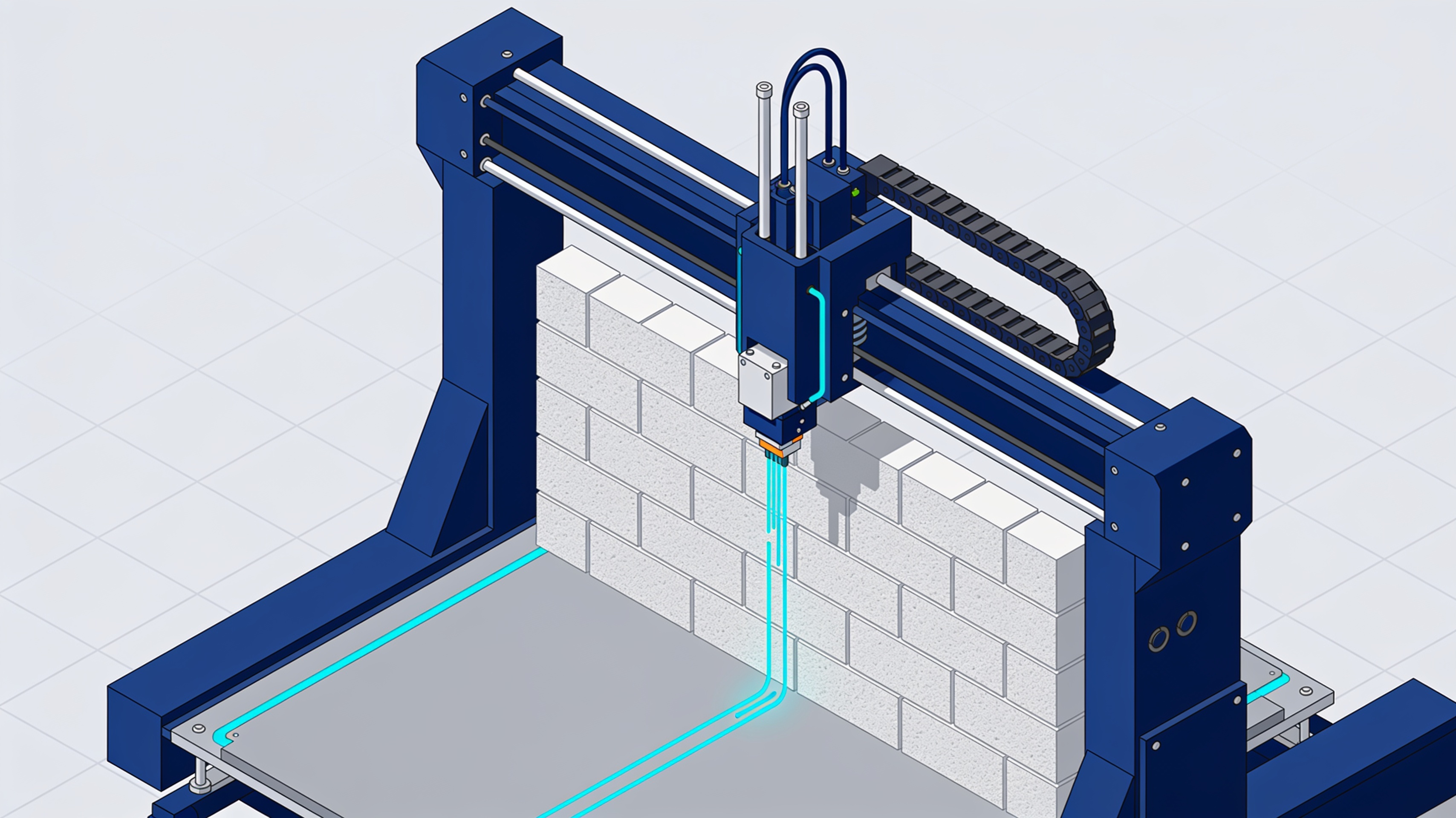
University of Maine launches production of nine 3D-printed homes with bio-based materials
The University of Maine moves from the experimental phase to serial production of 3D-printed homes. The university's Advanced Structures and Composites Center (ASCC) will build up to nine homes in the Greater Bangor area, in collaboration with the nonprofit organization Penquis. The homes will use composite materials largely derived from the residues of Maine's forest industry.
The project represents a qualitative leap compared to the experimental BioHome3D house presented in 2022. The goal is no longer to demonstrate technical feasibility, but to verify whether the process can be repeated, accelerated, and transformed into an economically sustainable production system.
- Nine 3D-printed homes with bio-based materials derived from the forest industry
- Production in three successive phases to progressively optimize the process
- Goal: create a repeatable and economically sustainable industrial production system
- Recipients: people without housing or at risk of losing it in the Greater Bangor area
From prototyping to serial production
The project marks the transition from a technological demonstration to a real industrial process, with the ambition of creating a “Ford factory of houses”.
In 2022, BioHome3D had demonstrated the possibility of printing not only walls, but also floor and roof using composite materials of biological origin. This approach differs from construction 3D printing systems based on concrete, which typically produce only vertical elements.
Now the question changes radically. The University of Maine wants to understand whether the same process can be replicated industrially.
The executive director of ASCC, Habib Dagher, described the vision as a “Ford factory of houses”: homes produced industrially through a highly automated process and subsequently transported to the installation site.
Three-phase development strategy
Production will not occur in a single solution, but through three successive groups of homes, each optimized based on previous results.
The nine homes will not be produced all together with a definitive configuration. The University of Maine plans to proceed in three successive phases.
Each group of houses will serve to collect data on material behavior, production process, assembly, and building performance. The results obtained will be used to modify the next group.
Project phases
- First group: Initial production and data collection on materials and process.
- Second group: Implementation of the improvements identified in the first phase.
- Third group: Final optimization towards industrial production.
This strategy allows for the progressive introduction of improvements rather than merely verifying the repeatability of an initial process. The project simultaneously becomes a housing program and a true pilot production line.
Forest materials and social purpose
The homes will use materials derived from the local forest industry and will be intended for people in housing vulnerability conditions.
The composite materials used largely come from residues of Maine's forest industry. This approach creates a direct link between local resources and housing production, valorizing industrial waste.
The homes will be installed in the Greater Bangor area and intended for people who are homeless or at risk of losing their homes. Collaboration with Penquis, a nonprofit organization, ensures that the project has a direct social impact.
BioHome3D uses large-format 3D printing technologies that allow the production of not only walls but also floor and roof in a single integrated process, differentiating itself from traditional concrete-based construction 3D printing systems.
Industrial prospects
The project aims to demonstrate that 3D printing of homes can become a scalable industrial process, not just a technological curiosity.
The final goal is to create a production system that can be replicated and scaled. The metaphor of the “Ford factory” evoked by Dagher is not accidental: it recalls the transition from artisanal production to mass industrial production.
If the project succeeds, it could pave the way for a new mode of housing production. A system that combines automation, sustainable locally sourced materials, and production speed.
The division into three phases allows for systematically addressing technical, economic, and logistical challenges. Each iteration will provide valuable information to optimize the process toward industrial production.
article written with the help of artificial intelligence systems
Q&A
How many 3D-printed homes will the University of Maine produce?
The project involves building nine 3D-printed homes in the Greater Bangor area. Production will be carried out in collaboration with the non-profit organization Penquis.
What materials are used for the new bio-printed homes?
The homes use composite materials largely derived from residues of Maine's forest industry. These are bio-based materials that differ from traditional concrete.
What is the main objective compared to the previous BioHome3D project?
The goal is no longer to demonstrate technical feasibility, but to verify whether the process can be replicated and turned into an economically sustainable production system. The aim is to create a sort of 'Ford factory for homes'.
How will the production of the nine homes be structured?
Production will not occur all at once but through three successive phases with progressively optimized groups of homes. Each group will serve to collect data to improve the process for the next group.
Who are these 3D-printed homes intended for?
The homes are aimed at people who are homeless or at risk of losing their housing in the Greater Bangor area. The project seeks to provide fast and efficient housing solutions for this segment of the population.