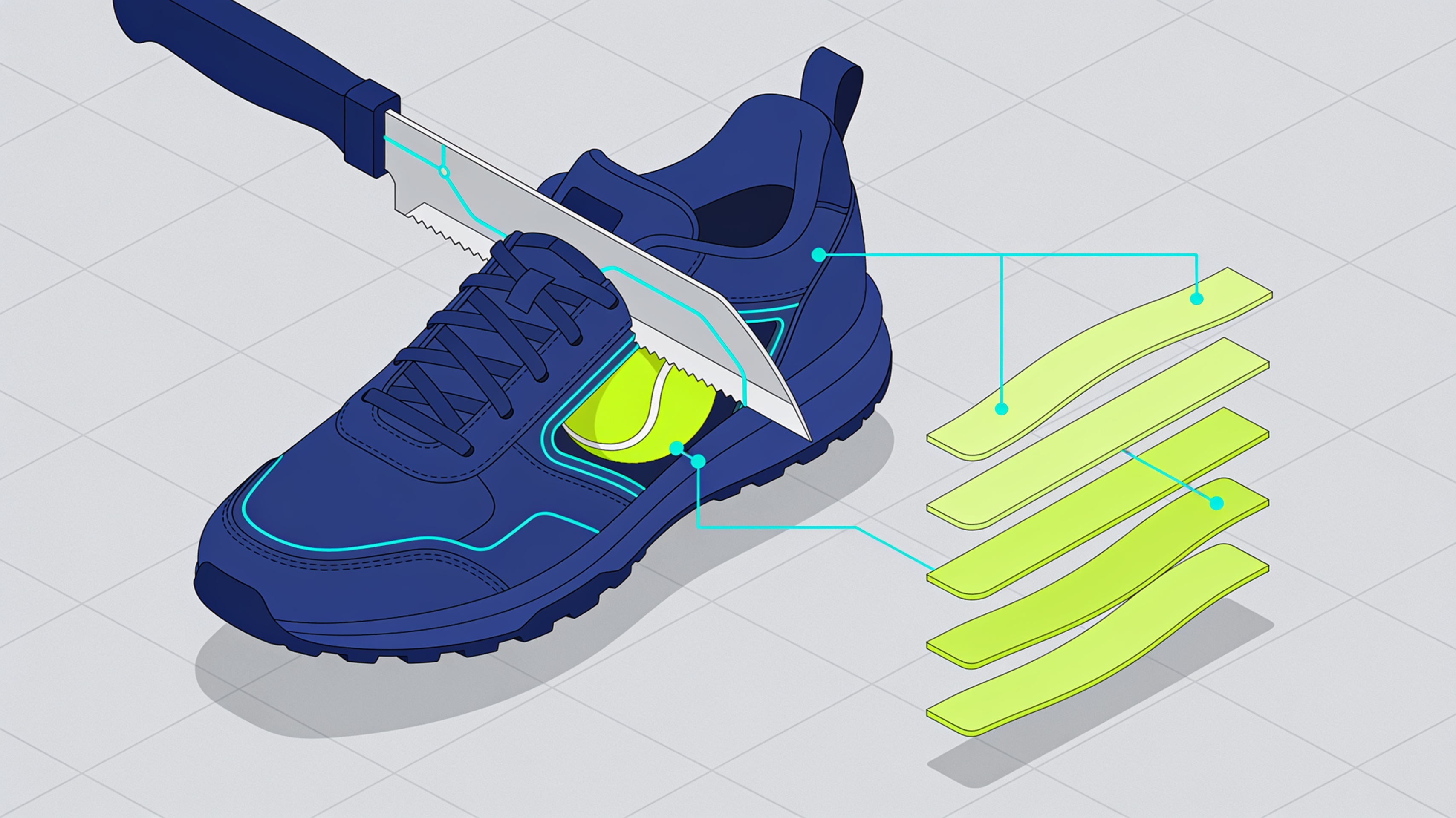
SLICE: from used tennis balls to new sneakers thanks to 3D printing
A young designer transforms a sports waste into footwear using 3D-printed guides. The project aims to give new life to millions of balls that end up in landfills every year.
Soroosh Riazi Isfahani, a design student at the Royal College of Art and Imperial College London, presented SLICE this summer at the James Dyson Award 2026. The system transforms discarded tennis balls into footwear through a process that requires neither heat nor chemical adhesives.
The problem of sports waste
Every year, hundreds of millions of tennis balls become waste that is difficult to recycle. Most end up in landfills for centuries.
Between 300 and 400 million tennis and padel balls are produced worldwide every year. Only a small fraction is reused.
After a few matches, the balls lose pressure and become unusable. In landfills, they can take over 400 years to degrade.
- 300-400 million balls produced worldwide every year
- Only 11% is recycled
- A Grand Slam tournament uses almost 100,000 balls in two weeks
- Over 400 years to degrade in landfill
Traditional recycling is complicated. Rubber, adhesive, and felt are difficult to separate in an economically sustainable way. Recovered balls end up in low-value applications such as flooring or pet toys.
From shredding to precision cutting
The designer changed approach after discovering that shredding the balls destroyed their best characteristics.
Isfahani initially tried shredding the balls and mixing the material with natural rubber to make soles. The process worked but required a lot of energy.
The main problem: shredding nullified valuable characteristics such as curvature, elasticity, and the bond between rubber and felt. Hence the turning point: cutting instead of shredding.
3D-printed guides for each cut
Cutting a tennis ball with precision is complex. The solution comes from additive manufacturing.
The curved surface, internal pressure, and deformation under the blade make it difficult to achieve regular cuts freehand. Isfahani solved the problem by 3D printing guides that lock the ball and divide its surface into precise sections.
Each guide originates from a digital file. This allows it to be easily adapted to different shoe sizes or new designs, including bags and sports accessories.
The SLICE process
- Guided cutting: The 3D printed guides lock the ball and define the blade path to obtain curved strips and caps.
- Modeling: The pieces are modeled on a traditional shoemaker's last.
- Sewing: The sections are sewn together using end-of-life racket strings, without heat or adhesives.
Aesthetics of visible reuse
From each ball, curved strips and caps are obtained and shaped on a shoemaker's last. The sections are sewn together using end-of-life racket strings.
The yellow felt, white stitching, and signs of wear remain visible. They become part of the shoe's aesthetic, with an approach reminiscent of Freitag bags made from truck tarpaulins.
The process requires neither heat nor chemical adhesives. Everything is based on mechanical cutting and traditional sewing with recovered materials.
Future developments
Isfahani now wants to develop more complex models, combining ball sections with leather scraps. The system based on digital files makes production scalable and facilitates customization.
3D printing confirms itself as a key tool not only for final production, but also for enabling circular economy processes through customized, low-cost equipment.
article written with the help of artificial intelligence systems
Q&A
Who developed the SLICE project for recycling tennis balls?
The project was developed by Soroosh Riazi Isfahani, a design student at the Royal College of Art and Imperial College London. It was submitted as a candidate for the 2026 James Dyson Award.
Why is shredding tennis balls not the best solution?
Shredding destroys valuable material properties such as curvature, elasticity, and the existing bond between rubber and felt. Moreover, this process requires significantly higher energy consumption compared to precision cutting.
What is the role of 3D printing in the SLICE system?
3D printing is used to create custom guides that secure the ball and define the blade's exact path. This enables regular cuts on curved surfaces without deforming the material.
How long do tennis balls take to degrade in a landfill?
Discarded tennis balls can take over 400 years to fully degrade if sent to landfill. Currently, only 1% of the hundreds of millions of balls produced annually are recycled.
Does the SLICE process use heat or chemical adhesives?
No, the SLICE system is designed to transform balls into footwear without requiring heat or chemical adhesives. This approach makes the process more sustainable and preserves the material's original properties.