A hybrid system for every challenge?
Multi-process hybrid desktop systems are changing the way components are designed and produced, but their effectiveness depends on precise technical choices. The integration of different technologies requires clear application criteria, consistent hardware architectures, and optimized workflows.
The combination of additive and subtractive processes, or of different technologies on the same platform, is not automatically advantageous. Value emerges when the part geometry, the materials involved, and the required tolerances justify the investment in complexity.
Architecture of hybrid systems
Le configurazioni hardware e software determinano se l’integrazione di più tecnologie sarà efficace o solo un accumulo di complessità.
Industrial hybrid systems combine laser deposition and CNC machining in the same machine reference. This eliminates downtime related to moving the part between different machines and reduces the risk of positioning errors.
DMG MORI, for example, integrates milling, DED laser deposition, 3D scanning, and monitoring in a single platform. The component is built and finished without leaving the machine. It is not a solution for every part, but it works when additive geometry and CNC precision must coexist.
- Shared machine reference between additive and subtractive processes
- Integrated monitoring for in-cycle verification
- Internal 3D scanning for real-time geometric control
Other approaches exist. Hybrid Manufacturing Technologies Global has shown AMBIT XTRUDE, where a pellet polymer extrusion module is integrated on a CNC to then return to milling. The process is different, but the principle is similar: bringing 3D printing into an already known processing chain.
Process selection: application criteria
Not all components benefit from multi-process integration. The choice depends on geometry, materials, and tolerances.
HP has stated that different processes are increasingly seen as complementary, each with a role in a flexible production setup. The goal is to help manufacturers understand where filament-based production makes sense and where it does not.
Hybrid production is valuable when multiple functions need to be combined: material addition, repair, different materials, thermal channels, hard coatings, geometries not achievable with standard tools, and tolerance finishing. In these cases, working in a single machine reduces steps and opens up design solutions that are difficult with separate processes.
| Criterion | Single process | Hybrid system |
|---|---|---|
| Complex geometry | Requires multiple setups | Single setup |
| Tight tolerances | Separate post-processing | Integrated finishing |
| Lead times | High | Reduced |
| Cost per simple part | Low | Not justified |
If a component can be quickly milled from solid, or produced with casting and traditional machining at lower costs, hybrid manufacturing is not automatically the best choice. Value emerges with high-value parts where documentation matters and where multiple functions must be combined.
Continuous workflows
L’integrazione hardware e software deve minimizzare i tempi morti e garantire la continuità operativa tra processi diversi.
Hybrid systems aim to solve the problem of workpiece movement. If the component is transferred from one machine to another, time, error risks, and setup costs are added. Hybrid manufacturing builds and finishes the workpiece in the same machine reference.
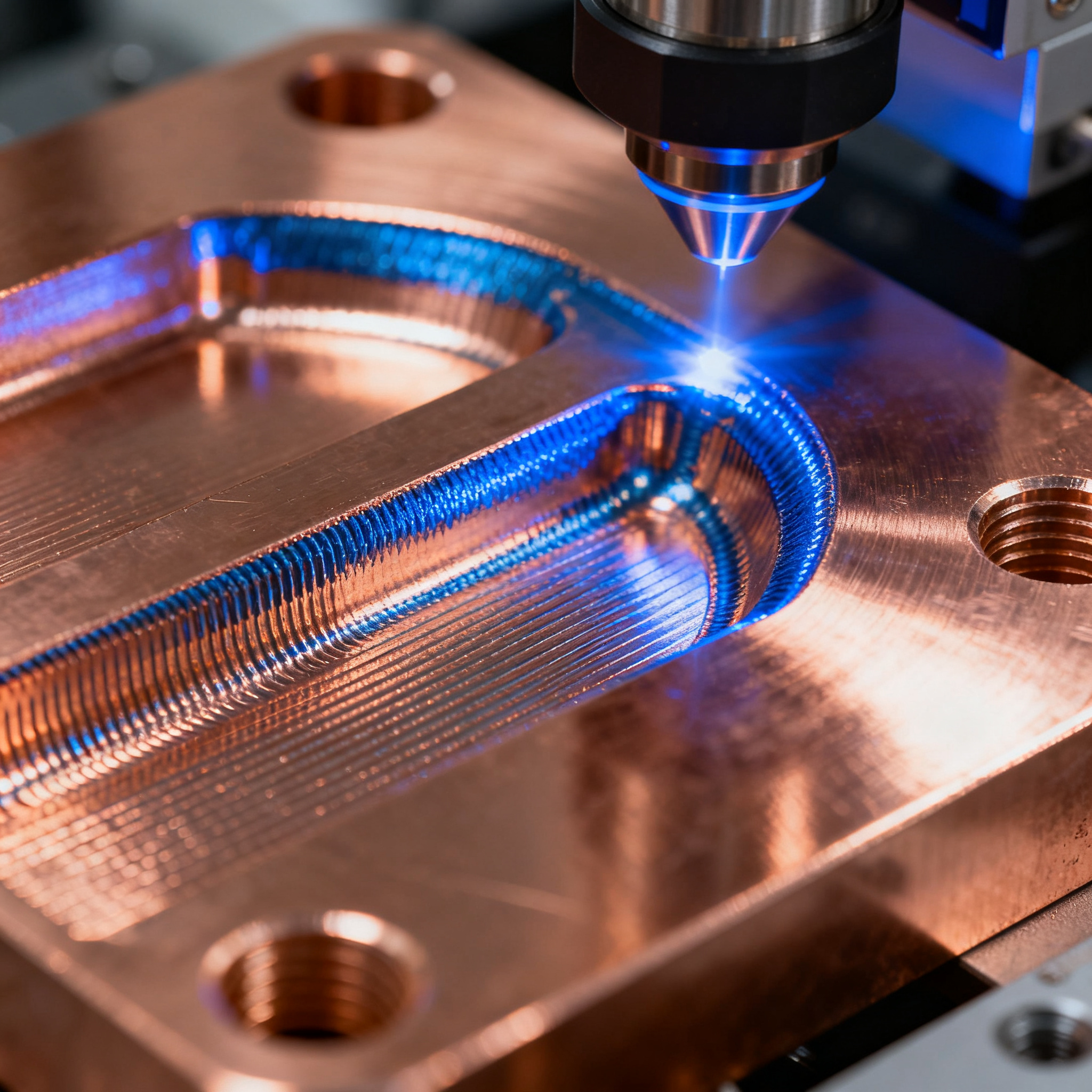
The presence of the blue laser extends the discussion to copper and reflective metals, while integrated monitoring makes the process more suitable for parts where documentation is critical. Internal 3D scanning allows checking the workpiece during the cycle and not only at the end of machining.
Two nozzles or processes working on the same part must be precisely aligned. Differences in height, X/Y offsets, or process parameters can create defects at transition points.
Coordination becomes as important as the deposition itself. When additive printing scales up, managing multiple deposits in space and time becomes the central problem. This applies to both desktop systems and more complex industrial architectures.
Advanced interaction with AR/VR
Le tecnologie immersive stanno trasformando l’interfaccia uomo-macchina nei sistemi ibridi portatili, abilitando nuove modalità operative.
Portable workstations with AR/VR devices offer previously unattainable advantages. A compact setup on a mobile cart includes computer, display, keyboard, and mouse, but the user wears an AR/VR headset to view stereoscopic 3D data.
The visualization can be in 2D or 3D and viewed from different angles. In the medical field, visualization of anatomical structures can be projected onto the real patient, overlaying volumetric data with the corresponding anatomical structures.
AR configuration for hybrid workstation
- Optical tracking: a device connected to the computer detects the position of real objects via optical markers.
- Markers on objects: constellations of spheres, QR codes or 3D objects are attached to instruments or anatomies to be tracked.
- Synchronized visualization: the AR viewer shows 3D data aligned in real time with physical objects.
The AR/VR viewer can be connected to the workstation via USB cables or display, or via network connections if it has autonomous computing and communication capabilities. Other input and output devices, such as displays and mouse, remain available for interaction via graphical interfaces.
Optical markers can be constellations of spheres, two-dimensional QR codes or three-dimensional objects. They are attached to objects of interest and to the viewer to track position and orientation in real time. In a medical environment, the attachments can be custom-designed 3D printed objects.
Conclusion
Hybrid systems represent an operational breakthrough when implemented with precise criteria. The value lies not in the accumulation of technologies, but in their coherent integration to respond to specific production needs.
The choice between a single process and a hybrid system depends on part geometry, materials, tolerances and production volumes. The AR/VR integration adds a new dimension to interaction, but requires accurate calibration and well-defined workflows.
Design your hybrid system starting from a precise analysis of production needs and available technologies. Solo così l’investimento in complessità si traduce in vantaggio operativo reale.
article written with the help of artificial intelligence systems
Q&A
Under what conditions is a hybrid additive-subtractive system truly advantageous compared to a single process?
The value emerges when complex geometry, the materials involved, and required tolerances justify the investment in complexity. It is ideal for high-value parts requiring multiple functions such as repairs, different materials, thermal channels, or precise finishes, reducing manufacturing steps. If a component can be produced quickly with casting or traditional milling, the hybrid is not the best choice.
What are the main advantages of integrating laser deposition and CNC machining in the same machine reference?
Integration eliminates downtime related to moving the part between different machines and reduces the risks of positioning error. The component is built and finished without leaving the machine, ensuring operational continuity and greater geometric precision.
What key components characterize an effective industrial hybrid system?
An effective system requires a shared machine reference between additive and subtractive processes, integrated monitoring for in-cycle verification, and internal 3D scanning for real-time geometric control. These elements ensure that integration does not reduce to a mere accumulation of complexity.
Why is calibration a critical aspect in multi-process hybrid systems?
Two nozzles or processes working on the same part must be perfectly aligned; differences in height, offset, or process parameters can generate defects at transition points. Precise coordination is therefore as fundamental as deposition itself to ensure the quality of the final component.
How are AR/VR technologies transforming interaction with portable hybrid systems?
Portable workstations with AR/VR headsets allow visualization of stereoscopic 3D data aligned in real time with physical objects, through optical tracking and markers. In the medical field, for example, it is possible to overlay virtual anatomical structures onto the real patient, enabling new operational modes.
What is the guiding principle for correctly designing a hybrid system according to the article?
The value lies not in the accumulation of technologies, but in their coherent integration to address specific production needs. It is necessary to start from a precise analysis of the part geometry, materials, tolerances, and production volumes to translate the investment in complexity into a real operational advantage.