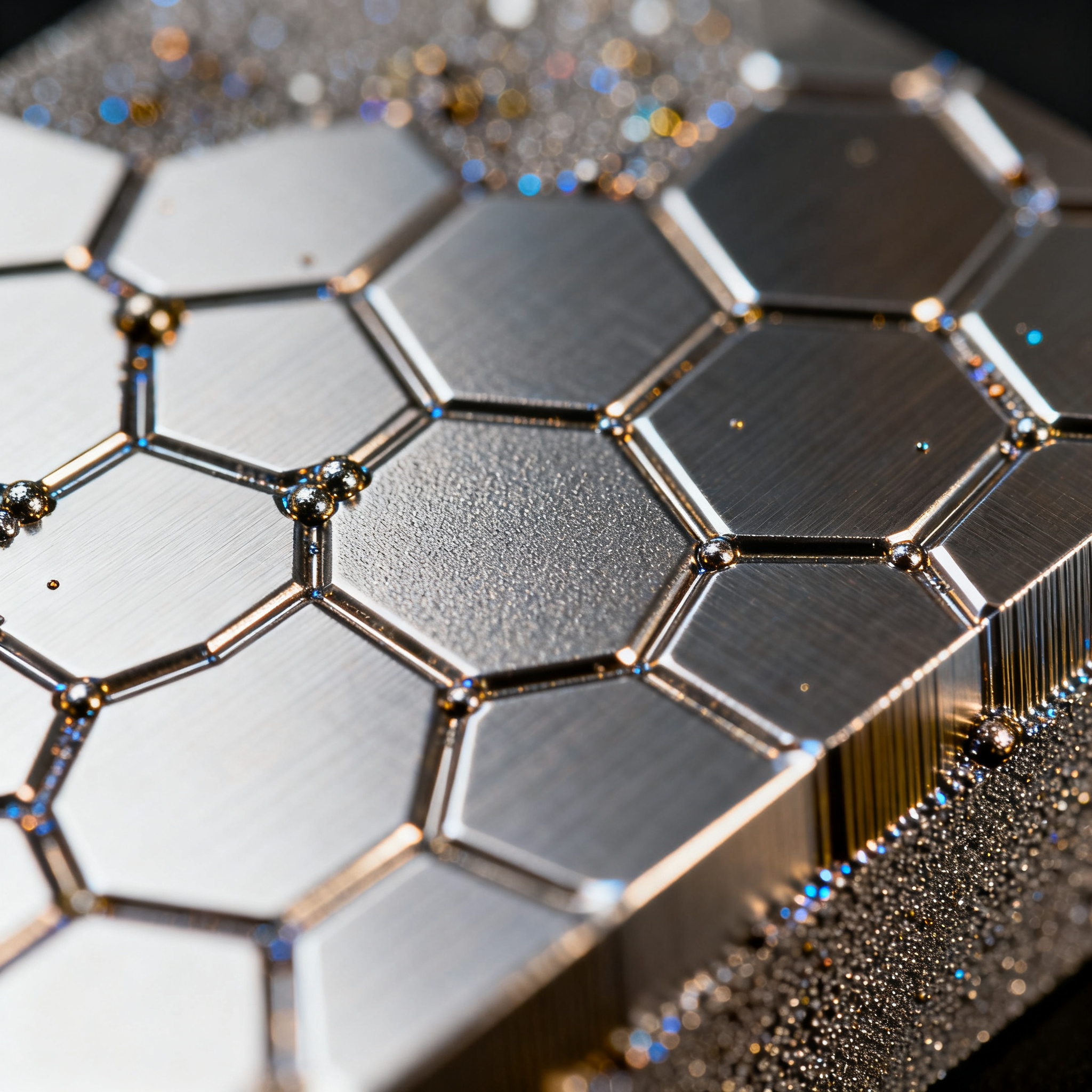
Predicting the future of advanced metal alloys?
Advanced metal alloys do not behave like traditional materials: their crystalline structure determines unique properties that go beyond the simple sum of the elements. Today, computational models and simulations allow predicting the behavior of these alloys even before physically producing them.
Refractory Complex Concentrated Alloys (RCCA) and High Entropy Alloys (HEA) represent a new frontier. These alloys combine elements in high proportions, creating complex crystalline structures that challenge the traditional rules of metallurgy.
Crystalline structures and mechanical behavior
*The FCC or BCC configuration of HEA and RCCA directly determines the macroscopic properties of the material, influencing strength, ductility, and thermal stability.*
HEAs can exhibit Face-Centered Cubic (FCC) or Body-Centered Cubic (BCC) structures. Materials like CrCoFeNi predominantly show FCC structure, similar to aluminum and gold, but can also form BCC structures under certain conditions.
RCCAs combine refractory elements such as hafnium, ruthenium, titanium, and tungsten in high proportions. The result is typically a disordered BCC alloy with a complex microstructure. This configuration ensures melting points above 1000°C and exceptional resistance to oxygen corrosion.
- FCC: CrCoFeNi (Cantor alloy) for turbines and marine applications
- BCC: FeCoCrAlCu for wear resistance
- RCCA: refractory alloys for combustion chambers and nozzles
The AlCoCrFeNi alloy has an FCC structure suitable for marine applications. FeCoCrAlCu, on the other hand, is classified as an HEA with a BCC structure and high wear resistance. This structural diversity makes each alloy specific for targeted applications.
Predictive models: from composition to performance
*Advanced computational models allow predicting mechanical behaviors starting from microstructural parameters, drastically reducing development times.*
MIT researchers have developed a machine learning-based method that uses information theory to build more representative training datasets. Instead of randomly generating atomic configurations, the system identifies critical atomic “motifs” that determine the alloy's properties.
Chemical disorder represents the main challenge. Two alloys with identical composition can show different properties if the atoms are distributed differently. Traditional methods required over 100,000 hours of computation for a single material, without guaranteeing transferability when the composition changes.
Chemical disorder in advanced alloys means that different local configurations coexist in the same material, making it necessary to have models that describe behavior atom by atom.
Researchers at Carnegie Mellon University have automated the evaluation of alloys for laser powder bed fusion using Large Language Models. The system integrates Thermo-Calc property calculations with analytical melt pool models, generating process maps for rapid screening of compositions.
Simulations and optimization of alloys
*The use of techniques such as CALPHAD and DFT allows optimizing specific alloys like CrCoFeNi for extreme applications, reducing dependence on physical experimentation.*
The automated CMU workflow combines three components: a Thermo-Calc layer for CALPHAD-based predictions, a module for generating process maps, and state management tools. For each alloy, the system calculates density, thermal conductivity, specific heat capacity, and phase transition temperatures.
Automated prediction process
- Composition input: The system generates files with element mass fractions, retrieving known alloys from databases or analyzing hypothetical compositions.
- Property calculation: Thermo-Calc determines thermophysical parameters and phase transitions using appropriate databases for multi-principal alloys.
- Process simulation: The Rosenthal model estimates melt pool dimensions and applies overlap criteria to map process regimes.
The current approach assumes melt pool behavior in conduction mode. It does not directly model keyholing or balling, which would require more complex computational fluid dynamics simulations.
Shenzhen University has demonstrated how TiN nanoparticles reduce functional anisotropy in high-entropy shape memory alloys. The addition of TiN during LPBF triggers a transition from columnar to equiaxed grains, reducing the anisotropy of yield strength from 39.6% to 20.5%.
| Parameter | HESMA base | HESMA + TiN |
|---|---|---|
| Yield strength (horizontal) | 582.5 MPa | 802.4 MPa |
| Yield strength (vertical) | 417.4 MPa | 665.9 MPa |
| Strength anisotropy | 39,6% | 20,5% |
| Grain size | 15.8 μm | 1.68 μm |
Limits and perspectives of predictions
*Despite progress, the complexity of atomic interactions still imposes a strong link with physical experimentation to validate computational models.*
Current models have significant limitations. The CMU implementation does not directly model defects such as keyholing or balling. Absorptivity is estimated using approximations based on Drude, less accurate for materials with strong power dependence.
L’University College London ha sviluppato una lega di alluminio personalizzata usando imaging in tempo reale durante deposizione a energia diretta. La lega PA1 raggiunge 191 MPa di resistenza allo snervamento e 421 MPa di resistenza ultima, miglioramenti del 70% e 50% rispetto ad AlSi10Mg.
Mechanical tests on PA1 were conducted on relatively small samples using indentation-based methods rather than conventional tensile tests. This approach is validated but indirect. The alloy also shows reduced ductility compared to AlSi10Mg, likely due to the larger volume of intermetallic compounds.
Scalability remains an open question. Producing complex and large geometries requires further validation. Performance under real service conditions still needs to be systematically verified.
Conclusion
Understanding advanced alloys today means anticipating tomorrow's technologies, from aerospace to nuclear. The combination of computational design and real-time multimodal characterization represents a template for the next generation of high-performance alloys.
RCCAs and HEAs are not just better materials: they are platforms to create specific alloys optimized for each application. Instead of looking for a universal material, industry can now design dedicated alloys for aircraft skins, turbofans, combustion chambers, and nose cones.
Explore public datasets of HEAs and RCCAs to build custom predictive models. The global competition in advanced materials is played on the ability to simulate, optimize, and produce innovative alloys before competitors.
article written with the help of artificial intelligence systems
Q&A
What is the main structural difference between High Entropy Alloys (HEA) and Refractory Complex Concentrated Alloys (RCCA) and how does it reflect on their properties?
HEAs can exhibit FCC or BCC crystal structures: for example, CrCoFeNi has an FCC structure while FeCoCrAlCu is BCC, which determines their ductility or wear resistance. RCCAs, on the other hand, combine refractory elements such as hafnium and tungsten in a disordered BCC structure with complex microstructure. This configuration ensures melting points above 1000°C and exceptional resistance to oxygen corrosion, making them ideal for combustion chambers and nozzles.
How do MIT researchers address the challenge of chemical disorder in advanced alloys?
They developed a machine learning-based method that uses information theory to build more representative training datasets. Instead of randomly generating atomic configurations, the system identifies critical atomic "motifs" that determine the alloy's properties. This approach overcomes the limitation of traditional methods, which required over 100,000 hours of computation for a single material without guaranteeing transferability between different compositions.
What is the automated workflow proposed by Carnegie Mellon University for the production of advanced alloys?
The system integrates three components: a Thermo-Calc layer for thermophysical predictions based on CALPHAD, a module for process map generation using the Rosenthal model, and state management tools. For each alloy it calculates density, thermal conductivity, specific heat capacity, and phase transition temperatures. This enables rapid screening of compositions for laser powder bed fusion, although it does not directly model defects such as keyholing or balling.
What effects does the addition of TiN nanoparticles have on high-entropy shape memory alloys according to Shenzhen University?
The addition of TiN during the LPBF process triggers a transition from columnar to equiaxed grains, reducing grain size from 15.8 μm to 1.68 μm. This microstructural change reduces the anisotropy of yield strength from 39.6% to 20.5% and significantly increases strength in both printing directions, improving the overall mechanical performance of the material.
What limitations do current predictive models for advanced metallic alloys present?
The models still exhibit significant approximations: for example, CMU's implementation does not directly simulate defects such as keyholing or balling, which would require complex fluid dynamics simulations. Furthermore, absorptivity is often estimated using Drude-based approximations, which are less accurate for materials with strong power dependence. Finally, physical experimental validation remains indispensable, as demonstrated by indirect tests on small samples for the PA1 alloy at University College London.
Why does the article define HEAs and RCCAs as "platforms" rather than simply better materials?
These alloys represent platforms because they allow designing specific compositions optimized for each individual application, rather than seeking a universal material. Thanks to computational design and multimodal characterization, it is possible to create alloys dedicated to aircraft skins, turboprop engines, combustion chambers, and nose cones. This approach signals a paradigm shift: from the selection of existing materials to their bespoke creation for specific performance requirements.