
3D-printed cementitious supercapacitors: when building materials store energy
Chinese researchers have developed cementitious supercapacitors made by 3D printing, paving the way for building components capable of storing electrical energy. The study, published in ACS Nano, demonstrates how additive manufacturing can integrate electrical functions directly into building materials.
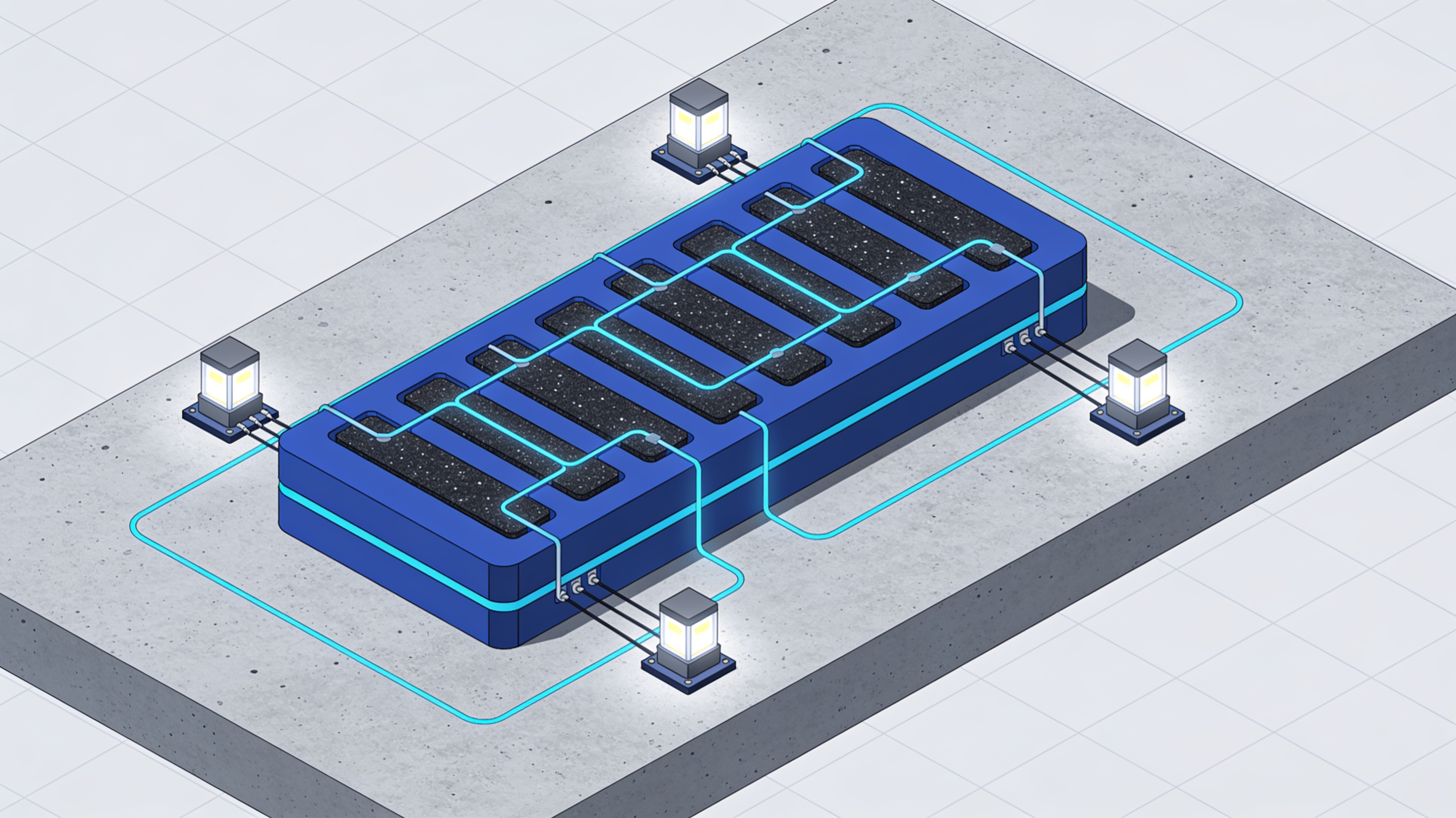
The prototypes combine energy storage capacity and mechanical compressive strength. The practical demonstration involved three devices connected on a small slab powering a group of LEDs.
- Supercapacitors made with cement, carbon nanotubes, and carbon black via Direct Ink Writing
- 3D-printed interdigitated electrodes to optimize ion pathways
- Envisaged applications: autonomous sensors and emergency lighting in buildings
- Development led by Harbin Institute of Technology and Institute of Metal Research
A cementitious ink for functional electrodes
The research group developed a printable mixture that integrates structural and electrical properties, using cement as the active component of the device.
The ink is composed of cement, carbon nanotubes, and carbon black. This mixture is deposited by 3D printing according to a pattern made of interlocking finger-like elements belonging to the two electrodes.
Cement is not only a structural material but plays an active role in storage. During hydration, water containing ions is found in the pores of the matrix; these ions can move between the electrodes and participate in the electrochemical operation.
3D printing makes it possible to precisely define the arrangement of the electrodes and the distance separating them. The contribution of additive manufacturing therefore concerns the geometry of the functional device, produced on small test plates.
Interdigitated geometry: the advantage of additive printing
The configuration of the 3D-printed electrodes optimizes electrical performance by shortening the ion path and increasing the active contact area.
The study describes fabrication by Direct Ink Writing, with cementitious electrodes embedded in a cement mortar separator. The monolithic architecture solves the interface problems between these elements.
The interdigitated arrangement shortens the ion path: transfer occurs between adjacent electrodes in the plane, instead of crossing a greater thickness. It also increases the active contact area between electrode and electrolyte.
The printed shape contributes directly to electrical performance. The ability to control the deposition path makes geometry a variable to be designed together with the material composition.
This approach represents a paradigm shift: additive manufacturing does not simply replicate existing shapes, but enables functional architectures that are impossible to achieve with traditional methods.
Fast storage for building applications
Supercapacitors offer fast recharging but limited capacity, a profile suited to low-power loads powered by local renewable sources.
Supercapacitors can absorb and release energy quickly, while storing relatively small amounts. The prospect indicated by the researchers is to exploit frequent recharges, for example from renewable sources installed near the building.
The proposed applications include autonomous sensors and emergency lighting. These uses will require further verification before transfer from laboratory samples to real buildings.
The project was developed by the Harbin Institute of Technology in collaboration with the Institute of Metal Research of the Chinese Academy of Sciences.
Prospects for structural energy storage
The research opens a possible path toward building components with integrated electrical functions. Structural energy storage could transform passive building elements into active components of building energy management.
Issues of scalability, long-term durability, and integration with existing electrical systems remain to be addressed. The transition from laboratory prototypes to certified building elements will require extensive validation of mechanical, electrical, and safety performance.
Additive manufacturing is confirmed as an enabling technology for multifunctional materials, where geometry and composition are optimized jointly to achieve otherwise inaccessible properties.
article written with the help of artificial intelligence systems
Q&A
What materials make up the ink of 3D-printed cementitious supercapacitors?
The ink is composed of cement, carbon nanotubes, and carbon black. This mixture is deposited via 3D printing to form electrodes with interdigitated finger-like elements. The cement is not only structural but actively participates in energy storage.
How does cement function in energy storage?
During hydration, water containing ions is found in the pores of the cementitious matrix. These ions can move between the electrodes and participate in the electrochemical operation of the device. Cement therefore plays an active role, not just a structural one.
Which 3D printing technique was used to make the supercapacitors?
Fabrication was carried out via Direct Ink Writing. This technique made it possible to precisely define the arrangement of the electrodes and the distance separating them. The contribution of additive manufacturing concerns the geometry of the functional device.
What is the advantage of the interdigitated electrode geometry?
The interdigitated arrangement shortens the path of the ions, which transfer between adjacent electrodes in the plane instead of crossing a greater thickness. It also increases the active contact area between electrode and electrolyte. The monolithic architecture solves the problems of interfaces between elements.
What applications have been envisioned for these cementitious supercapacitors?
The envisioned applications include autonomous sensors and emergency lighting in buildings. In the practical demonstration, three devices connected on a small slab powered a group of LEDs. The development was conducted by Harbin Institute of Technology and the Institute of Metal Research.


