
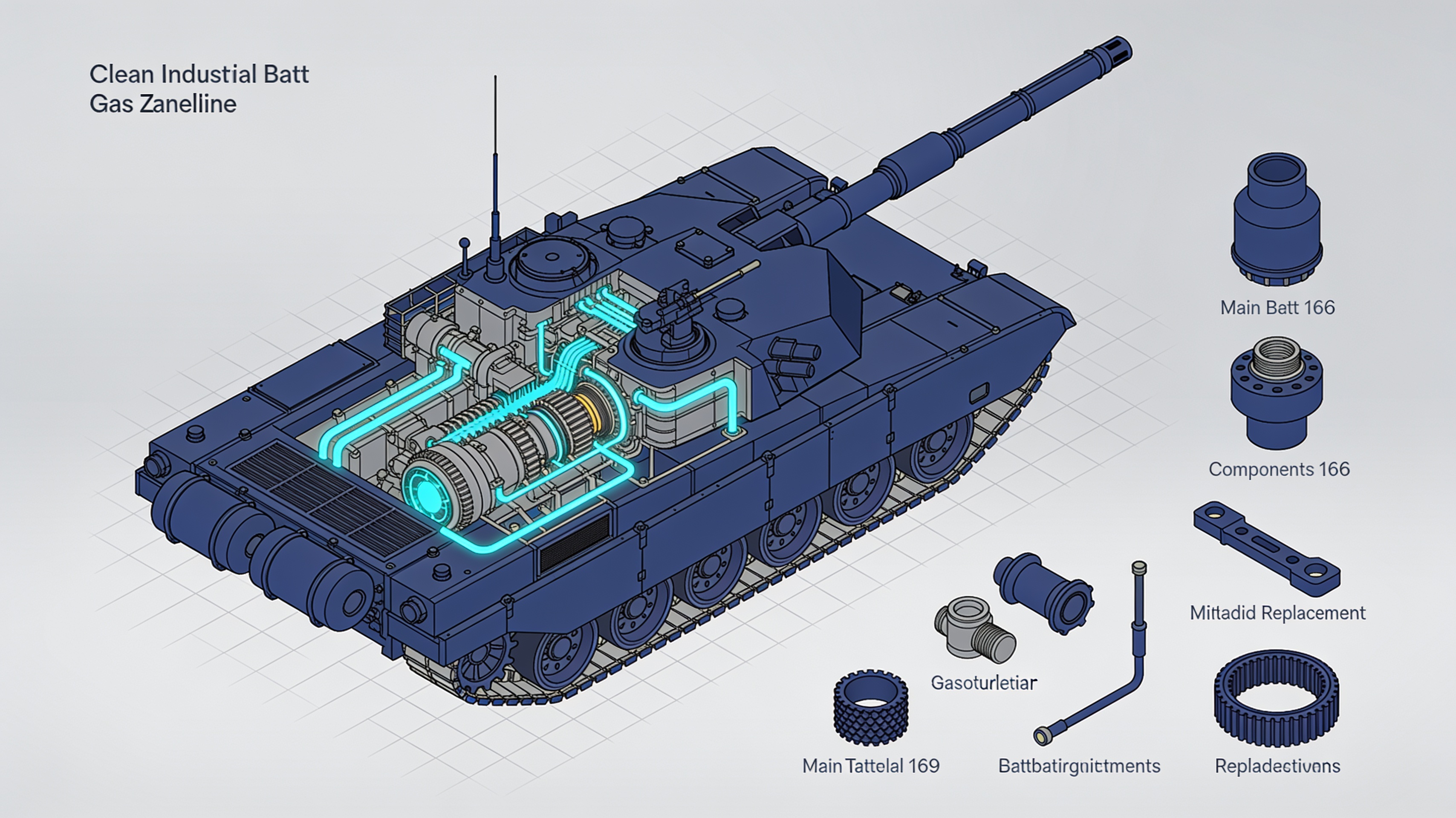
The US Army digitizes the Abrams tank: 166 critical components toward additive manufacturing
The US Army has launched an initiative to qualify alternative suppliers for 166 hard-to-source components of the M1 Abrams tank. The goal is to overcome spare parts shortages through digital twin, additive manufacturing, and generative design.
The program represents a transformation in how military systems can be sustained over the long term. For decades, maintenance of the M1 Abrams has depended on a limited number of highly specialized suppliers.
- 166 critical components of the Abrams tank need alternative suppliers
- The US Army owns the intellectual property rights to 122 of the 166 components
- Digital twin and additive manufacturing will accelerate the qualification of new manufacturers
- Honeywell's AGT1500 engine, designed 40 years ago, presents obsolescence challenges
The obsolescence problem
Many original suppliers no longer exist or cannot economically produce low-volume components for legacy systems.
Honeywell, manufacturer of the AGT1500 gas turbine engine that powers the Abrams, has acknowledged the challenges associated with supporting an engine designed more than 40 years ago. Some suppliers have disappeared, while others cannot economically produce low-volume replacement components.
The obsolescence of production tooling further aggravates the problem. Legacy manufacturing processes become increasingly difficult to maintain as the decades pass.
The advantage of intellectual property
The U.S. Army owns much of the technical data package and intellectual property for the Abrams project, paving the way for digital solutions.
This ownership makes it possible to create accurate digital twins of components and make them available to qualified manufacturers through competitive bidding. The alternative would be to continue relying on single-source production.
The Army holds the intellectual property rights to 122 of the 166 critical components. This represents a significant advantage compared with many commercial manufacturers.
Digital twin: the key to expanding the industrial base
Digital twins eliminate the need for reverse engineering and drastically reduce the qualification time for new suppliers.
Digital twins have become one of the most important technologies in modern manufacturing. Instead of relying exclusively on decades-old technical drawings, manufacturers receive complete three-dimensional digital models.
These models precisely define geometry, tolerances, materials, and production requirements. For the Abrams program, they could drastically reduce the time needed to qualify new suppliers.
Instead of reverse engineering worn parts or recreating missing tools, suppliers can manufacture directly from validated digital models. This is particularly important because many of the 166 critical components are low-volume items.
Additive manufacturing and generative design
The combination of 3D printing and optimization algorithms opens new possibilities for legacy components.
The Army initiative signals the beginning of a broader transformation through digital engineering, additive manufacturing, and generative design. These technologies create new pathways to overcome legacy engine parts shortages.
Generative design can optimize existing components for additive manufacturing. This approach makes it possible to consolidate multiple parts into integrated elements, reducing complexity and assembly costs.
Implications for the defense industry
The Abrams initiative could become a model for other legacy military programs facing similar challenges.
The U.S. Army's approach represents much more than a simple traditional supply chain exercise. It demonstrates how digital and additive technologies can extend the operational life of systems designed decades ago.
Other defense programs with obsolescence issues could follow this model. The combination of intellectual property, digital twin, and additive manufacturing offers a scalable and replicable solution.
article written with the help of artificial intelligence systems
Q&A
How many M1 Abrams components are involved in the US Army initiative?
The initiative concerns 166 critical components of the M1 Abrams tank that are difficult to source. The goal is to qualify alternative suppliers to overcome spare parts shortages.
For how many of the 166 components does the US Army hold intellectual property rights?
The US Army holds intellectual property rights on 122 of the 166 critical components. This makes it possible to create accurate digital twins and make them available to qualified manufacturers through competitive tenders.
Which technologies are used to qualify new suppliers of Abrams components?
The program relies on digital twins, additive manufacturing, and generative design. Digital twins eliminate the need for reverse engineering and reduce the qualification time for new manufacturers.
What is the main problem with Honeywell's AGT1500 engine?
The AGT1500 gas turbine engine was designed over 40 years ago and faces obsolescence challenges. Some original suppliers have disappeared or cannot economically produce low-volume replacement components.
Why is the obsolescence of manufacturing tooling a problem for the M1 Abrams?
Legacy manufacturing processes become increasingly difficult to maintain over the decades. Tooling obsolescence further aggravates the component sourcing problem.


