
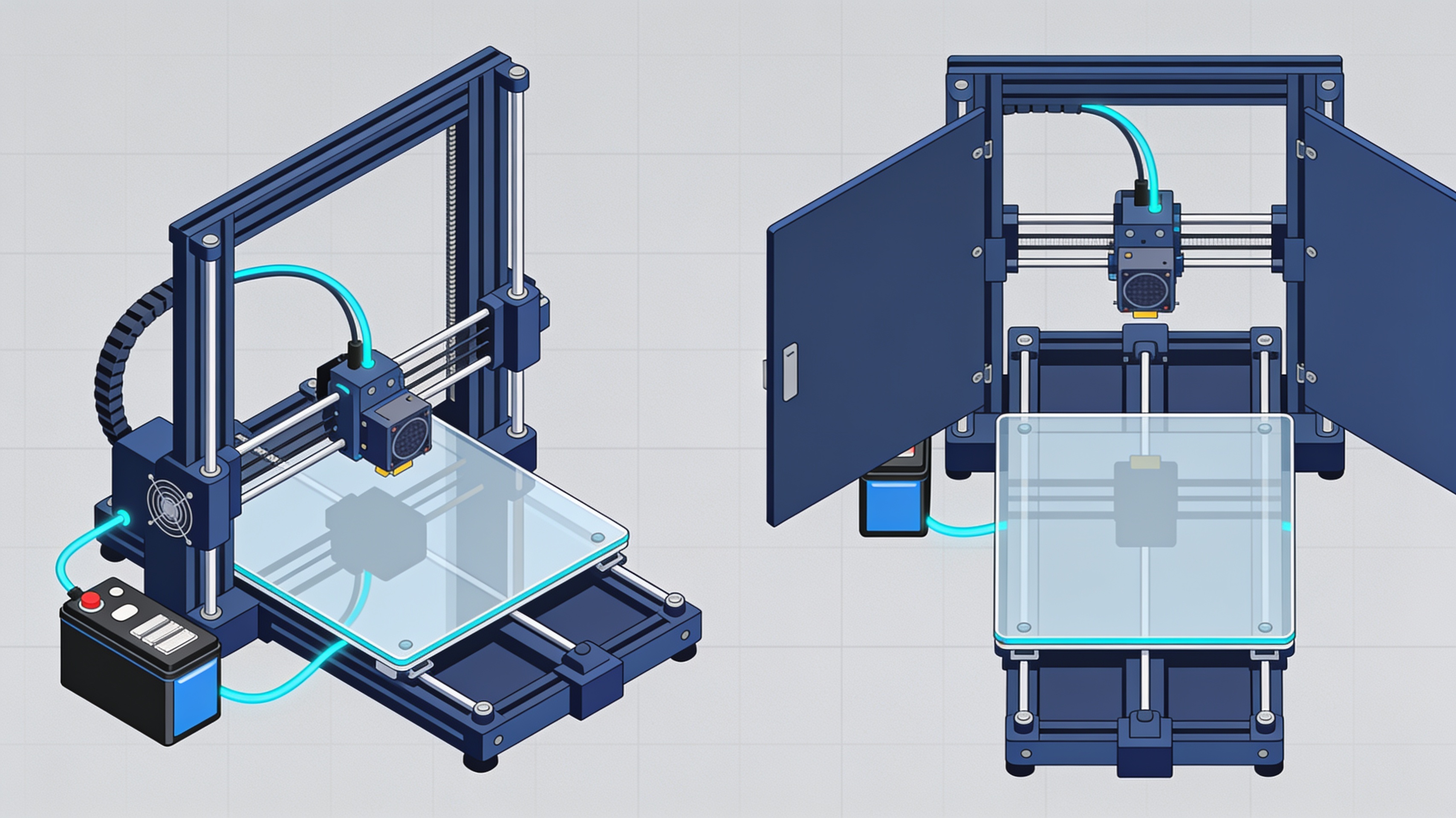
Muon3D M1: foldable 3D printer 8 cm high with 15 hours of battery life
British startup Muon3D is preparing the Kickstarter launch of the M1, an FFF printer that folds down to 200 × 200 × 80 mm while maintaining a print volume of 200 × 180 × 160 mm. The project is inspired by the open-source Positron V3 and includes an optional 1 kWh battery.
Extreme portability in the world of FFF 3D printing is about to take a significant leap. Muon3D, a British manufacturer, has announced the M1: a printer that takes up just 3.2 liters once folded, less than a slim briefcase.
The most surprising figure is the ratio between footprint and capacity. The theoretical print volume (5.76 liters) exceeds the physical volume of the closed machine. It is not a mathematical trick: it is the result of a design that starts from the opposite constraint compared with traditional printers.
Technical specifications and stated performance
Muon3D M1 combines inverted CoreXY kinematics, a high-flow hotend, and components designed to maximize volumetric efficiency without sacrificing speed.
- Print volume: 200 × 180 × 160 mm
- Dimensions when closed: 200 × 200 × 80 mm
- Weight: 2.9 kg
- Maximum speed: 600 mm/s
- Acceleration: 20,000 mm/s²
- Benchy: approximately 9 minutes and 30 seconds
- Battery life: up to 15 hours
The machine uses inverted CoreXY kinematics, a solution that allows the Z-axis to be compressed in a folding manner. The hotend is high-flow and the heated bed is completely transparent, probably made with ITO (indium tin oxide) technology.
The extrusion system is direct drive, with the motor mounted close to the hotend to handle flexible materials. The stated compatibility includes PLA, PETG, ABS, ASA, and TPU.
Energy autonomy: optional 1 kWh battery
The optional battery base turns M1 into a printer completely disconnected from the power grid, with a stated runtime of up to 15 hours of continuous operation.
Muon3D offers an optional 1 kWh battery pack that integrates into the printer's base. With this configuration, M1 can operate without a grid connection for extended print cycles.
The battery uses a Stackable Expansion Port, suggesting the possibility of connecting multiple units to further extend runtime. This feature opens up usage scenarios in remote contexts, construction sites, mobile laboratories, or emergency situations.
Advanced technical components
M1 integrates sensors and control systems typical of higher-end printers, compressed into a portable format.
The machine includes a nozzle load cell, a sensor that measures the force exerted by the nozzle on the part being printed. This component enables more precise automatic calibrations and detection of anomalies during the process.
There is also an accelerometer, used to optimize motion profiles and reduce vibrations. Cooling of the extruded material is handled by a remote 30 W CPAP blower, a solution that moves the bulkiest component away from the hotend.
The open-source legacy: from Positron V3 to Muon3D M1
The project explicitly acknowledges the inspiration from the Positron V3, an open-source printer that pioneered the foldable CoreXY architecture.
Muon3D does not hide the origins of the concept. Positron V3 is an open-source project originally developed by Kralyn and later evolved by the Positron3D team. Positron also uses an inverted configuration to achieve extreme compactness.
Muon3D states that it completely redesigned the M1, while retaining the general idea of the kinematics and the design constraints of the original machine. The architecture stems from the requirement to minimize transport volume, not from adding hinges to a conventional printer.
This relationship is significant. It demonstrates how open-source projects can generate commercial innovation while maintaining recognition of the original sources.
Comparison with traditional printers
A standard FFF printer with a similar print area occupies three to six times more space than the folded M1.
| Parameter | Muon3D M1 | Standard 200×200 printer |
|---|---|---|
| Footprint | 200 × 200 mm | 350–450 mm per side |
| Height when closed | 80 mm | Not applicable |
| Operating height | ~240 mm (estimated) | Over 500 mm |
| Weight | 2.9 kg | Typically 8–15 kg |
The advantage is not only in transport. A printer that takes up 3.2 liters can be stored in otherwise unusable spaces: narrow shelves, drawers, car compartments.
Prospects and availability
Muon3D is preparing a Kickstarter campaign for the commercial launch of M1. Definitive prices or timelines are not yet available.
The British manufacturer has announced its intention to launch M1 via crowdfunding on Kickstarter. This choice is common for innovative hardware that needs market validation before large-scale production.
The combination of extreme portability, high performance, and energy autonomy positions M1 in a niche that has so far been little explored. If the stated specifications are confirmed in production, it could redefine the concept of a portable 3D printer for professionals, makers, and users who work on the go.
article written with the help of artificial intelligence systems
Q&A
What are the dimensions of the Muon3D M1 when closed?
When closed, the M1 measures 200 × 200 × 80 mm, taking up just 3.2 liters. Despite its compact size, it maintains a build volume of 200 × 180 × 160 mm.
How much runtime does the optional battery of the Muon3D M1 offer?
The optional 1 kWh battery pack guarantees up to 15 hours of continuous operation without being connected to the power grid. It uses a Stackable Expansion Port that allows multiple units to be connected to further extend runtime.
What materials can the Muon3D M1 print?
The M1 states compatibility with PLA, PETG, ABS, ASA, and TPU. The extrusion system is direct drive, with the motor mounted close to the hotend to also handle flexible materials.
What performance does the Muon3D M1 achieve in terms of speed?
The M1 reaches a maximum speed of 600 mm/s with an acceleration of 20,000 mm/s². It prints a Benchy in about 9 minutes and 30 seconds.
Which open source project is the Muon3D M1 derived from?
The M1's design is inspired by the open source Positron V3 printer. Muon3D is a British startup that plans to launch the M1 on Kickstarter.


