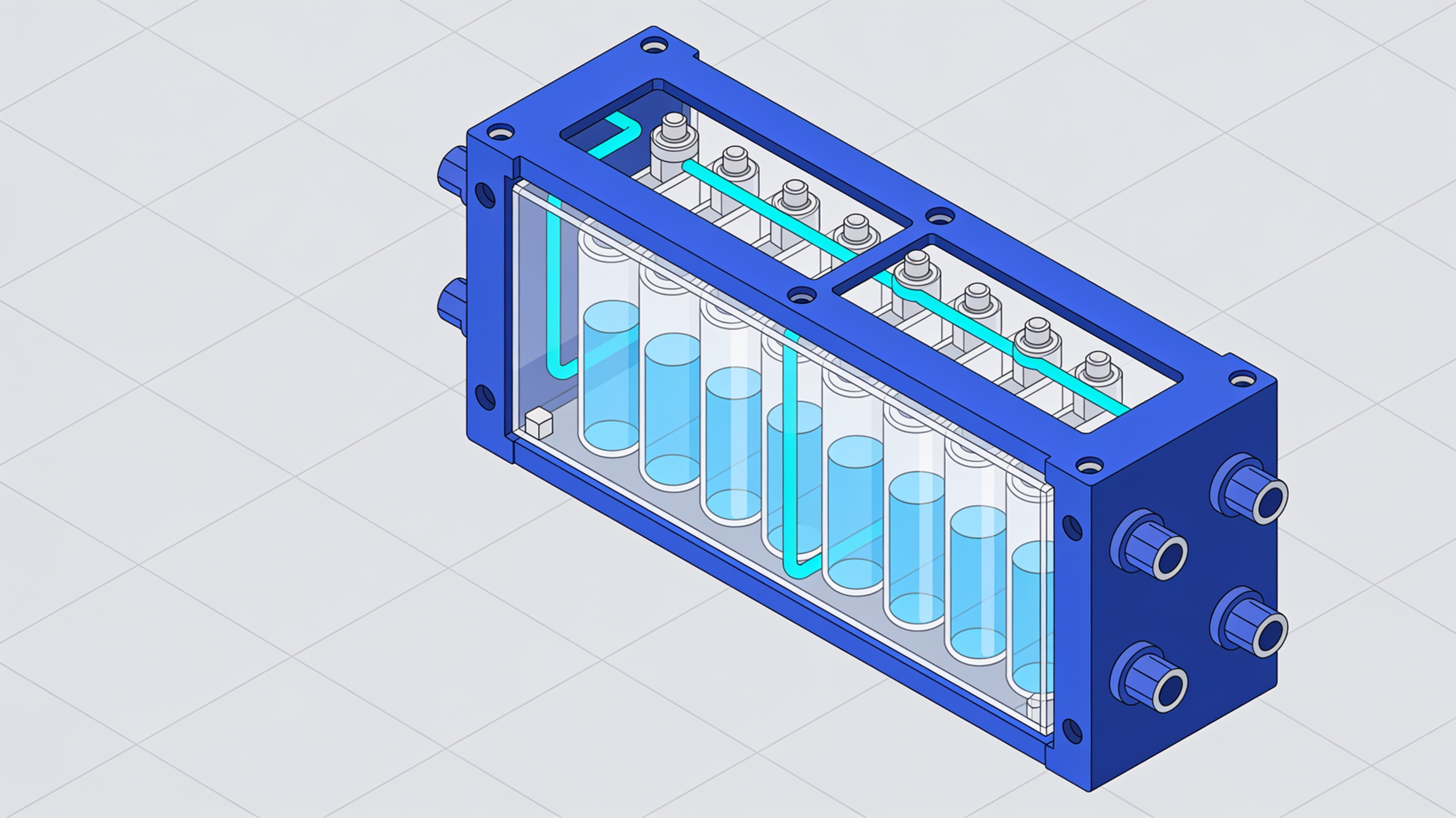
3D-printed flow batteries at £74: research becomes accessible
A team from Queen’s University Belfast has developed an experimental redox flow battery cell that costs about 74 pounds. The device uses 3D-printed components and off-the-shelf materials, compared to the 2,000-3,000 pounds required for commercial laboratory cells.
The project is led by Hugh O’Connor, a postdoctoral researcher at the School of Chemistry and Chemical Engineering, together with Josh J. Bailey, an Illuminate Fellow at the same university. The team also includes Peter Nockemann, Oana M. Istrate, Stephen Glover, and other researchers specializing in electrochemical systems for energy storage.
A device for research, not for the consumer market
The cell is not a ready-to-use home battery. It is a laboratory tool designed to standardize scientific research.
The goal is not to commercialize complete batteries for homes or power grids at low cost. The device serves as a common test platform to study electrolytes, membranes, electrodes, and fluid dynamics configurations.
The project files and instructions have been shared free of charge with the international scientific community. This choice allows different laboratories to build identical versions of the device and perform comparable procedures.
- Cost: 74 pounds vs. 2,000-3,000 pounds for commercial cells
- Components: 3D-printed with standard materials
- Target: research laboratories, not consumer market
- Availability: files and instructions shared free of charge
The problem of costs in research
Hugh O’Connor started the project during his PhD, when purchasing a commercial cell represented an insurmountable economic obstacle.
During his PhD, O’Connor needed a cell for experiments on flow batteries. Purchasing a commercial model required thousands of pounds, a prohibitive expense not only for the individual project.
Reliable research often requires multiple cells, experiment replicates, and replacement of worn or contaminated components. Purchasing a single expensive cell forces laboratories to reuse the same equipment for different tests.
This increases the risk that residues of one electrolyte affect subsequent experiments. It also limits the possibility of conducting parallel tests, slowing down research progress.
Development through 3D printing
O’Connor used a desktop 3D printer to produce the flow frames, progressively iterating the design until obtaining a functional device.
The researcher began producing the components with a desktop 3D printer, modifying geometry, sealing, liquid distribution, and assembly method. The different versions were tested until achieving reliable performance.
The 3D printing technology used is fused deposition modeling (FDM). The materials employed include ABS and polypropylene, both easily available and compatible with desktop printers.
Fused deposition modeling (FDM) is a 3D printing process that deposits thermoplastic material layer by layer. It is the most widespread technology in desktop printers due to its low cost and ease of use.
Standardization for comparable results
The availability of a common device solves a methodological problem: distinguishing whether differences in results depend on the chemistry studied or the equipment used.
Sharing the design allows laboratories to build identical versions of the cell. This makes it possible to more accurately verify the origin of variations in experimental results.
When each laboratory uses different equipment, comparing data becomes complex. A standardized device eliminates this variable, making research more reproducible and reliable.
The democratization of access to research tools accelerates innovation. Laboratories with limited budgets can now contribute to the development of energy storage technologies without economic barriers.
Implications for energy storage research
Redox flow batteries represent a promising technology for energy storage from renewable sources. The availability of low-cost experimental cells can accelerate the development of more efficient electrolytes and configurations.
The Queen’s University Belfast project demonstrates how 3D printing can break down economic barriers in scientific research. The open sharing of design files creates a collaborative ecosystem that benefits the entire community.
article written with the help of artificial intelligence systems
Q&A
How much does the new 3D-printed flow battery cell cost?
The experimental cell developed by Queen's University Belfast costs approximately £74. This price is drastically lower than the £2,000–£3,000 required for commercial laboratory cells.
Who is this 3D-printed battery intended for?
The device is not a battery for domestic or consumer use, but a laboratory tool designed for scientific research. It serves as a standardized platform for studying electrolytes, membranes, and fluid dynamic configurations.
Who developed the low-cost cell project?
The project is led by Hugh O'Connor and Josh J. Bailey from Queen's University Belfast, with support from other researchers specializing in electrochemical systems. O'Connor initiated the development during his PhD to overcome economic barriers.
Why did researchers choose to use 3D printing?
3D printing enables the production of low-cost components using standard materials, making research accessible. Furthermore, it allows the creation of identical replicas for parallel testing, preventing contamination between different experiments.
How can laboratories obtain the files to build the cell?
The design files and instructions have been shared free of charge with the international scientific community. This choice allows various laboratories to build identical versions of the device and perform comparable procedures.