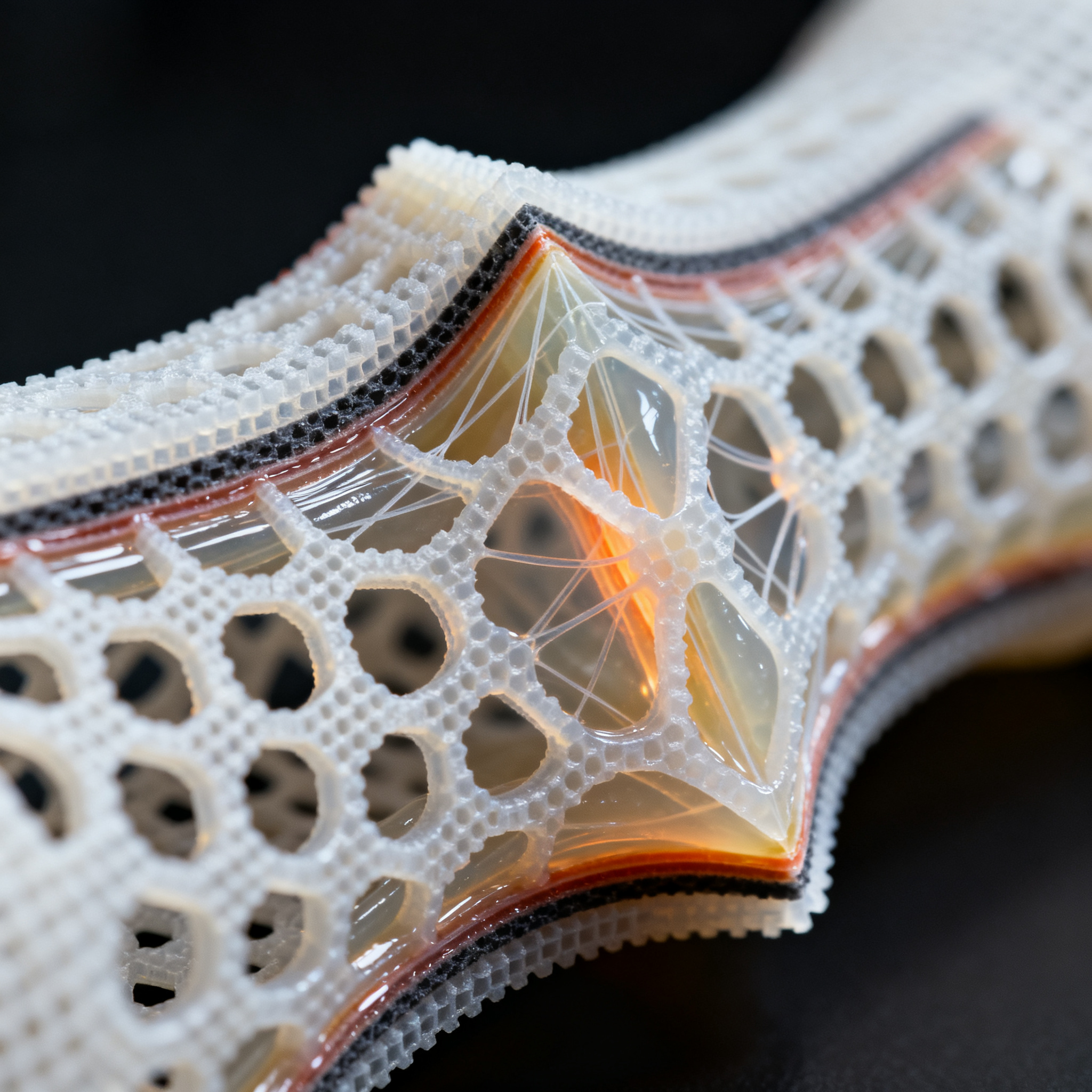
4D Printing: AI Predicts How the Future Transforms
4D materials are no longer just printed objects, but intelligent systems that self-repair or adapt thanks to external stimuli and AI algorithms. The fourth dimension is time: structures designed to transform autonomously after printing.
The programmed metamorphosis of 4D materials
4D materials transform over time thanks to external stimuli and controlled physical properties, representing the leap from passive to active hardware.
The technical leap of 4D printing lies in the chemo-mechanical programming of the ink. Unlike standard 3D printing, 4D uses shape-memory polymers (SMP) or specialized hydrogels encoded to react to environmental triggers such as heat, pH gradients, or light.
This transition from passive to active hardware represents a frontier in precision medicine. An example: a flat-pack orthopedic scaffold printed for minimally invasive surgery. Once inserted, internal body heat activates the material, which spontaneously folds into a pre-programmed complex structure designed to regenerate tissue and support healing.
- Shape-memory polymers react to heat, pH, or light to modify the structure
- Body heat can activate orthopedic scaffolds that self-assemble after insertion
- The specific healthcare sector will reach $4.7 billion by 2034
Multimaterial printing: the DNA of transformations
Precision in the choice of materials and thermal coefficients allows for programming complex final shapes through the controlled management of internal stresses.
Programming these materials involves multimaterial printing, where different expansion coefficients create internal tension. When triggered, this latent tension is released, forcing the object into a predetermined configuration.
The ability to program material behavior is now as critical as the physical printing itself. This creates a multi-billion dollar intersection between materials science and artificial intelligence.
The software segment of 4D printing is currently the fastest-growing component of the market. Projections place the specific healthcare sector beyond $4.7 billion by 2034.
AI and inverse design: predicting the future of material
AI algorithms model the material's temporal behavior in advance, reducing trial-and-error and accelerating development from years to months.
The most significant growth in the sector is driven by artificial intelligence. Predicting how a complex 3D structure will fold over time involves high-dimensional non-linear equations often insurmountable for human engineers alone.
AI and Machine Learning are now used to solve the inverse design problem. Generative design identifies the optimal distribution of active materials (voxels) to achieve a target transformation, ensuring the device adapts to the patient's unique anatomy.
ML models simulate how a 4D stent will behave within a fluctuating biological environment, reducing the R&D cycle from years to months.
Predictive precision is the true competitive advantage. AI not only accelerates development but makes it possible to design transformations that would be impossible to calculate manually.
Medical applications: from self-assembly inside the body
In the medical sector, 4D materials promise smart implants that autonomously adapt to physiological conditions, opening scenarios unthinkable with traditional surgery.
Orthopedic scaffolds are just the beginning. 4D materials allow devices that self-assemble inside the body, adapting to the patient's specific physiological conditions.
The frontier of intellectual property presents a unique challenge: not only is an object patented, but a behavior over time. This legal complexity reflects the revolutionary nature of the technology.
The union between smart materials and artificial intelligence is redefining the boundaries of biomedical engineering. The ability to design devices that evolve autonomously after implantation opens therapeutic possibilities that were previously impossible.
Discover how AI is accelerating the design of 4D systems for cutting-edge medical applications. The future of personalized medicine passes through materials that think and transform autonomously.
article written with the help of artificial intelligence systems
Q&A
What does the "fourth dimension" in 4D printing consist of, and what is the fundamental difference compared to 3D printing?
The fourth dimension is time, that is, the ability of objects to transform autonomously after printing. While 3D printing produces passive hardware, 4D printing creates active intelligent systems that react to external stimuli such as heat, light, or pH.
What materials are used in 4D printing and what environmental stimuli trigger their transformation?
Shape-memory polymers (SMPs) and specialized hydrogels are mainly used, encoded to react to specific triggers. These stimuli include heat, pH gradients, and light, which alter the material's structure over time.
How does the example of the flat-pack orthopedic scaffold described in the article work?
The scaffold is printed in a flat shape to allow minimally invasive surgical insertion. Once placed in the body, body heat triggers the material to spontaneously fold into the pre-programmed complex structure to regenerate tissue.
What is the role of artificial intelligence in the design of 4D materials?
AI algorithms and machine learning solve inverse design problems, modeling the temporal behavior of materials in advance. This reduces the research and development cycle from years to months and makes it possible to design transformations that are impossible to calculate manually.
What are the economic projections for the 4D printing healthcare sector and what medical applications does it promise?
The 4D printing healthcare sector is expected to reach $4.7 billion by 2034. Applications include smart implants that self-assemble and autonomously adapt to the patient's physiological conditions, opening up scenarios unthinkable for traditional surgery.