Is equestrian biomechanics 3D printed?
The customization of equestrian equipment thanks to 3D printing is redefining the boundary between craftsmanship and technology, allowing tailor-made solutions based on objective data.
3D printing enters the equestrian sector through a concrete need: to better adapt the equipment to the horse's body. Saddles, bits, bridles, horseshoes, pads and protections touch sensitive areas, distribute loads and influence movement, posture and comfort.
Each horse has a different morphology that changes with age, training, discipline and health. A saddle suitable for one back can create problems on another. For this reason, 3D scanning, CAD design, flexible materials and lattice structures become additional tools to work on the individual animal.
Tailor-made data: the basis of biomechanical customization
The precision of 3D scanning and pressure sensors makes it possible to adapt each component to the specific needs of the horse.
Digital technologies allow more precise information to be collected compared to choosing between standard sizes. With a 3D scanner, the shape of the back or hoof is acquired. With sensor mats, the pressure distribution under the saddle during movement is observed.
An example is the pressure measurement system developed by T&T medilogic Medizintechnik GmbH. The flexible medilogic mat is placed between the back and the saddle and records the load distribution even during movement. This data helps the technician understand if the saddle creates pressure peaks, asymmetries or unwanted load zones.
- 3D scanner for back and hoof morphology
- Sensorized mats for pressure mapping in motion
- Image analysis software for comparison of X-rays and photographs
In the field of the hoof, tools like Metron-Hoof work on images and X-rays, creating measurements and reports. The digital collects the shape, the software transforms it into geometry, 3D printing produces a physical component that is controllable and modifiable.
Smart materials and geometries for dynamic comfort
The’use of advanced polymers and reticular structures allows the creation of harnesses that adapt to movement, improving performance and well-being.
The materials must resist sweat, water, dirt, impacts, flexions, and compressions. The parts in contact with the horse's skin must avoid edges, friction, and heat buildup. The structural components must pass rigorous tests because failure can cause risks.
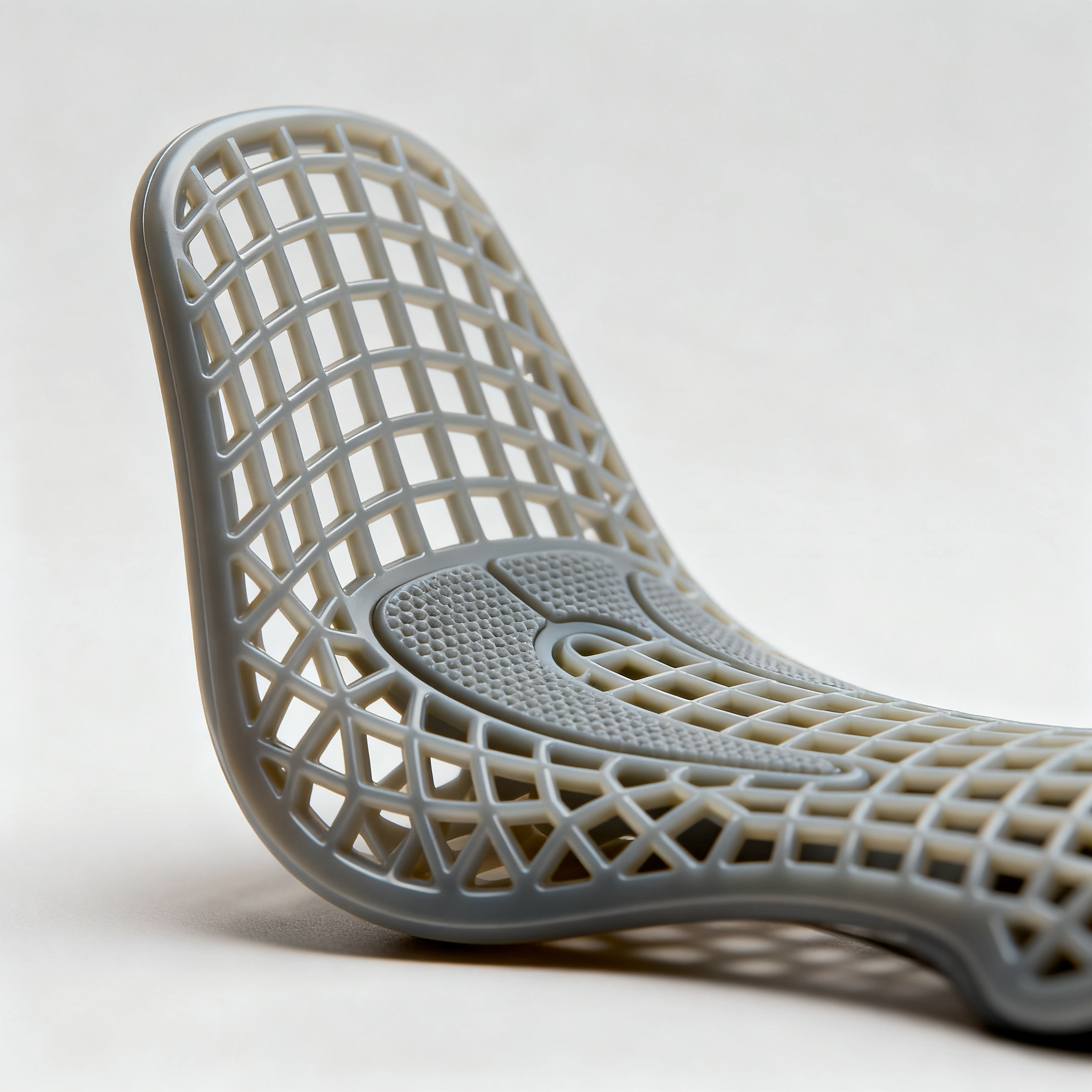
Lattice structures allow local modulation of the surface behavior. The saddle can be more supported where stability is needed and more open where pressure needs to be relieved. With biometric data or dynamic tests, customization becomes more precise compared to choosing among a few standard widths.
Additive manufacturing allows modifying the digital geometry and producing components with differentiated stiffness zones, lightweight structures, and controlled support areas. The lattice is not a generic pattern but the structural base, with variable density to create stiffer or more yielding zones according to the required function.
Lattice geometries allow controlling the mechanical response point by point, creating components that support weight, avoid localized pressures, and absorb vibrations without becoming too heavy.
From scan to saddle: the end-to-end digital workflow
An integrated process of acquisition, modeling and printing allows producing customized equipment in times compatible with professional use.
The process starts from data collection through 3D scanning and pressure sensors. The information is processed in CAD software to create optimized geometries. 3D printing produces the final component, often in materials like TPU for flexibility or advanced polymers for strength.
Customization workflow
- Acquisition: 3D scanning of morphology and pressure mapping during movement.
- Design: CAD modeling with variable density lattice structures and biomechanical optimization.
- Production: 3D printing in flexible or rigid materials according to functional specifications.
- Validation: testing in real conditions with veterinarians, saddlers and expert users.
A 3D scan is not enough if the designer does not know anatomy and biomechanics. A lattice is not useful if it is not sized correctly. 3D printing works when it is inserted into a process guided by professionals: designers, veterinarians, farriers, saddlers and materials technicians.
The value is not in mass production but in customization. A 3D printed saddle, a hoof sole or a pad must solve specific problems: better distribute the load, adapt to a particular morphology, lighten a part or accelerate the development of a prototype.
The digitalization of equestrian design does not cancel the traditional experience, but enhances it with objective and repeatable tools. The farrier can use data and geometries to better support a difficult hoof. The saddler can evaluate pressures and shapes with digital tools. The veterinarian can print an anatomical model to study a case.
The first applications will likely remain in premium products, research, specialist veterinary care, and prototyping. But the combination of 3D scanning and additive manufacturing creates a new toolbox for the equestrian world, where custom-made is not a decorative luxury but a necessity linked to the animal’s well-being.
Explore how your manual processes can benefit from the integration with scanning and additive manufacturing technologies.
article written with the help of artificial intelligence systems
Q&A
How does 3D printing improve the fit of equestrian equipment to the horse?
3D printing allows the creation of custom components based on objective data such as 3D scans and pressure maps. This overcomes the limitations of standard measurements, adapting saddles, bits and other tack to the specific morphology of each animal, which changes with age, training and health.
What tools are used to collect the horse's biomechanical data?
3D scanners are used for the morphology of the back and hoof, sensorized mats to map pressures under the saddle in motion and image analysis software for radiographs and photographs. This data allows identifying pressure peaks, asymmetries and unwanted load zones with precision superior to traditional measurements.
What are lattice structures and what is their advantage in 3D-printed equestrian equipment?
Lattice structures are lattice geometries with variable density that constitute the structural base of components. They allow modulating stiffness locally, supporting weight where stability is needed, avoiding localized pressures and absorbing vibrations while maintaining lightness.
What is the complete digital workflow for the production of a customized saddle?
The process begins with acquisition through 3D scanning and pressure sensors, followed by CAD design with biomechanically optimized lattice structures. 3D printing manufactures the component in flexible or rigid materials according to needs, finally validation takes place with tests in real conditions conducted by veterinarians, saddlers and expert users.
Why does 3D printing not replace the traditional experience of equestrian professionals?
Because technology must be embedded in a process guided by experts such as veterinarians, saddlers and farriers who know anatomy and biomechanics. Digitization enhances craftsmanship with objective and repeatable tools, but does not erase the value of practical experience necessary to correctly interpret data and size components.