How does Nourished print custom supplements?
From a British startup to an international reality: here's how Nourished is scaling the production of custom supplements with 3D printing.
Rem3dy Health, the company behind the Nourished brand, has raised £14 million to expand the production of custom 3D-printed supplements. The model is based on a proprietary production platform that generates custom nutritional gummies for each customer. The goal is to bring this technology to the United States, India, the Middle East, and North Africa.
- Current production: about 500,000 custom gummies per day
- 2025 revenue: over £10 million (+611% year over year)
- 29 patents filed on technology and production processes
- Distribution in thousands of European pharmacies and major UK chains
The technology behind personalized nutrition
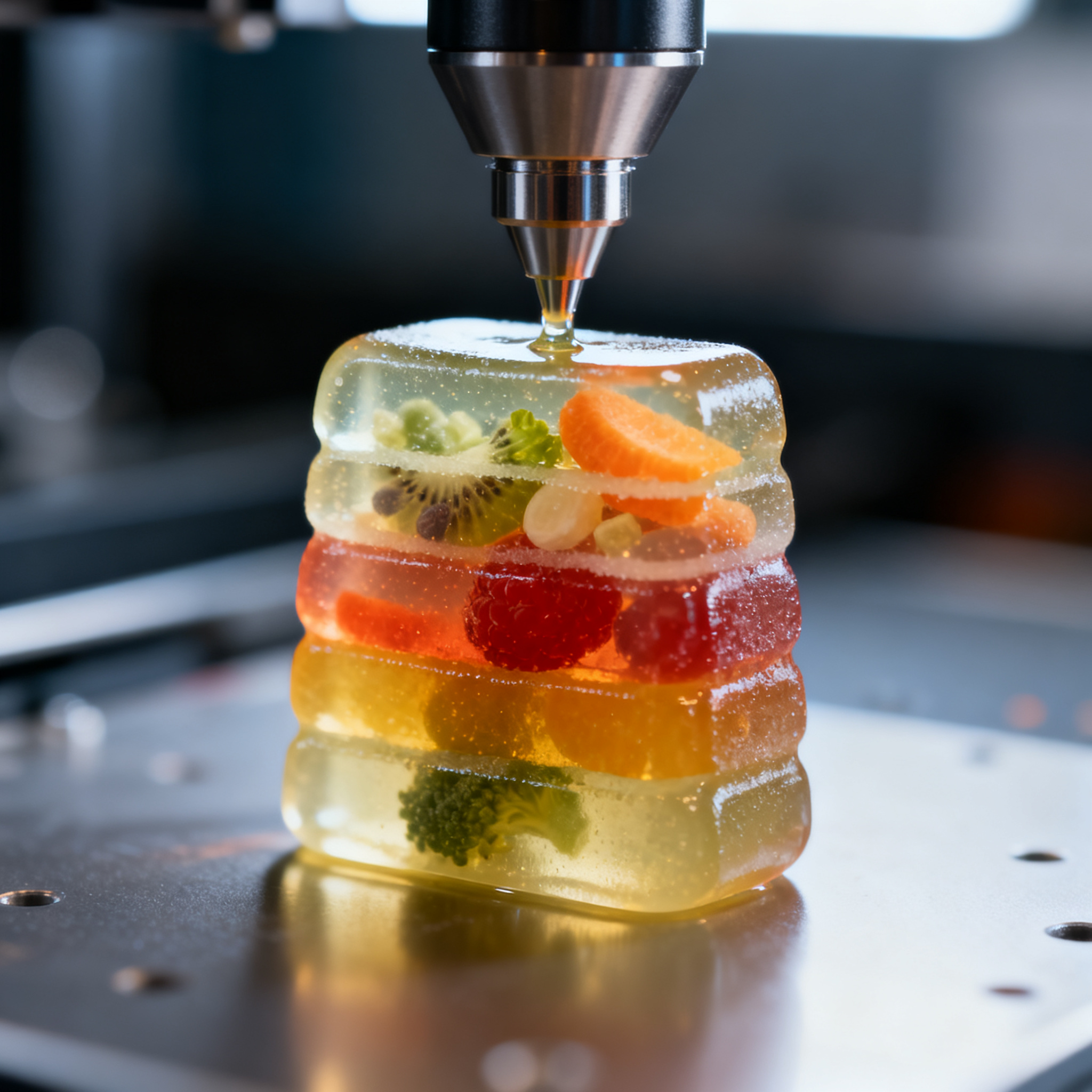
Nourished uses multi-layer 3D printing to produce unique nutritional gummies for each customer.
The production system is based on a proprietary technology that deposits seven layers of nutrients. Each layer can contain a different formulation: vitamins, minerals, specific supplements. 3D printing allows for the combination of ingredients that in a traditional process would require separate lines or batches.
Controlled deposition manages formulations, consistencies, dosages, and product stability. Customization is not only aesthetic but compositional. Each gummy is built based on the individual consumer's profile.
The value of the technology lies in the ability to maintain a common format while producing infinite variants. The platform can scale without losing control over the quality and consistency of the final product.
Customization automation
An algorithm powered by data collected online allows for the automatic generation of the ideal formulation for each user.
The process starts with an online questionnaire. The customer answers questions about health goals, lifestyle, diet, and specific needs. The data is processed by an automated system that generates the personalized recipe.
Operational workflow
- Data collection: The customer completes the online questionnaire with their nutritional needs.
- Processing: The algorithm generates the optimal formulation by combining the available ingredients.
- Production: The 3D printer builds the seven-layer gummy according to the generated recipe.
- Delivery: The product is shipped to the customer or made available in-store.
This workflow eliminates the need for manual intervention in the customization phase. Scalability depends on the system's ability to manage thousands of different profiles while maintaining constant production times.
The integration between data collection, algorithm, and additive manufacturing represents the true competitive advantage. It is not just 3D printing, but an end-to-end digital system.
Scale without losing focus
Investments in artificial intelligence and automation have allowed the company to expand production while maintaining high personalization.
Rem3dy Health has increased production by 61% in one year thanks to greater automation and use of artificial intelligence. The company now produces about 500,000 custom gummies per day. The challenge is to maintain this capacity while expanding into very different markets.
Investors include Suntory, Estrella Galicia, Apollo Hospitals, and the French pharmaceutical group UPSA. This composition suggests interest in both the production model and commercial applications. The capital will be used for automation, artificial intelligence, and new production facilities.
The United States, India, the Middle East, and North Africa are markets with growing demand for wellness products, but they require regulatory, logistical, and communicative adaptations. The challenge will be to replicate the British model without losing control over quality and costs.
The company is also developing products for pets. The pet wellness sector has grown rapidly, but requires specific formulations, different tests, and dedicated regulatory compliance. The technological platform is the same, but ingredients, dosages, and communication change.
Distribution through Boots, Holland & Barrett, and Ocado demonstrates that Nourished is no longer just e-commerce. The brand is bringing personalization to channels where the consumer chooses ready-made products. Coexisting shelf and custom-made product is an operational and commercial challenge.
Conclusion
Nourished demonstrates how 3D printing can revolutionize personalized nutrition at an industrial level. The model combines proprietary technology, data automation, and multichannel distribution. The £14 million funding indicates that investors and industrial partners consider this approach scalable.
The case is relevant for the additive manufacturing sector because it shows a repeatable consumer application, linked to a daily routine and sellable through traditional channels. 3D printing is no longer just prototyping or small series, but high-volume production with real personalization.
Do you want to understand how to adapt this technology to your sector? Start by analyzing key automation and data collection processes. Production technology is only part of it: adequate margins, regulatory compliance, stable supply chain, and the ability to manage thousands of variants while maintaining constant quality are needed.
article written with the help of artificial intelligence systems
Q&A
How does the 3D printing technology used by Nourished to produce supplements work?
Nourished uses a proprietary multi-layer 3D printing technology that deposits seven layers of nutrients to create unique nutritional gummies. Each layer can contain different formulations such as vitamins, minerals, or specific supplements, allowing the combination of ingredients that would require separate batches in a traditional process. The controlled deposition manages formulations, consistencies, dosages, and stability of the final product.
What is the process that allows Nourished to customize the gummies for each individual customer?
The process begins with an online questionnaire in which the customer indicates health goals, lifestyle, and specific needs. An algorithm automatically processes the data and generates the optimal formulation by combining the available ingredients. Subsequently, the 3D printer produces the seven-layer gummy according to the generated recipe, eliminating the need for manual intervention in customization.
What are the production figures and growth achieved by Rem3dy Health?
The company produces approximately 500,000 customized gummies per day and recorded revenues of over 10 million pounds sterling in 2025, with 61% year-over-year growth. This scalability is made possible by automation and artificial intelligence, which allow thousands of different profiles to be managed while maintaining constant production times and high quality.
Which markets does Nourished intend to expand into and what challenges will it have to face?
Rem3dy Health aims to expand into the United States, India, the Middle East, and North Africa, markets with strong demand for wellness products. The main challenge is replicating the British model by adapting it to very different regulatory, logistical, and communication contexts, without losing control over quality and production costs.
Who are Nourished's investors and how will the funding of 14 million pounds be used?
The company raised 14 million pounds sterling from investors such as Suntory, Estrella Galicia, Apollo Hospitals, and the French pharmaceutical group UPSA. This capital will be used to strengthen automation, artificial intelligence, and the construction of new production facilities to support international expansion.
How does Nourished's distribution differ from a pure e-commerce model?
In addition to e-commerce, Nourished is present in thousands of European pharmacies and major British chains such as Boots, Holland & Barrett, and Ocado. This multichannel distribution represents an operational and commercial challenge, as it requires customized made-to-order products to coexist with items already ready on the shelves.