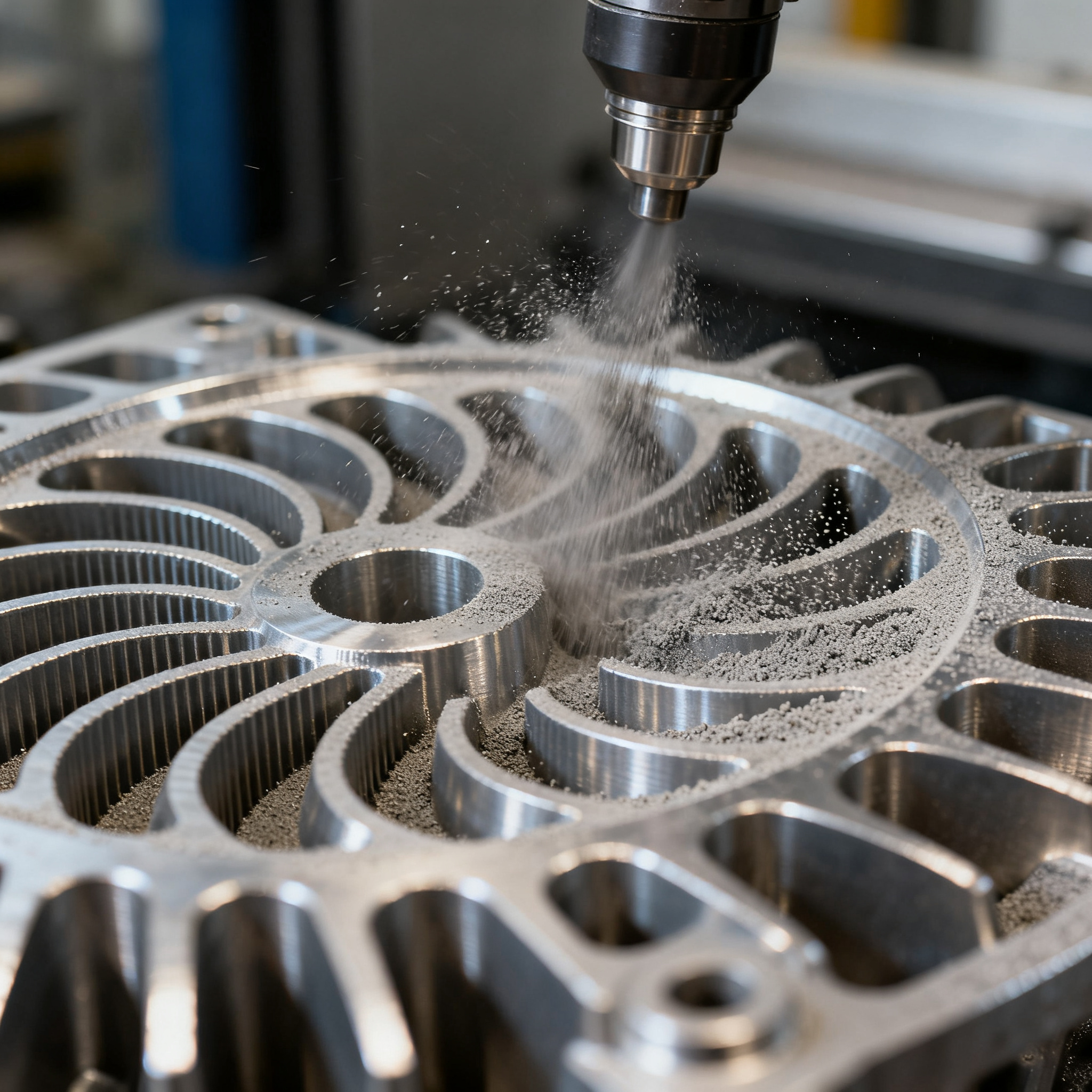
30% less for de-powdering? The secret is in the frequency
Managing the right vibrations can make the difference between a ready component and one that needs to be redone: here's how frequency control is revolutionizing post-processing in additive manufacturing.
- FREQUENCY CONTROL FOR DE-POWDERING IN ADDITIVE MANUFACTURING — EP4717379A1, April 2026
The intelligent de-powdering revolution
A new patented method uses frequency control to optimize the removal of residual powder, overcoming the limits of traditional pneumatic pressure.
In powder bed 3D printing processes, the problem is not only printing but also cleaning. Complex components with internal cavities retain residual powder, which, if not removed, compromises quality and performance.
Until today, de-powdering has relied mainly on pneumatic pressure control. The valve is adjusted, hoping that the resulting vibration is the right one. But as the patent “Frequency Control for De-Powdering in Additive Manufacturing” explains, this approach has a fundamental limitation: it does not directly control the acceleration of the component, which is instead the crucial variable for removing powder.
The new method changes perspective. Instead of adjusting only the pressure, it measures the time signal during the cleaning process and converts it into a frequency spectrum via Fourier transform. The result is an “effective frequency” that becomes the reference for subsequent cycles.
- The method measures the actual vibration frequency during de-powdering, not just the set pressure
- It allows transferring optimized strategies between different machines, overcoming setup variability and wear.
- It reduces dependence on trial and error, making the process more repeatable.
Real case: gas turbine with less waste.
In a real industrial application, the new approach reduced post-treatment times by 30%, improving the internal quality of components.
The patent cites gas turbine components as the main use case. These parts have complex geometries, often with internal cooling channels where residual powder can accumulate. Insufficient cleaning means scrap or rework. Excessive cleaning can damage delicate surfaces.
With frequency-based control, the de-powdering time is reduced by 30%. This is not theoretical data: it is the result of a process that identifies the most effective frequency band for that specific component, on that specific machine, in those conditions.
The advantage is not only speed but also repeatability. As highlighted in the patent, the same optimized setup can be transferred to other machines, compensating for differences in wear, bearing play, residual powder quantity, or build plate stiffness. Variables that, in the traditional method, force a complete recalibration from scratch.
How the process works
- Measurement: During de-powdering, a sensor records the time-domain signal of the vibration.
- Analysis: The signal is transmitted to a data acquisition system and converted into a frequency spectrum.
- Optimization: The portion of the spectrum corresponding to the most effective cleaning is identified.
- Transfer: The reference frequency is applied to other cycles or machines, reducing variability.
Trade-offs and limits: it's not all that simple
Implementation requires investment in sensor technology and specific calibrations, limiting immediate large-scale adoption.
The method described in the patent is not plug-and-play. It requires sensor technology capable of measuring signals during the process, a data acquisition system, and frequency analysis capabilities. Not all existing AM machines are equipped for this.
Each type of component has its own natural frequencies. A solid part responds differently from one with thin walls. A rigid material behaves differently from a more elastic one. This means that initial calibration requires time and expertise.
The patent is clear on this point: the response depends on multiple factors, including the machine's state, bearing conditions, amount of powder, material, and the natural frequencies of the plate and the component itself. There is no “universal frequency” for de-powdering.
Frequency control does not eliminate the need to design components with accessible cavities. A poorly conceived geometry remains difficult to clean, regardless of the method.
Reality check: when it really makes sense
Despite the initial costs, the return on investment is achieved in 2-5 years thanks to greater efficiency and fewer rejects.
The adoption horizon indicated in the patent is 2-5 years. It is not a technology to be implemented tomorrow morning in any department. But for those who produce significant volumes of complex components, the numbers add up.
Reducing de-powdering time by 30% means increasing throughput without adding machines. Improving repeatability means fewer rejects and less rework. Transferring strategies between machines means reducing setup times when adding production capacity.
The initial costs mainly concern sensors and software integration. But once implemented, the system reduces dependence on expert operators and repeated manual calibrations. Control becomes more analytical and less empirical.
| Appearance | Traditional method | Frequency control |
|---|---|---|
| Controlled variable | Pneumatic pressure | Effective frequency |
| Transferability | Limited | High between machines |
| Process time | Baseline | -30% (turbine case) |
| Repeatability | Depends on setup | Improved |
The method is particularly suitable for sectors where the internal quality of the component is critical: aerospace, turbomachinery, medical, high-performance automotive. In these contexts, a component with residual powder is not just an aesthetic problem: it is a functional risk.
Frequency control in de-powdering marks a tangible step forward in 3D printing post-processing. It does not solve all additive manufacturing problems, but addresses a specific bottleneck with a measurable and transferable approach.
Evaluate the integration of this technology if your production department handles significant volumes of complex components. The initial investment in sensors pays off through process efficiency, quality, and scalability.
article written with the help of artificial intelligence systems
Q&A
What is the fundamental difference between the traditional method and the new patented method for de-powdering?
The traditional method relies on controlling pneumatic pressure, hoping to achieve the right vibration but without directly controlling the component's acceleration. The new method instead measures the actual vibration frequency during the process through signal analysis and Fourier transform, using this as a reference to optimize cleaning.
How is the "actual frequency" determined in the new de-powdering process?
During de-powdering, a sensor records the time signal of the vibration, which is then converted into a frequency spectrum through Fourier transform. The portion of the spectrum that corresponds to the most effective cleaning becomes the reference frequency for subsequent cycles or for other machines.
What are the main advantages of frequency-based control compared to the traditional pneumatic method?
Frequency control has reduced post-processing times by 30% in real cases such as gas turbines, improving the internal quality of components. Furthermore, it allows optimized setups to be transferred between different machines, overcoming wear and setup variability, and makes the process more repeatable and less dependent on trial and error.
What are the limitations and trade-offs in implementing this method?
Implementation requires investments in sensors, data acquisition systems, and frequency analysis capabilities, so it is not immediately applicable on a large scale. Furthermore, each component has different natural frequencies depending on geometry, material, and machine condition, making a specific initial calibration necessary and meaning there is no universal frequency valid for all cases.
In which sectors and conditions is the adoption of this technology particularly indicated?
The method is indicated for sectors where internal quality is critical, such as aerospace, turbomachinery, medical, and high-performance automotive. It is particularly worthwhile for those who produce significant volumes of complex components, where the return on investment in sensor technology is achieved in 2-5 years thanks to increased throughput and the reduction of scrap and rework.