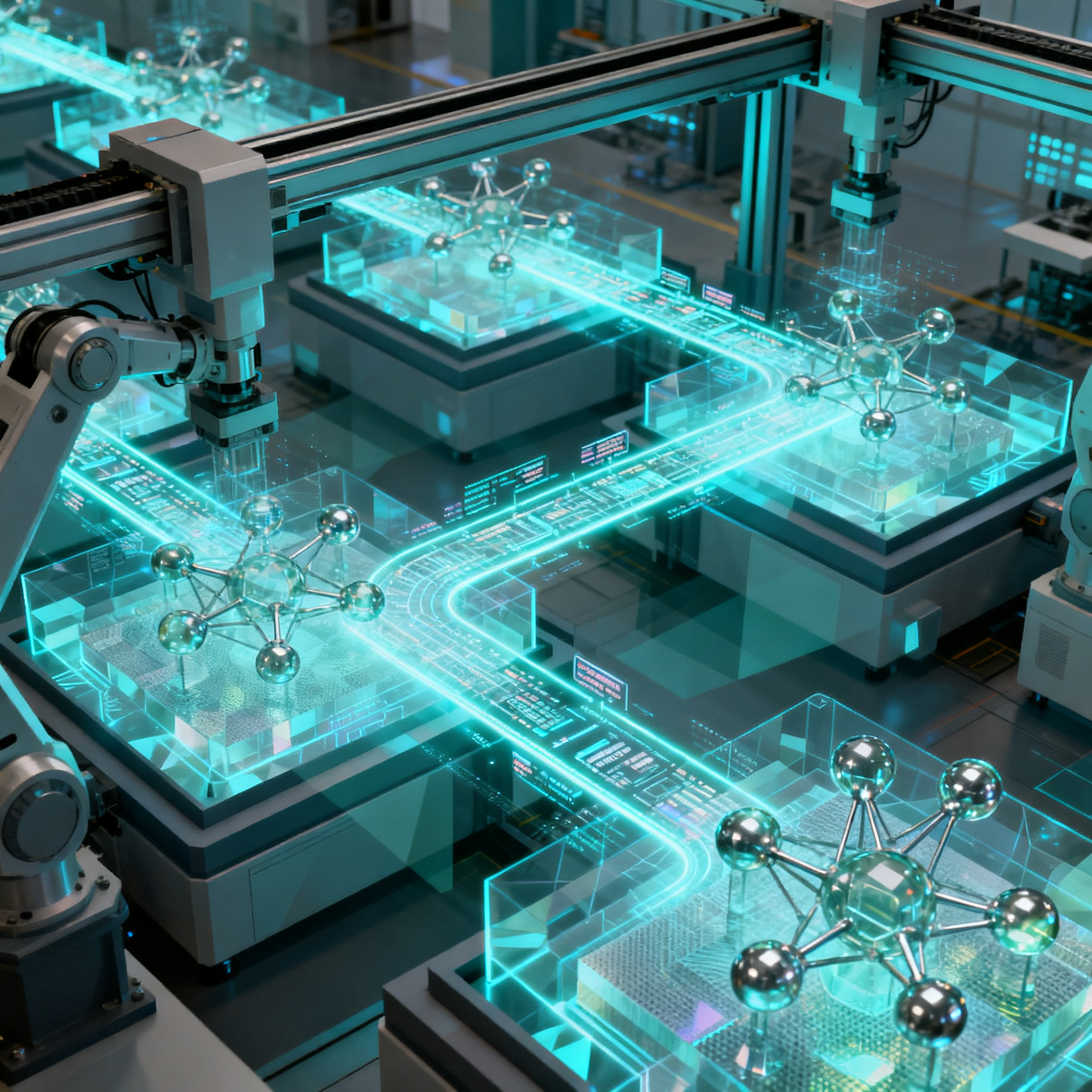
AI at scale: the automation that doesn't fail?
The integration of AI into industrial automation processes is not just a matter of advanced algorithms, but of rethinking the entire production flow. The real value emerges when artificial intelligence operates across the entire production chain, not on individual isolated steps.
Most AI implementations in additive manufacturing remain confined to individual machines and local optimizations. This approach improves the quality of individual builds, but does not solve scale problems: bottlenecks, manual handoffs, data fragmentation, and disconnected quality control continue to limit productivity and economic performance.
Reducing uncertainty with predictive AI
Predictive AI anticipates failures and optimizes parameters in real time, but requires consistent and structured data to work effectively.
Industrial additive manufacturing workflows involve complex multi-stage chains: digital preparation, material conditioning, printing, part removal, cleaning, heat treatment, surface finishing, inspection, and secondary operations. These steps are performed on equipment from different vendors with different control systems, data formats, and protocols.
- Unified data from printers, sensors, robots, and inspection systems
- Real-time coordination between different assets
- Open and extensible architectures to integrate new AI models
Historically, these workflows have been assembled through manual coordination. Without systemic coordination, downtime occurs, compliance risks increase, bottlenecks emerge, and the benefits of AI optimization remain limited.
Convergence between additive manufacturing and automation
The implementation of AI in additive manufacturing requires an integrated architecture that connects machines, sensors, and control software into a unified system.
Advanced production environments combine multiple additive platforms with robotic handling systems, post-processing equipment, inspection technologies, CNC finishing machines, and enterprise IT systems. To operate efficiently, these assets must function as a unified system, not as islands of automation.
The emerging approach is software-defined automation. Instead of coding one-off control logic into individual machines or PLCs, modern platforms provide centralized orchestration capabilities. These connect equipment, data flows, and production workflows into a single infrastructure.
In the industrial context, the primary concern is not losing data, but losing control of the physical process. Cloud vulnerabilities could lead to remote hijacking of the infrastructure, impacting workforce safety.
Edge computing becomes essential. Before integrating new AI software platforms, a structured plan is needed that considers the additional bandwidth and hardware requirements necessary to enable AI in the work environment.
End-to-end automation: the crux of interoperability
Without common standards and open protocols, AI remains isolated in technology islands unable to communicate with one another.
Fixed automation architectures and proprietary systems make it difficult to adapt workflows, integrate new tools, and deploy custom AI models as production methodologies evolve. Open platforms that support standard interfaces, modular integration, and configurable workflows enable continuous innovation without excessive costs.
| Approach | Proprietary architectures | Open platforms |
|---|---|---|
| AI integration | Difficult and expensive | Modular and scalable |
| Workflow adaptation | Requires infrastructure rebuild | Configurable without rebuilding |
| Interoperability | Limited to a single vendor | Open multi-vendor standards |
These architectures allow manufacturers to introduce AI techniques in a controlled manner, scale successful applications across plants, and adapt processes without rebuilding the core infrastructure. AI can thus operate on closed-loop control across production processes, coordinating real-time execution with manufacturing IT systems.
The most immediate use case with clear ROI is predictive quality control. By monitoring parameters in real time, AI can predict batch quality in advance, eliminating wait times for traditional tests and optimizing energy consumption.
Conclusion
AI is not a plug-and-play tool in industrial manufacturing. Its value is realized only with a systemic approach and infrastructures designed for continuous integration. Successful implementations require coordination across physical, digital, and control layers.
Companies that treat the network as a mere commodity discover that legacy architectures cannot support the performance and bandwidth required by modern use cases. Specific design is needed for the performance and security required by the process.
Assess the connectivity level of your plant: is it ready for distributed intelligence? Before investing in AI, verify whether your network infrastructure, security protocols, and data architecture support real-time orchestration across heterogeneous assets.
article written with the help of artificial intelligence systems
Q&A
Why does the integration of AI in industrial automation require rethinking the entire production flow?
Because the real value of artificial intelligence is realized only when it operates along the entire production chain, rather than limiting itself to isolated individual phases. Implementing advanced algorithms without redefining business processes risks generating local optimizations with little strategic impact. A holistic approach that reconfigures the overall flow is therefore necessary.
What is the main limitation of current AI implementations in additive manufacturing?
Most solutions remain confined to single machines and local optimizations. This fragmentation prevents leveraging the benefits derived from an overall view of production. Consequently, the transformative potential of AI in this sector remains largely unexpressed.
Where does the real value of AI in industrial automation manifest itself?
The real value emerges when artificial intelligence is integrated along the entire production chain, connecting all phases of the process. Point optimizations, while useful, do not generate the radical change needed to elevate overall efficiency. Only a systemic vision allows for lasting competitive advantages.
Is the adoption of AI in industry sufficient to successfully automate production processes?
No, because effective automation depends not only on advanced algorithms, but requires the redesign of the entire production flow. Without this structural rethink, AI risks remaining a technology applied in isolation. Success therefore derives from the combination of technological innovation and process transformation.
What distinguishes a large-scale AI implementation from a local optimization?
A large-scale implementation involves the entire production chain, creating value through the integration of all operational phases. Conversely, local optimizations act on individual machines or isolated processes, limiting the overall impact. The fundamental difference therefore lies in the scope of action: systemic versus point-based.