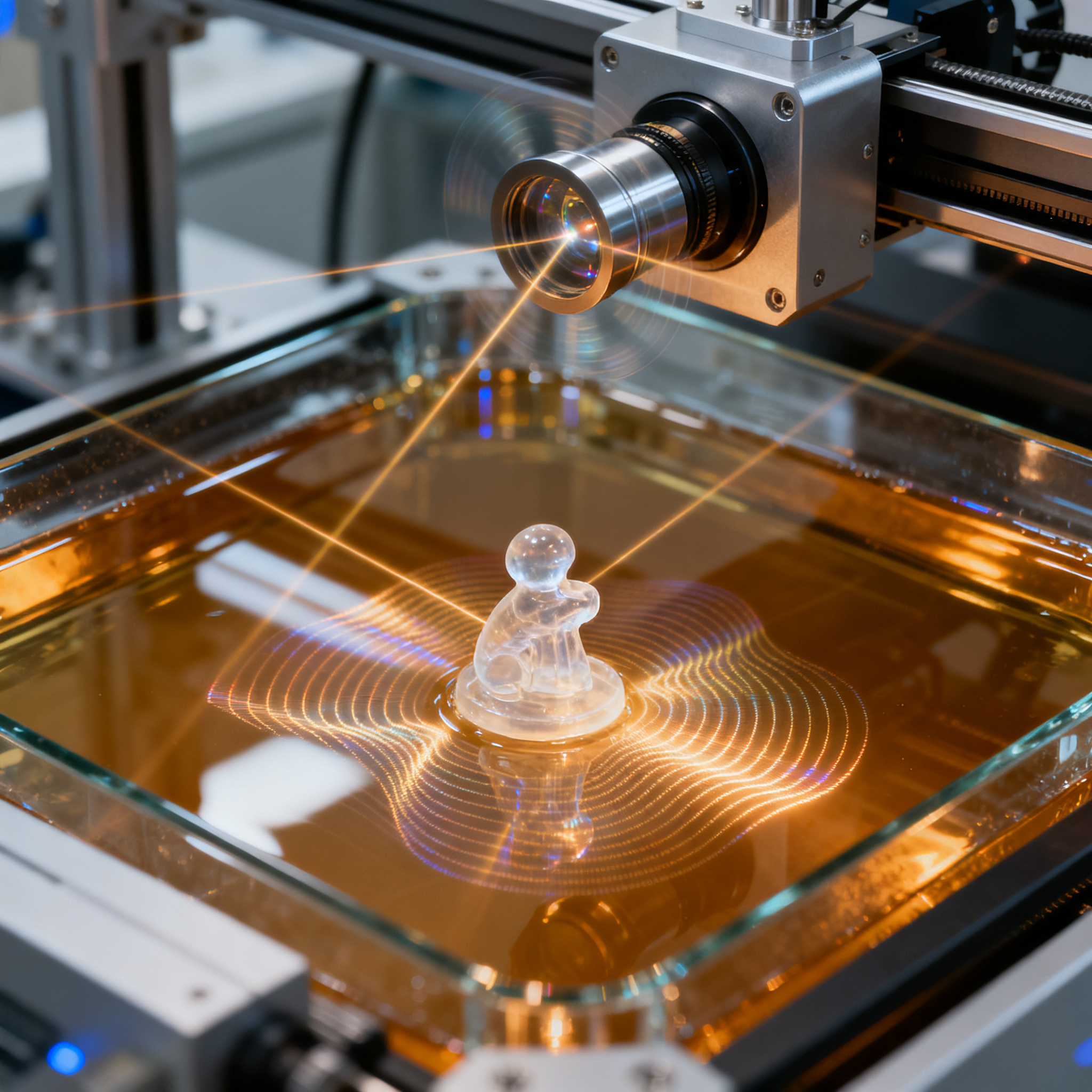
DISH Volumetric 3D Printing: How the Layer-Free Technology Works
DISH technology eliminates layer-by-layer printing and mechanical sample rotation, leveraging holographic light fields calculated with wave optics models. Developed by Tsinghua University, it prints millimeter objects in 0.6 seconds with a uniform resolution of 19 μm over 1 cm of depth.
Wave Optics at the Base of DISH
DISH overcomes the limits of geometric optics by introducing advanced physical models that consider light diffraction, allowing high resolution to be maintained beyond the native focal plane.
Previous volumetric systems relied on geometric optics (ray-optics) approximations. This approach works for simple geometries but fails when high resolution over extended volumes is required.
The Tsinghua team implemented a wave optics propagation model that accounts for diffraction and refraction at the air-resin interface. It uses angular spectrum methods to calculate how light actually propagates in the material.
Coherent laser illumination is fundamental. It enables the holographic calculation of light fields that maintain high-resolution modulation well beyond the projection optics focal plane. This eliminates the need for mechanical focus shifts.
- Wave propagation model with angular spectrum methods
- Holographic calculation of light fields instead of geometric approximations
- Coherent laser illumination to maintain resolution beyond the focal plane
- Diffraction and refraction correction at the air-resin interface
Key Components of the DISH System
A rotating periscope and a synchronized DMD enable volumetric writing in a static volume of photosensitive resin, eliminating the problems of mechanical sample rotation.
The heart of the system is a rotating periscope positioned in front of the lens. This component redirects the modeled laser projections towards a fixed resin container, achieving up to 10 rotations per second.
A digital micromirror device (DMD) operates up to 17,000 Hz. It synchronizes binary projection patterns with the angular position of the periscope, ensuring that each angle receives the correct pattern at the right time.
The holographic optimization algorithm works in two phases. First, it computes 180 angular dose distributions in grayscale. Then it converts them into 1,800 binary projections using a binarization parameter G=10 to reduce motion blur and preserve tonal fidelity through incoherent summation.
Rotating liquids at high speeds generates fluidodynamic instability and vibrations. With the rotating periscope, the resin remains static and less viscous formulations can be used, useful for applications with continuous material flow.
Adaptive optics-based calibration corrects single-pixel misalignments through projection angles. Two orthogonal cameras observe fluorescence in the material and allow for correction of shifts and aberrations for each angle.
Resolution and Speed: Real Data
With 19 μm of constant resolution over 10 mm of depth and times under one second for millimeter-sized objects, DISH redefines the parameters of quality and productivity in volumetric printing.
The uniform resolution of 19 μm over 1 cm of depth represents a remarkable result. In traditional systems, an objective with a numerical aperture of 0.055 at 405 nm has a depth of field of about 0.4 mm. Maintaining high-resolution modulation on a centimetric scale would require axial scanning or loss of fidelity.
DISH prints millimeter-sized objects in 0.6 seconds, reaching a volumetric speed of approximately 333 mm³/s. This eliminates the traditional trade-off between spatial resolution and volumetric build speed.
| Parameter | DISH | Traditional CAL |
|---|---|---|
| Print time (mm objects) | 0.6 seconds | Minutes |
| Uniform resolution | 19 μm on 1 cm | Variable with depth |
| Volumetric speed | 333 mm³/s | <100 mm³/s |
| Mechanical rotation | No (periscope) | Yes (sample) |
Demonstrative geometries include lattices, bifurcated tubular structures, Benchy-type models, and helical geometries. Bifurcated tubes are particularly significant for biofabrication: building complex channels within hydrogels without internal supports is an open problem that volumetric printing can address.
The system supports continuous flow production. A pump can move printed parts out of the exposure zone, replenish new material, and produce different structures in succession. This opens possibilities for microcomponents, pharmaceutical screening, and micromachines.
Conclusion: DISH represents a conceptual leap in volumetric 3D printing, founded on rigorous physical principles that overcome geometric approximations. The integration of wave optics, high-speed synchronization, and adaptive calibration eliminates mechanical constraints that limited speed and resolution. Explore how wave propagation models are redefining high-precision additive manufacturing technologies for applications in biomedicine, microfluidics, and miniaturized photonics.
article written with the help of artificial intelligence systems
Q&A
What is DISH technology and what is its main advantage over traditional 3D printing?
DISH is a volumetric 3D printing technology developed by Tsinghua University that eliminates layer-by-layer construction. Its main advantage is the ability to print millimeter-scale objects in 0.6 seconds with a uniform resolution of 19 μm over 1 cm of depth, overcoming the traditional trade-off between speed and resolution.
How does wave optics improve the performance of the DISH system compared to geometric optics?
Wave optics considers phenomena such as diffraction and refraction at the air-resin interface, using angular spectrum methods. This allows high resolution to be maintained beyond the native focal plane, unlike geometric optics which fails on extended volumes.
What are the key components of the DISH system and how do they interact?
The system relies on a rotating periscope that redirects light toward a static resin and a digital micromirror device (DMD) operating at up to 17,000 Hz. The DMD synchronizes binary patterns with the periscope's rotation, while a holographic algorithm calculates the required dose distributions.
Why does the resin container remain stationary during the printing process?
The resin remains static to avoid fluid dynamic instabilities and vibrations caused by rotating liquids at high speed. This allows less viscous formulations to be used and enables continuous-flow production, where printed parts are moved and replaced automatically.
How is the precision of the DISH system ensured during printing?
Precision is ensured by an adaptive optics-based calibration that corrects misalignments of individual pixels across projection angles. Two orthogonal cameras monitor fluorescence in the material to correct shifts and aberrations in real time.
What are the most promising applications of DISH technology?
DISH is particularly suited for the biofabrication of bifurcated tubular structures without internal supports, the production of microcomponents, pharmaceutical screening, and micromachines. Its ability to work in continuous flow makes it ideal for applications requiring high productivity and precision.