Cold Spray: metals without fusion?
Cold Spray is a metal deposition technology that uses the supersonic speed of particles to create components without altering their original structure. Metal particles are accelerated beyond 1000 m/s and mechanically bond to the substrate thanks to the kinetic energy of the impact, preserving the properties of the base material.
Supersonic impact physics
The process is based on accelerating metal particles to high speeds via compressed gases, avoiding heating.
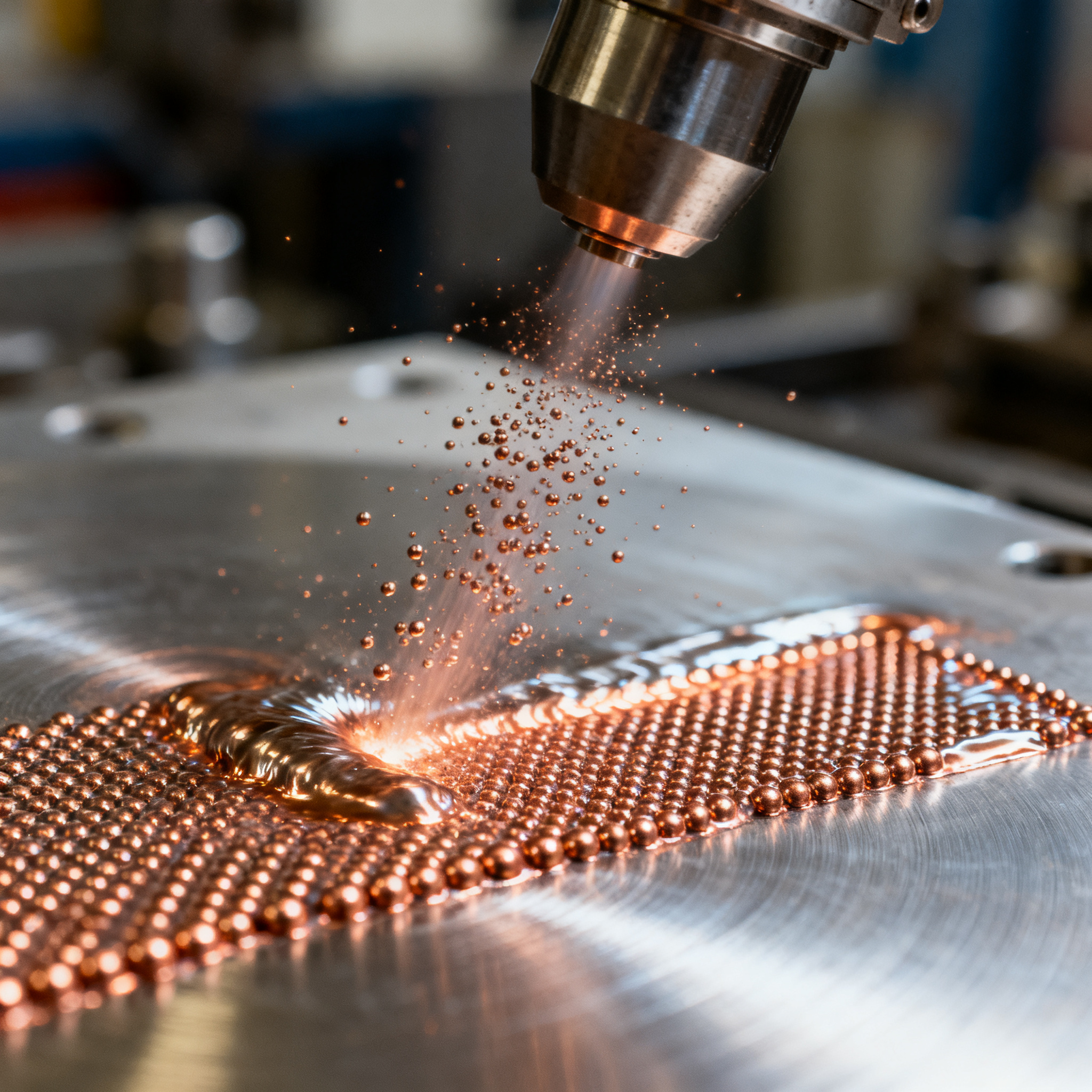
The Cold Spray system nozzle expels metal particles at speeds exceeding 1000 m/s. This supersonic acceleration provides sufficient kinetic energy for the particles to adhere to the substrate upon impact.
The process uses compressed gases to accelerate particles without bringing them to the melting point. The original structure and properties of the metal remain unchanged, avoiding changes caused by phase transitions typical of melting, forging, or casting.
- Particle speed: greater than 1000 m/s (supersonic)
- Temperature: below the material's melting point
- Deposition rate: up to 10 kg/hour for high-pressure applications
Solid-state welding
Adhesion occurs thanks to the kinetic energy of the impact, which plastically deforms the particles and welds them to the substrate.
High-velocity impact generates plastic deformation of the metallic particles. This deformation creates a mechanical bond with the substrate without requiring thermal melting of the material.
Particles are deposited in successive layers called “beads”. The deposition strategy involves aligning the centers of the lower layers with the edges of the upper ones, creating an interlocked structure similar to the arrangement of bricks in masonry.
The process preserves the microstructural characteristics of the original material. There are no alterations due to aggressive thermal cycles, making the technology particularly suitable for heat-sensitive materials such as titanium and copper.
Robotic precision in deposition paths
Robotic arms move the nozzle with micrometric precision to build complex geometries layer by layer.
A robotic arm positions and orients the nozzle during the deposition process. A programmable controller sends commands that define the configuration of the robotic arm, determining the position and orientation of the nozzle.
These commands define the trajectory of the metallic particles ejected at high velocity. The deposition process builds over time an outer layer of material that surrounds and bonds to the support.
Deposition sequence
- Positioning: The controller moves the robotic arm to orient the nozzle towards the target area.
- Deposition: Metallic particles are expelled at supersonic speed, forming a “bead” of material.
- Stratification: Subsequent layers are interlaced to create a cohesive and resistant structure.
The precision of the robotic system allows for the construction of complex geometries. Integrated systems such as Integrated Spray Booth platforms combine deposition, material management, and powder extraction in a controlled environment.
Materials and industrial applications
This technology is compatible with a wide range of metals, making it ideal for repairs and industrial prototyping.
Cold Spray works with various metallic materials including nickel, titanium, copper, and aluminum. Compatibility with materials that are difficult to process with thermal technologies expands application possibilities.
Industrial applications range from the repair of aerospace components to the production of heat exchangers. In the railway sector, it is used to repair components without completely replacing them. In the Oil & Gas sector, aluminum coatings deposited with Cold Spray offer corrosion protection.
Aerospace and defense for turbine and structural component repairs, energy for extending the life of expensive parts, shipbuilding for corrosion protection, space propulsion for copper nozzles with integrated cooling channels.
The technology reduces production times from months to days for complex components. A copper nozzle for rocket engines can be produced in drastically reduced times compared to traditional methods, even though full validation still requires testing on real engines.
Conclusion
Cold Spray represents an innovative approach to additive metallurgy, based on material dynamics rather than thermodynamics. The ability to deposit metal without fusion preserves original properties and opens up possibilities for heat-sensitive materials.
The combination of supersonic speed, robotic precision, and absence of thermal fusion is redefining the boundaries of high-performance metal production. Discover how this technology can transform repair and production processes in your industrial sector.
article written with the help of artificial intelligence systems
Q&A
How does particle adhesion occur in the Cold Spray process without resorting to thermal melting?
Adhesion occurs thanks to the kinetic energy generated by the supersonic impact of metallic particles, which exceed 1000 m/s. This high velocity causes plastic deformation of the particles upon impact with the substrate, creating a strong mechanical bond. In this way, the process completely avoids heating the material to its melting point.
What are the main advantages of Cold Spray compared to traditional metal melting processes?
Cold Spray preserves the original microstructure and mechanical properties of the metal, avoiding the alterations caused by the aggressive thermal cycles typical of melting. This makes it particularly suitable for heat-sensitive materials such as titanium and copper. Furthermore, it allows production times for complex components to be significantly reduced.
In which industrial sectors is Cold Spray technology applied?
The technology is employed in several strategic sectors, including aerospace and defense for turbine repair, the railway sector for restoring damaged components, and oil & gas for aluminum anticorrosion coatings. It is also used in shipbuilding, in the energy sector to extend the life of expensive parts, and in space propulsion for the production of copper nozzles.
What is the role of the robotic system in the Cold Spray process?
A robotic arm positions and orients the nozzle with micrometric precision following trajectories defined by a programmable controller. This system allows metallic particles to be deposited in successive layers called "beads", interlacing them to create complex geometries and cohesive structures similar to the arrangement of bricks in a wall.
Which metallic materials can be used in Cold Spray and what parameters govern the process?
Cold Spray is compatible with a wide range of metals, including nickel, titanium, copper, and aluminum. The key parameters include a particle velocity exceeding 1000 m/s, a process temperature maintained below the material's melting point, and a deposition rate that can reach up to 10 kg/hour in high-pressure applications.