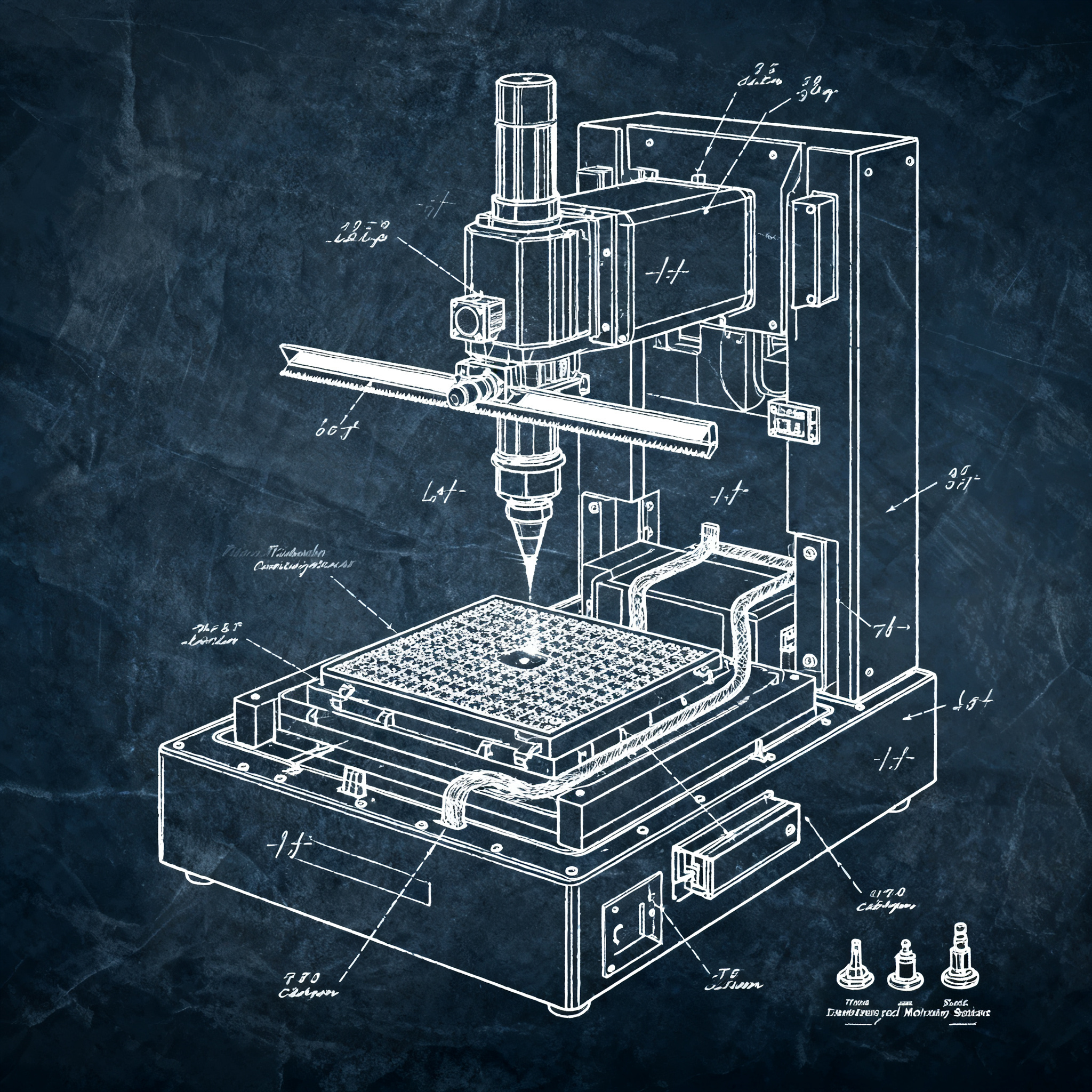
3 phases, 1 result: qualified machine
In the industrial environment of Additive Manufacturing, process monitoring and quality assurance are not optional: they are critical phases that determine operational success. The difference between a reliable and an unpredictable production system depends on the ability to structure qualifications, tests, and controls systematically.
Machine qualification, material validation, and in-process monitoring form an integrated chain. Each link has specific objectives and requires clear acceptance criteria.
FAT, IQ, OQ: the qualification chain
The qualification of an Additive Manufacturing system requires a precise sequence of tests: FAT to verify installation, IQ to confirm operational specifications, OQ to validate performance in production.
The best practices of the Aerospace Industries Association (AIA) recommend a qualification in three distinct phases. Each phase has a precise application context and cannot be skipped.
The Factory Acceptance Testing (FAT) is performed by the machine manufacturer before delivery. It verifies that the system functions correctly and establishes a known default condition. This test guarantees the customer that the machine starts from a certified state.
- FAT: performed by the manufacturer, verifies operation before delivery
- IQ: executed at the user's, confirms suitability to produce components
- OQ: executed after IQ, validates that the printed material meets the required specifications
The’Installation Qualification (IQ) takes place at the final user's site. Verifies that the machine is suitable for producing real components. This test, also called Site Acceptance Testing (SAT), may involve different alloys, specific geometries, and energy levels not covered by FAT.
The’Operational Qualification (OQ) is the last and most critical phase. It requires the production of one or more builds of test specimens, heat treatments, and non-destructive controls. Samples undergo compositional, microstructural, and mechanical testing. Results must match the material specification requirements. OQ is mandatory for every requested specification.
Qualified or tested feedstock in process?
The choice between prior material qualification or in-line validation influences the traceability and reliability of the final production process.
For starting materials (feedstock), the organization must decide whether to qualify the material based on its intrinsic characteristics or whether qualification also requires the evaluation of the printed material. In the first case, composition, powder particle size distribution or wire diameter, and production method are evaluated. In the second case, verification of the final part's properties is added.
This choice is not neutral. Qualifying the feedstock independently of the printing process simplifies supply chain management but reduces validation robustness. Qualifying the material in relation to the printed part increases traceability but requires more complex and costly testing.
The qualification of the feedstock separate from the printing process may be sufficient for non-critical applications, but for aerospace or medical components, it is necessary to validate the material in the context of the complete process.
Overlap between printing and testing is common in machine qualification and the generation of design values. This ambiguity can create operational confusion if clear boundaries between phases are not defined.
In-process monitoring: where QA begins
Continuous monitoring during printing allows for real-time intervention, but requires clear acceptance criteria and standardized intervention protocols.
Monitoring alone is not enough. Most powder bed fusion systems rely on combinations of optical imaging, infrared cameras, photodiodes, or AI-based anomaly detection. These tools provide visibility but are subjective and uncalibrated.
In traditional production, qualitative decisions are never made based solely on subjective monitoring. Machined parts are verified with calipers, coordinate measuring machines (CMM), and instruments that produce traceable data. AM has attempted for years to infer quality from relative signals that vary from machine to machine and from build to build.
| Approach | Data type | Traceability | Industrial applicability |
|---|---|---|---|
| Optical monitoring | Subjective | Low | Limited |
| Calibrated inspection | Quantitative | High | Scalable |
| Calibration elements | Quantitative | High | Proactive |
In-process inspection based on structured metrology measures the three-dimensional profile of each layer during construction. For laser powder bed fusion, this produces quantitative measurements of the powder layer uniformity, the fused surface topology, and the actual layer thickness. These data are calibrated and can be compared across machines, materials, and facilities.
An innovative approach involves positioning calibration elements in the CAD model, in free spaces not occupied by the part. These elements replicate the critical features of the final component. They are produced before the corresponding features in the part, allowing deviations to be detected and process parameters to be adjusted in real time before the critical features are printed.
Flexible monitoring can include layer-by-layer control, preset time intervals, or continuous video recording. The acquired data are saved and linked to the production sample and the parameters used. When relevant anomalies are measured and controlled, qualification becomes a continuous process rather than a costly final obstacle.
Conclusion
A robust Process Monitoring and Quality Assurance strategy is built on structured phases and defined operational criteria. Machine qualification through FAT, IQ, and OQ establishes the foundation. The choice regarding feedstock qualification influences process robustness. In-process monitoring transforms visibility into control when based on calibrated and traceable data.
Start with machine qualification and integrate in-process monitoring: only then can you scale safely. As AM strategies mature, the competitive advantage will be defined by who can produce confidently on an industrial scale. When the process is measured, quality becomes predictable. And when quality is predictable, AM becomes truly industrial.
article written with the help of artificial intelligence systems
Q&A
What are the three phases of the qualification chain for an Additive Manufacturing machine and who performs them?
The three phases are Factory Acceptance Testing (FAT), Installation Qualification (IQ), and Operational Qualification (OQ). FAT is performed by the machine manufacturer before delivery to verify correct operation. IQ takes place at the end user to confirm suitability for producing real components, while OQ validates that the printed material meets the required specifications through tests on specimens.
Why might feedstock qualification separate from the printing process not be sufficient for all applications?
Qualifying the starting material solely based on its intrinsic characteristics simplifies the supply chain but reduces the robustness of validation. For aerospace or medical components, it is necessary to validate the material also in the context of the complete process, verifying the properties of the final printed part. This increases traceability but requires more complex and expensive testing.
What is the main limitation of traditional in-process monitoring systems in powder bed fusion?
Traditional systems often rely on optical imaging, infrared cameras, or AI-based anomaly detection, which provide subjective and uncalibrated visibility. These relative signals vary from machine to machine and from build to build, making qualitative decisions insufficiently reliable for scalable industrial production.
What does the innovative approach of structured metrology for in-process monitoring consist of?
In-process inspection based on structured metrology measures the three-dimensional profile of every layer during the build, producing quantitative and calibrated data. An innovative approach involves placing calibration elements in the CAD model in free spaces, which replicate the critical characteristics of the component and allow deviations to be detected and process parameters to be adjusted in real time.
What are the pillars of a solid Process Monitoring and Quality Assurance strategy in industrial Additive Manufacturing?
A solid strategy is built on three pillars: machine qualification through FAT, IQ, and OQ; the conscious choice regarding feedstock qualification, preferably in the context of the process for critical applications; and in-process monitoring based on calibrated, traceable, and quantitative data. Only the integration of these phases allows scaling with confidence and making quality predictable.