Category: Manufacturing

Advanced Training for Industrial 3D Printing: How Companies Build Scalable Competencies

Advanced Training for Industrial 3D Printing: How Companies Build Scalable Competencies

Advanced training in industrial 3D printing is now strategic for bridging the skills gap and ensuring the growth of the sector. Structured programs, academic partnerships, and hybrid learning models are preparing professionals capable of integrating technology and productive practice.

Additive Manufacturing vs Plastic Injection: Trade-offs in Industrial and Aerospace Contexts

Additive Manufacturing vs Plastic Injection: Trade-offs in Industrial and Aerospace Contexts

The choice between 3D printing and plastic injection depends on volume, customization, and operational context. Injection dominates in high volumes, while 3D printing is preferred for small batches and complex geometries. Both are complementary.

Industrial 3D Printing: Contract Clauses at Risk and How to Avoid Them

Industrial 3D Printing: Contract Clauses at Risk and How to Avoid Them

Industrial 3D printing presents often underestimated contractual risks, with clauses that unilaterally shift liability and costs onto clients. Key points include: GPS tracking, geographic limits, training obligations, vague definitions of “failure”, and choice of jurisdiction. It is essential to negotiate fair contracts to avoid legal constraints and ensure safe operations.

Implementing WAAM in Civil Engineering: A Real Case of Industrial Integration

Implementing WAAM in Civil Engineering: A Real Case of Industrial Integration

The collaboration project between NAICO Malaysia and WAAM3D demonstrates the concrete integration of Wire Arc Additive Manufacturing (WAAM) in civil engineering, with a systemic approach covering every phase of the process, from engineering to finishing. Through the MiniWAAM platform, the project develops advanced industrial capabilities, promoting the efficient production of metallic components of

New Frontiers of the Workforce in Additive Manufacturing: Operational Skills at the Center of Industrial Transformation

New Frontiers of the Workforce in Additive Manufacturing: Operational Skills at the Center of Industrial Transformation

The additive manufacturing industry is evolving towards greater maturity, with a focus on specific skills, production, and customer interaction. An increasing number of professionals is changing the job market, making hiring more selective and promoting internal skill development.

Implementing Direct-to-Consumer in the industrial sector: an operational plan for regional expansion

Implementing Direct-to-Consumer in the Industrial Sector: An Operational Plan for Regional Expansion

Implementing a Direct-to-Consumer (DTC) model in the industrial sector requires a structured approach that goes beyond online sales, integrating design, production, and logistics into an end-to-end workflow. Success depends on the governance of distributed capacity, secure digital platforms, and transparency in processes. Cases like Polymaker and Juise Mobility show how DTC, if well pro

How Conductive Elastomer Pellets Work for Reliable 3D Printing

How Conductive Elastomer Pellets Work for Reliable 3D Printing

Mechnano's new conductive elastomeric pellets offer reliable electrical and mechanical performance thanks to D'Func technology, which guarantees uniform dispersion of carbon nanotubes, overcoming the limits of traditional ESD materials. Ideal for sectors such as electronics, automation and medical, these materials enable the scalable production of flexible components with yields

Sustainable 3D Printing: Quality vs. Environmental Impact in Recycled Materials

Sustainable 3D Printing: Quality vs. Environmental Impact in Recycled Materials

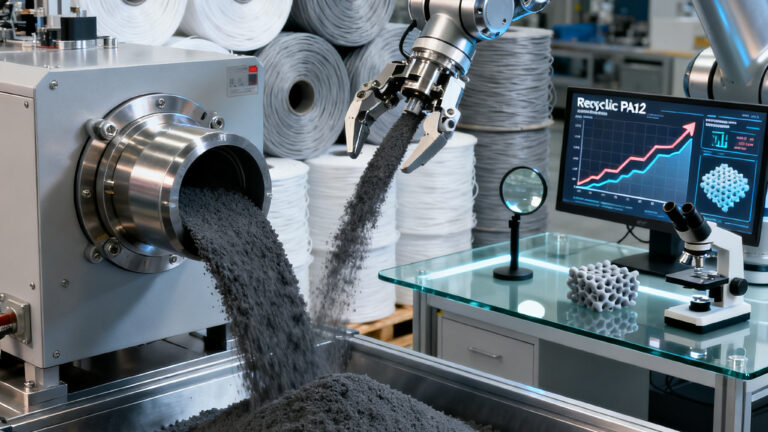
Industrial 3D printing with recycled materials offers environmental benefits but requires balancing between quality, cost, and performance. The use of recycled powders, if well managed, can reduce the carbon footprint without compromising mechanical properties, provided that parameters such as sphericity, oxygen content, and particle size distribution are controlled. Studies show up to 98.71% reduction

How to Redesign Industrial Metal AM Production: An Operational Playbook for Scalability and Efficiency

How to Redesign Industrial Metal AM Production: An Operational Playbook for Scalability and Efficiency

The future of industrial metal AM requires an integrated approach that connects all production processes into a single intelligent architecture, eliminating physical movements and operational delays. Winning factories do not improve individual steps, but redesign the entire workflow as a system coordinated by a common layer of intelligence, automation, and shared data.

New Investment Criteria for Additive Manufacturing: Operational Excellence Over Speculation

New Investment Criteria for Additive Manufacturing: Operational Excellence Over Speculation

Investors in additive manufacturing are increasingly focusing on operational efficiency and solid business models, leaving technological speculation behind. Businesses with stable contracts, sustainable margins, and the ability to generate real value in the production chain are being rewarded.

Implementing Mass Customization with Additive Manufacturing: A Technical Playbook for Consumer Products

Implementing Mass Customization with Additive Manufacturing: A Technical Playbook for Consumer Products

Mass customization is now possible thanks to additive manufacturing, artificial intelligence, and parametric design. These technologies allow for the production of thousands of customized variants while maintaining efficiency and margins, overcoming the limits of traditional production. The integration of software toolchains and automated processes enables the management of variability without au

Additive Manufacturing Certification for Medical Devices: An Operational Framework for Effective Qualification

Additive Manufacturing Certification for Medical Devices: An Operational Framework for Effective Qualification

The certification of medical devices produced with additive manufacturing requires an operational framework that integrates regulatory requirements from the design phase. This approach, called “design for certification”, reduces delays and late reviews, turning compliance into a competitive advantage. It is fundamental to qualify the 3D printing process with documented proof of rep

/