Scalable Motion Control for Industrial 3D Printers: Practical Guide
The future of motion control in industrial 3D printers lies in a modular and scalable approach, far removed from classic monolithic controllers. Dyze Design has patented a system that separates motion control “blocks,” allowing manufacturers to reuse the same base across multiple models by changing only the necessary modules.
Modular Hardware Architecture
A scalable motion control system is based on a flexible and repeatable hardware structure, designed to adapt to different mechanical configurations without redesigning from scratch.
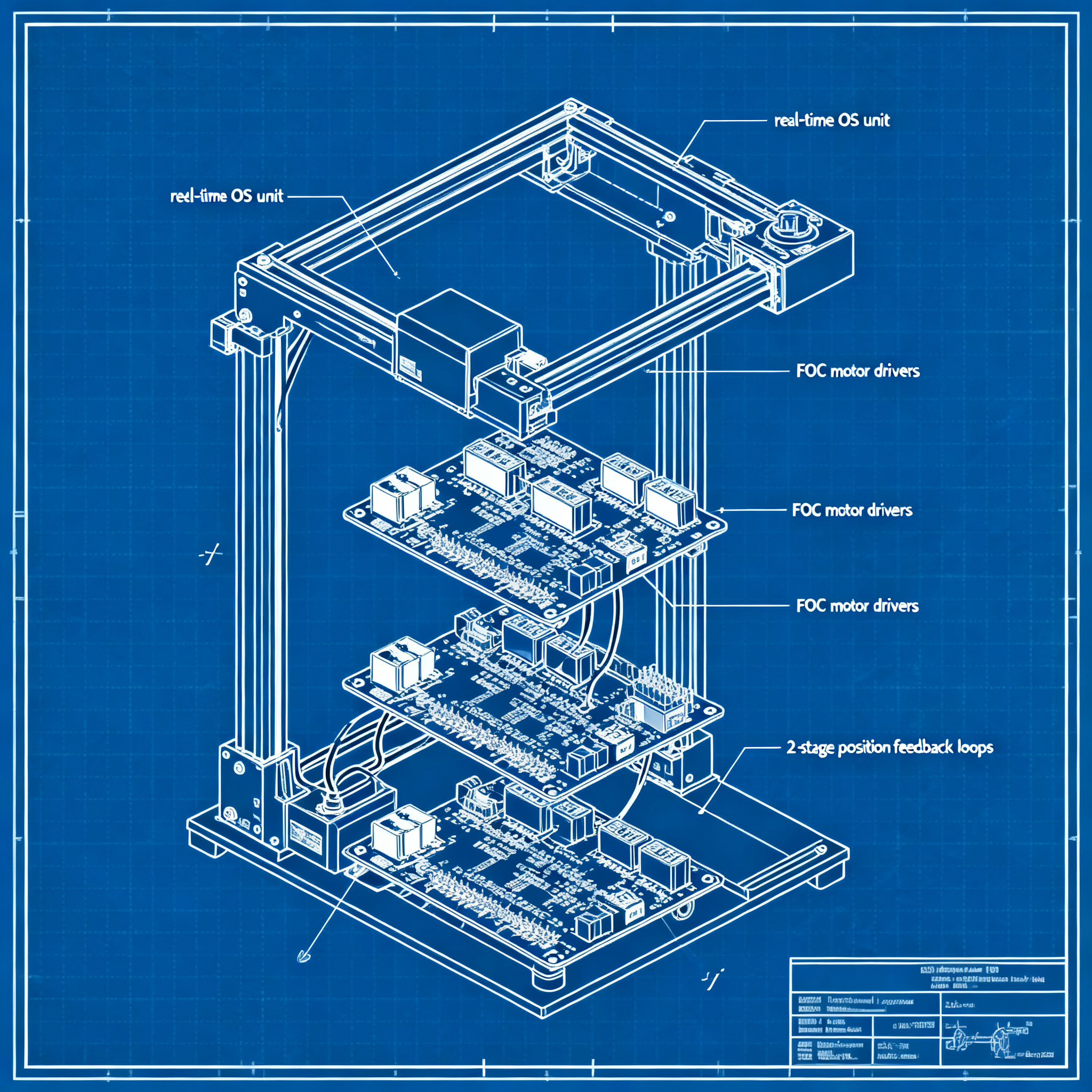
Dyze Design's Aurora controller replaces the traditional controller with an integrated platform composed of main units and expansion boards connected in a cascade. The main controller integrates a real-time operating system and an advanced motion planner.
Additional boards manage IO, sensors, multiple extruders, and actuators. This structure makes the architecture adaptable to Cartesian printers, large-scale gantries, robotic arms, or custom systems.
- Reuse of the same control base across multiple machine models
- Platform updates without redesigning the entire electronics
- Adaptability to different production scenarios, from large format to multi-axis systems
Machine builders can quickly configure new variants. Switching from a Cartesian configuration to a robotic arm requires only replacing the specific modules, not the entire control system.
Two-Stage Feedback Management
Implementing two-stage position feedback significantly increases control precision, especially in high-definition industrial applications.
The 2-Stage Position Feedback represents one of the key points of the system. Each motor has its own local feedback loop. A second synchronization level coordinates the entire set of axes.
The controller can quickly detect deviations, step losses, and synchronization problems. Intervention occurs before errors translate into print waste, a crucial aspect on large-format or multi-axis machines.
Two-stage feedback separates the local control of the single motor from the global synchronization of the axes. This allows for rapid corrections without compromising the overall movement coordination.
Dedicated FOC controllers for each motor manage encoder feedback and respond in real-time. This approach requires more expensive hardware than simple step/direction stepper drivers, but guarantees superior precision.
Expansion and Updates Over Time
Modularity allows for the expansion or updating of individual functions without having to replace the entire system, reducing operational costs and downtime.
Aurora accepts G-code from any slicer and works with existing hardware. This compatibility allows for gradual integration without disrupting the productive workflow.
The Reactive Motion Planner modifies parameters such as speed, flow, or ventilation in real-time in response to sensor data. The system shifts from an “open” control to constant process monitoring, which automatically adjusts to maintain constant quality.
Modular upgrade process
- Evaluation: Identify the modules to update based on specific production needs.
- Replacement: Install the new expansion boards while maintaining the existing main controller.
- Configuration: Update software parameters without modifying the overall system architecture.
The cloud-based analysis engine generates post-print reports, 3D visualizations, and summary PDFs for each job. This integration enables fewer manual interventions and data-driven decisions.
The separation between the main controller and expandable modules allows for targeted maintenance. Replacing a faulty IO card does not require prolonged machine downtime or complete system reprogramming.
Conclusion
A modular motion control system is not only more efficient but represents the only practical way to address the evolution of additive manufacturing machines. The ability to quickly adapt the same system to different mechanical configurations reduces development times and engineering costs.
Two-stage feedback and reactive motion planning ensure precision and constant quality. The expandable architecture protects the investment over time, allowing targeted updates without complete replacements.
Consider integrating a modular architecture into your next hardware upgrade. The system's scalability will pay off in terms of production flexibility and reduced operating costs.
article written with the help of artificial intelligence systems
Q&A
What is the fundamental principle of modular architecture for motion control in industrial 3D printers?
The modular architecture is based on the separation of motion control 'blocks', allowing the same base to be reused across multiple models by simply changing the necessary modules. This approach provides greater flexibility and scalability compared to traditional monolithic controllers.
How does the two-stage feedback system implemented in the Aurora controller work?
The two-stage feedback system features a local feedback loop for each motor and a second level of global axis synchronization. This allows rapid detection of deviations and real-time correction, improving accuracy and reducing print errors.
What are the main advantages of using a modular architecture like Aurora's?
Benefits include reusing the same control base across multiple models, platform updates without redesigning electronics, and adaptability to different mechanical configurations. Additionally, it enables targeted maintenance and reduces downtime during upgrades.
How does the Aurora controller integrate with existing systems?
Aurora is compatible with any slicer that generates G-code and can work with existing hardware. This backward compatibility allows gradual integration without disrupting the production workflow, facilitating adoption even on already operational machines.
What is the role of the Reactive Motion Planner in the Aurora system?
The Reactive Motion Planner modifies parameters such as speed, flow, and ventilation in real time based on sensor data. This shift from open-loop control to continuous process monitoring ensures consistent print quality and automatically responds to process variations.